Six New Projects Selected for 2025 in Hydrogen, CCU, and Carbon-Free Energy Sectors
Ministry of Science and ICT to Launch Flagship National R&D Initiatives for Climate Response
Hydrogen and carbon dioxide capture technology, fundamental research on future climate technology development based on artificial intelligence (AI), and carbon-free energy technology have been selected as national core technologies for responding to the climate crisis, and efforts to advance these technologies will now be intensified.
The Ministry of Science and ICT announced on April 24 that it has selected and finalized new projects for the 2025 Climate and Environment R&D Program in order to promote flagship projects for climate change response and global cooperation through R&D in the climate and environment sector. The ministry stated that it will officially launch the program.
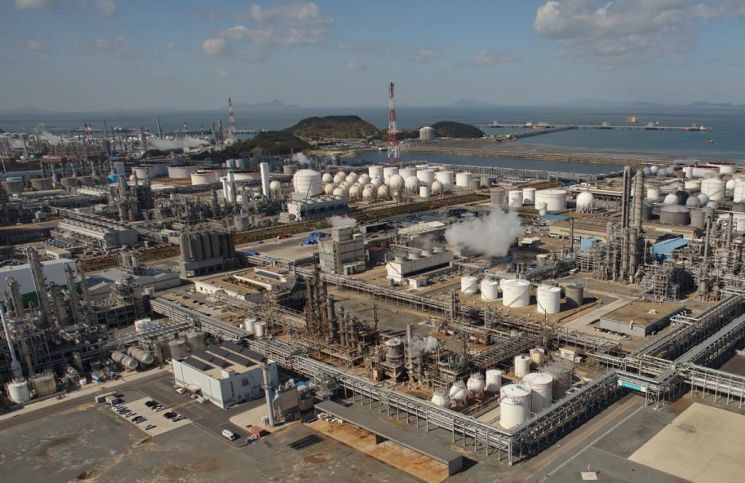 A factory that has established a methane dry reforming (DRM) facility to produce plastic using carbon dioxide captured from the factory and by-product gas methane. Photo by Yonhap News
To secure technologies of national importance, the Ministry of Science and ICT will first launch international joint R&D projects in the fields of hydrogen and CCU (carbon dioxide capture technology), which have been selected as part of the "First Global R&D Flagship Project."
In the hydrogen sector, Korea will collaborate with leading overseas research groups in the United States and Germany to solve technical challenges and develop next-generation water electrolysis innovation technologies at a world-class level.
The Korea Institute of Science and Technology plans to work with 12 institutions, including Argonne National Laboratory and Pacific Northwest National Laboratory under the U.S. Department of Energy (DOE), to conduct research on improving the durability of solid oxide electrolysis cells.
In the CCU sector, Hanyang University will collaborate with Brookhaven National Laboratory under the U.S. DOE to conduct research on producing e-SAF (sustainable aviation fuel) using carbon-free energy.
The ministry also plans to establish a full-cycle carbon reduction evaluation and certification system for CCU, which will be used for calculating the carbon footprint of CCU products and for operating the CCU technology product certification system in accordance with the Integrated CCUS Act.
Through the AI-based Future Climate Technology Development Fundamental Research Project, the ministry aims to accelerate climate technology innovation and strengthen future climate crisis response capabilities by developing core technologies for predicting and responding to future climate conditions on the Korean Peninsula using AI in the era of artificial intelligence.
Through the Carbon-Free Energy Technology Development Project, the ministry will pursue the acquisition of world-class fundamental technologies and foundational technologies (such as durability and stability) for domestic and international field application, including next-generation ultra-high-efficiency solar cells, carbon-free fuel utilization, and ultra-high-performance hydrogen fuel cell technology development.
The selected projects will be supported for up to six years, and after notifying the individual lead research institutions of the selection results, agreements will be concluded following an objection period.
In January, the Ministry of Science and ICT announced the 2025 Climate and Environment R&D Program Implementation Plan, which includes an investment of 86.2 billion won in the climate and environment R&D sector. The ministry has already announced the selection results for 27 new projects in six new initiatives (with a 2024 budget of 23.37 billion won) that will be launched this year.
© The Asia Business Daily(www.asiae.co.kr). All rights reserved.
![Clutching a Stolen Dior Bag, Saying "I Hate Being Poor but Real"... The Grotesque Con of a "Human Knockoff" [Slate]](https://cwcontent.asiae.co.kr/asiaresize/183/2026021902243444107_1771435474.jpg)
















