General Bacteria Standards Maintained Since 1998
Spring Water Standards to Be Unified with Product Standards
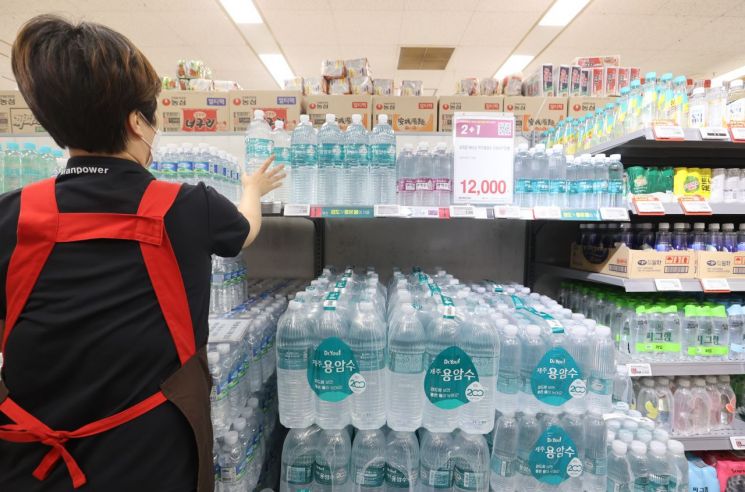
The system governing 'bottled spring water,' consumed by 30% of the population, is being overhauled for the first time in 30 years. Unreasonable water quality regulations for spring water will be relaxed, and an integrated certification system will be implemented.
On April 24, the Ministry of Environment reported its plan to improve the management system for bottled spring water at a cabinet meeting held at the Sejong Government Complex in Jongno-gu, Seoul. Bottled spring water refers to water sourced from natural underground or artesian springs and processed to be suitable for drinking. Most bottled water sold in the market is a type of bottled spring water.
According to the plan, the Ministry of Environment will rationalize water quality standards that have been maintained since 1998. Under current law, the standard for general bacteria in bottled water products is 20 CFU/mL at room temperature and 100 CFU/mL at low temperature. This means that the number of bacterial colonies in 1 mL of bottled water must not exceed 20 at room temperature or 100 at low temperature. However, for the raw water (spring water) used to produce bottled water, the standard is 5 CFU/mL at room temperature and 20 CFU/mL at low temperature. In effect, the raw material is regulated four to five times more strictly than the finished product that consumers actually drink.
This has led to unreasonable regulations in the market. For example, in 2021, 45 bacterial colonies were found in 1 mL of water sampled from a water intake station in Gyeonggi Province. If the bottled water product standard were applied, this water would be considered about twice as clean as required. However, because a separate spring water standard was enforced, the sample was deemed to have exceeded the limit by 2.2 times. Even though the bottled water produced from this spring water met all safety standards and was sold to consumers, the company received a heavy penalty of a one-month suspension of water intake.
Shin Youngsoo, Director of the Soil and Groundwater Division at the Ministry of Environment, explained, "The standard for raw water has been stricter than for products that people actually drink, leading to widespread criticism of excessive regulation. We will unify the general bacteria standard for raw water and finished products, taking into account human health risks, the latest international regulatory trends, and the overall manufacturing process."
Concrete Groundwater Management Measures... Incentives for Outstanding Companies
The safety management level for bottled spring water will also be enhanced. The safety certification system will be integrated into a single system. Currently, certifications for facilities, products, and distribution are all separate, but these will be unified this year, with full implementation starting in 2027. The storage standard for bottled water, which is currently only defined as "stored in an appropriate manner," will be made more specific by next year. Additionally, regulations will be established requiring specialized distributors to conduct hygiene inspections of manufacturers. Microplastic testing, which has so far only been conducted on domestic products, will be expanded to include imported products. The government also plans to develop analytical capabilities for ultrafine microplastics, a major public concern, by 2026.
On the same day, the Ministry of Environment also announced specific groundwater management measures necessary for spring water development. Currently, the total annual groundwater usage is 3.12 billion cubic meters, increasing by 2-3% each year. The permitted daily water intake is 64,000 cubic meters, of which 57,000 cubic meters are used for bottled spring water production. As spring water development becomes more active, groundwater levels drop and the risk of depletion increases, leading to significant conflicts between companies and local communities.
To address this, the government will require businesses to automatically measure groundwater levels at water intake wells. If there are concerns about groundwater depletion, provincial governors must request an analysis of spring water measurement data, and if negative impacts on groundwater levels are confirmed, water intake will be restricted or suspended. If groundwater conservation is necessary, local governments will also be given a legal basis to reject or deny spring water development projects.
Meanwhile, the government is considering granting 'planned import' privileges to outstanding importers in the bottled spring water industry. In the future, companies with no issues in the import process will be able to submit an annual import plan in advance, and their products will be cleared through customs immediately upon arrival in Korea.
© The Asia Business Daily(www.asiae.co.kr). All rights reserved.
![Clutching a Stolen Dior Bag, Saying "I Hate Being Poor but Real"... The Grotesque Con of a "Human Knockoff" [Slate]](https://cwcontent.asiae.co.kr/asiaresize/183/2026021902243444107_1771435474.jpg)
















