US Treasury: "There is an opportunity for a US-China big deal"
"Current tariffs are unsustainable"...Mutual reduction mentioned
WSJ: "White House considering cutting China tariffs to 50-65%"
Will the stalled US-China trade negotiations make progress?
The Donald Trump administration in the United States has been sending conciliatory messages to China, with which it is engaged in a tariff war, on a daily basis. As President Trump, cornered by financial market turmoil triggered by tariffs, hinted at a reduction in tariffs on Chinese goods, U.S. Treasury Secretary Scott Besant mentioned on the following day, the 23rd (local time), the possibility that both countries could simultaneously lower tariffs as part of a U.S.-China "big deal." Attention is now focused on whether the U.S.-China trade negotiations, which have been in a stalemate due to a hardline standoff, could make progress.
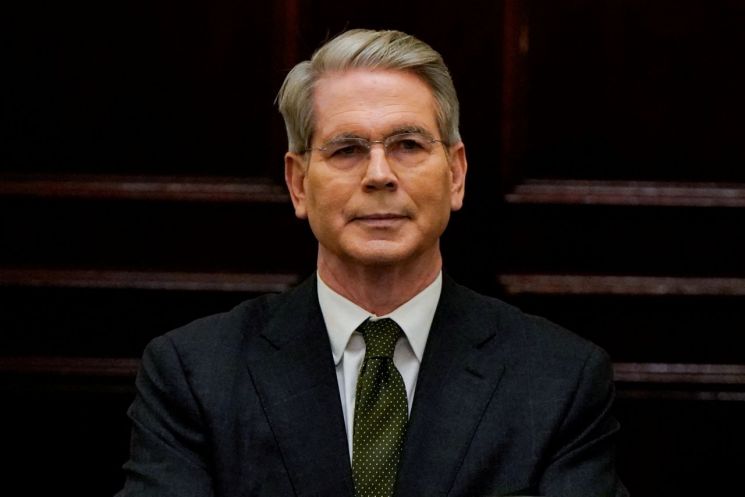
Secretary Besant stated at a discussion hosted by the Institute of International Finance (IIF) in Washington, D.C., "There is an opportunity for a big deal between the U.S. and China," and added, "If they (China) want to rebalance trade, let's do it together." He also said, "More than 100 countries have approached us to help with global trade rebalancing," and added, "We are having meaningful discussions. We also look forward to discussions with China and others."
This is interpreted as an optimistic outlook that the two countries could reach a comprehensive agreement amid the U.S.-China trade war, which has escalated into a game of chicken. This is the second consecutive day of conciliatory messages, following the previous day's remarks that the U.S.-China tariff war is unsustainable and that "the situation will ease in the very near future." As the financial markets have been shaken by the tariff war, these messages are seen as an attempt to ease tensions between the two countries to calm market anxiety and to bring China back to the negotiating table.
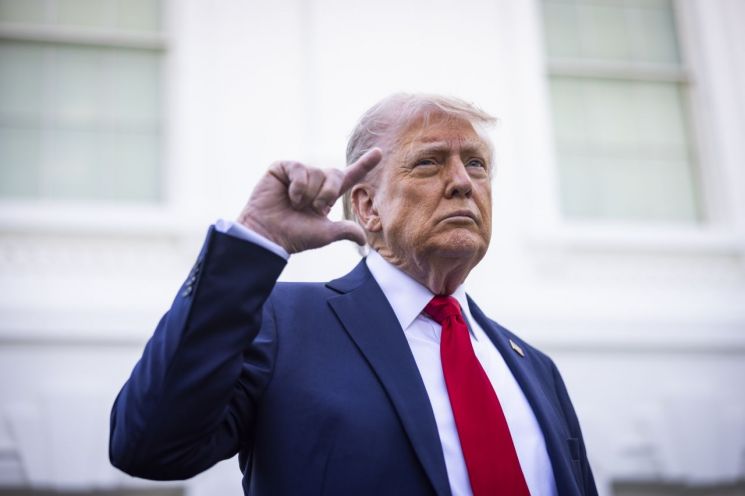
President Trump also expressed a strong willingness to negotiate with China. When asked by reporters at the White House whether he was actively negotiating with China, he replied, "Everything is active." When asked if an agreement was being reached with China, he said, "It will be fair."
The previous day, President Trump mentioned for the first time the possibility of reducing tariffs on Chinese goods. He said that negotiations with China were "going well," and added, "The current tariff rate of 145% is too high. It will come down significantly."
In this context, the Wall Street Journal (WSJ) reported that the Trump administration is considering lowering the additional tariffs imposed on China during its second term from the current 145% (20% fentanyl tariff + 125% reciprocal tariff) to 50-65%, which is more than half. It was also reported that the administration is considering imposing different tariffs on Chinese goods depending on whether they pose a national security threat.
The Trump administration did not deny these reports. However, aides made it clear that any reduction in tariffs on Chinese goods before the U.S.-China trade negotiations must be mutual, with both sides lowering tariffs together.
Additionally, after the IIF event, Secretary Besant told reporters that President Trump had "never" proposed a reduction in tariffs on Chinese goods. However, he added, "As I have said many times, the current tariff levels are unsustainable for both sides. Therefore, it would not be surprising if both sides reduced tariffs in a reciprocal manner," indicating that both the U.S. and China should lower tariffs simultaneously.
White House spokesperson Caroline Leavitt also stated in a Fox News interview on the same day, "There will be no unilateral tariff reduction on China." This is interpreted as not ruling out the possibility of simultaneous tariff reductions by both the U.S. and China.
As the Trump administration continues to send moderate messages to China and effectively proposes a mutual reduction of ultra-high tariffs, there is a growing assessment that a foundation is being laid for both countries to return to the negotiating table. Initially, the U.S. set reciprocal tariffs on China at 50%, but after Beijing responded with retaliatory tariffs, the U.S. imposed two rounds of counter-retaliation, raising the reciprocal tariff rate to a final 125%. Including the 20% 'fentanyl tariff,' the total cumulative tariff stands at 145%.
With the Trump administration repeatedly sending moderate messages to China and even signaling a reduction in tariffs on Chinese goods, the Chinese Ministry of Foreign Affairs also stated, "If we have to fight, we will fight to the end, but the door to dialogue remains wide open," indicating a willingness to engage in trade negotiations with the United States.
The WSJ noted, "Chinese policymakers see President Trump's remarks on Tuesday as a signal that he is preparing to abandon his (China) policy," and added, "The fact that both the U.S. and China have expressed openness to an agreement represents a significant shift from last month."
However, even if the U.S. and China lower tariff rates to the minimum level of 50% reported by the WSJ, the rates would still be extremely high, making it unlikely that the current near-complete suspension of trade between the two countries will be resolved easily before a big deal is reached.
© The Asia Business Daily(www.asiae.co.kr). All rights reserved.
![Clutching a Stolen Dior Bag, Saying "I Hate Being Poor but Real"... The Grotesque Con of a "Human Knockoff" [Slate]](https://cwcontent.asiae.co.kr/asiaresize/183/2026021902243444107_1771435474.jpg)

















