Korea Consumer Agency Analyzes Damage Relief Applications Over the Past Three Years
High Proportion of Cases in May (12%) and June (11%)
Keep Receipts and Clarify Responsibility to Prepare for Disputes
As more consumers use laundry services to clean winter clothing such as padded jumpers and coats, related damages are also expected to increase, prompting a need for caution.
The Korea Consumer Agency announced on April 24 that, after analyzing 4,855 applications for damage relief related to laundry services received over the past three years from 2022 to last year, the number of applications was highest in May (569 cases, 11.7%) and June (507 cases, 10.5%) on a monthly basis. In particular, the number of applications in May increased by 41.9% compared to April (401 cases), indicating that consumers should be especially cautious during this period.
Regarding the types of defects, "appearance damage"?including heat damage, wear, and damage to accessories?accounted for the largest share at 21.2% (1,028 cases). This was followed by "color change," such as fading or discoloration, at 17.6% (855 cases); "stain occurrence," such as dye transfer or contamination, at 16.8% (813 cases); and "shape change," such as shrinkage or hardening, at 14.7% (712 cases). There were also a significant number of cases involving "loss of laundry items" (4.5%, 220 cases). The Korea Consumer Agency explained that, to prepare for possible disputes when requesting laundry services, it is important to record the name and quantity of laundry items on the receipt and keep it well.
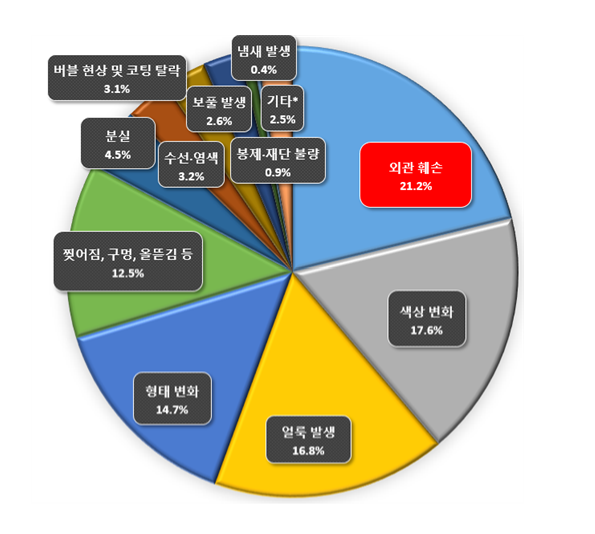 Status of Damage Relief Applications by Type of Laundry Service Defect. Provided by Korea Consumer Agency
When a product is damaged after using a laundry service, the cause may be the negligence of the laundry business operator, or it may be due to a defect in the product itself, such as the fault of the manufacturer or seller. In addition, natural damage due to the product's lifespan or the consumer's careless handling can also be issues. Therefore, it is necessary to check and inspect the time of purchase and the condition of the product, and to determine the cause and responsibility for defects through review bodies such as the Textile Product Review Committee.
According to an actual survey by the Korea Consumer Agency, cases where the business operator was not responsible?such as natural damage due to product lifespan or consumer mishandling?accounted for 42.9%, while the responsibility of the manufacturer or seller was 31.9%, and the negligence of the laundry business operator was 25.2%.
To prevent consumer damage related to laundry services, the Korea Consumer Agency emphasized that consumers should carefully check the condition of their clothing together with the laundry business operator when making a request, and be sure to receive and keep a receipt indicating the items and quantities. The agency also recommended: ▲ promptly collecting finished laundry items and immediately checking for defects; ▲ promptly raising any objections with the laundry business operator if damage occurs after washing; and ▲ exercising caution with clothing that has exceeded its expected lifespan, as such items may be deformed during washing due to the aging of the product itself.
© The Asia Business Daily(www.asiae.co.kr). All rights reserved.


















