Collaboration with the Military and Metal Detectors to Block External Influence
The Film Depicts the Secretive Election Process and Power Struggles
The "Secret Cardinal" in the Film Reflects a Real Vatican Practice
In the 1200s, the Conclave Lasted Two Years and Nine Months
With the passing of Pope Francis, a new Conclave to elect his successor is scheduled for early next month. In this context, the recently released film "Conclave" (directed by Edward Berger) is drawing renewed attention. The film is being praised for its realistic depiction of the secretive papal election process, which takes place in complete isolation from the outside world.
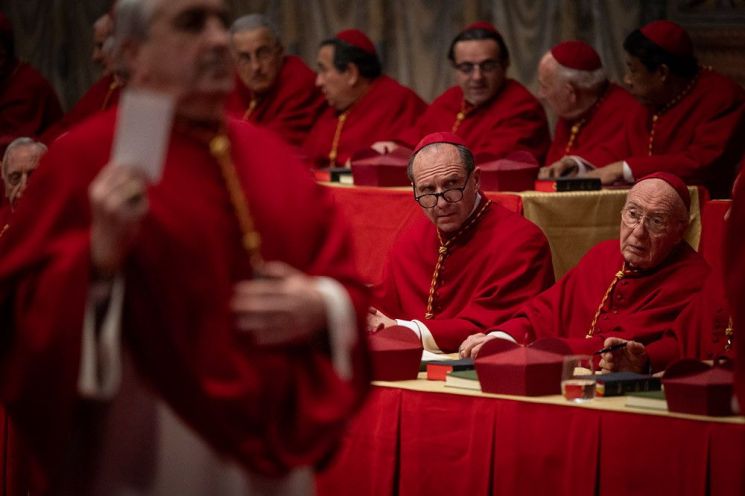
Collaboration with the Military to Block Signals and Prevent Eavesdropping
At the beginning of the film, large-scale construction and inspections are carried out at the Sistine Chapel in preparation for the Conclave. Signal-blocking and anti-eavesdropping systems are installed throughout the Sistine Chapel. Lawrence, the elderly cardinal in charge of the Conclave, asks, "Do we really have to go this far?" The staff responds, "Eavesdropping is possible if glass vibrations are detected with lasers." On the day of the Conclave, after the cardinals return their electronic devices and pass through metal detector screening, they gather in the chapel. All doors and windows are then sealed. The tension rises dramatically as wax is applied to the gaps in the doors and the entrances are sealed with red stamps.
The reason for such strict security is to ensure that no external influence affects the papal election. To uphold the principle that cardinals must make a free choice under the guidance of the Holy Spirit, the Vatican security authorities collaborated with the Italian military communications unit during the 2013 Conclave to install signal-blocking and anti-eavesdropping systems throughout the Sistine Chapel.
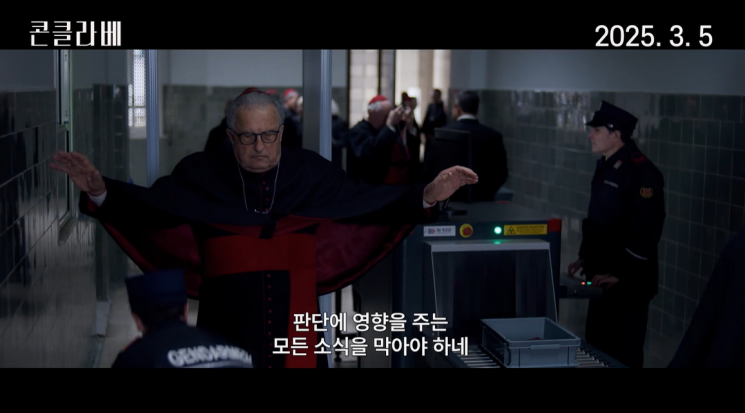 Cardinals undergoing metal detector screening before entering the cathedral for the conclave vote. Official trailer of the movie Conclave.
Cardinals from around the world stay at the Domus Sanctae Marthae in the Vatican. Originally built in 1891 as a clinic, it was designated as the official residence for the Conclave by Pope John Paul II in 1996. Pope Francis also lived there. During the Conclave, the Domus Sanctae Marthae is completely cut off from the outside world, and cardinals are prohibited from using any means of communication. Even when traveling the five-minute walk between the Sistine Chapel and their residence, cardinals must follow a designated route under the supervision of security personnel. This route is an internal passageway, separate from the paths used by the general public.
Voting Pressure through Restricted Meals and Water... Papal Elections Average Three Days in the 20th Century
"I hope no one here suffers from claustrophobia. Who knows how long we'll be here?"
As seen in Lawrence's line, the papal election vote is repeated until a candidate receives more than two-thirds of the votes. In this Conclave, about 130 cardinals have voting rights, and a candidate must receive at least 86 votes to be elected pope. White smoke rising from the chapel's chimney signals the election of a new pope. If no decision is reached, black smoke is emitted and the voting process resumes.
The longest Conclave in history was in 1268, which only elected Pope Gregory X after two years and nine months, in 1271. At that time, cardinals were split between French and Italian factions, making compromise impossible. It is known that the local authorities and residents, who were overseeing the vote, confined the cardinals and pressured them by limiting their meals to bread and water.
However, after subsequent revisions to the papal election rules, the duration of the Conclave was shortened. Since the 20th century, Conclaves have typically concluded in an average of three days. For example, the April 2005 Conclave that elected Pope Benedict XVI required four ballots over two days, while the March 2013 Conclave that elected Pope Francis required five ballots over two days.
Conflicts Among Cardinals... Even a Secret Cardinal?
Even in the solemn and sacred process of electing a pope, conflicts exist between factions, nations, and races. In the film, conservative Cardinal Tedesco, who insists the Church must restore its traditions, clashes with progressive Cardinal Bellini. Tedesco argues that the Church will be divided without Roman tradition and insists that the next pope should be Italian. In contrast, Bellini appeals, "We must do whatever it takes to defeat Tedesco," and adds, "I support a common-sense approach to issues like homosexuality and divorce. I also believe women should play a larger role in the Vatican."
In reality, the 2005 Conclave also saw a confrontation between conservative Cardinal Ratzinger (the baptismal name of Pope Benedict XVI) and reformist Cardinal Carlo Maria Martini.
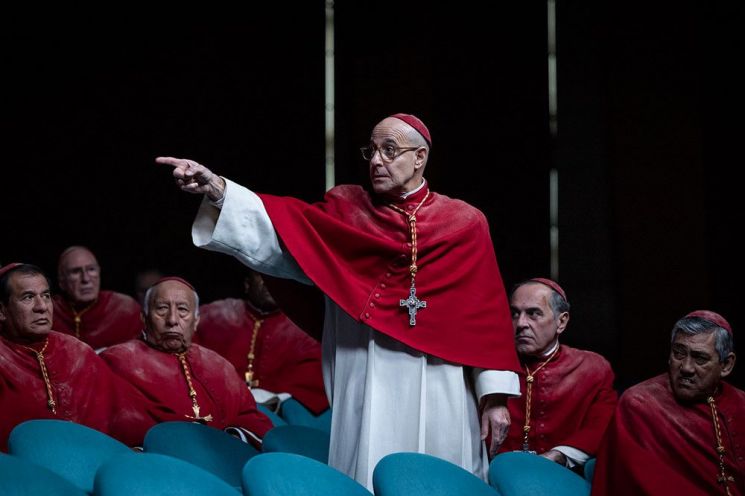 A scene where Cardinal Bellini opposes Cardinal Tedesco's opinion in the film. Naver Movie still from "Conclave"
The sudden appearance of the secret cardinal Benitez, whose existence was unknown to anyone, adds further tension to the film. The story is that the late pope had named an "in pectore" cardinal during his lifetime. The "in pectore" cardinal system is a protective measure used when appointing someone from a country facing religious or political persecution, or when public disclosure of the appointment could seriously endanger the individual or affect the operation of the Church. However, if the pope dies without revealing the name, the appointment is automatically considered invalid.
Pope John Paul II is known to have appointed four "in pectore" cardinals between 1979 and 2003. According to the Catholic news outlet Aleteia in January last year, in 1979 John Paul II appointed Chinese priest Kung Pinmei as an "in pectore" cardinal, but did not reveal his identity due to the negative climate toward Catholicism in China, only making it public in 1991. He also appointed cardinals Jaworski and Janis Pujats, but the identity of the last "in pectore" cardinal appointed in 2003 was never disclosed.
© The Asia Business Daily(www.asiae.co.kr). All rights reserved.



















