"Flexible Work Arrangements Needed to Increase Female Employment Rate"
There have been calls to diversify working hour arrangements and expand flexible work systems in order to increase female employment rates and address the issue of low birth rates.
It has been found that cooperation between labor and management plays a crucial role in the process of finding solutions tailored to the life cycle of workers or the specific characteristics of each workplace, such as reduced working hours during childcare or flexible work arrangements.
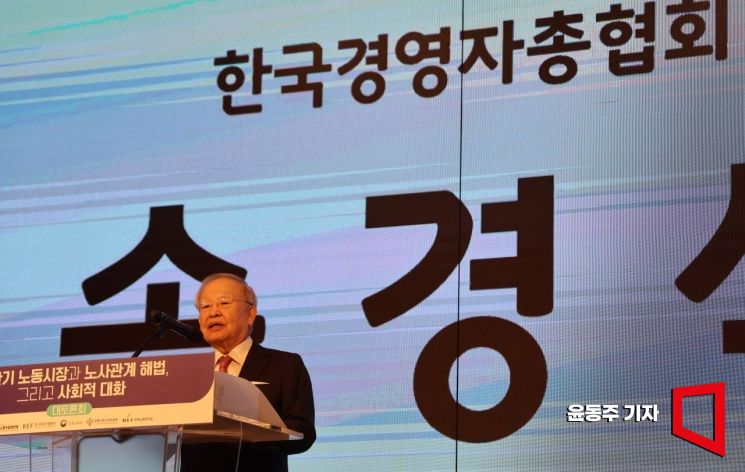 On the 26th, labor, management, and government representatives held the "Labor Market Transition, Labor-Management Relations Solutions, and Social Dialogue Grand Debate" at the Korea Federation of SMEs in Yeouido, Seoul. Sohn Kyungshik, chairman of the Korea Employers Federation, who attended the event, is giving the opening remarks. 2025.03.26 Photo by Yoon Dongju
On April 23, the Korea Employers Federation held a joint forum titled "Exploring Labor-Management Cooperation Measures to Address Low Birth Rates" together with the Federation of Korean Trade Unions and the Korean Women's Development Institute.
Sohn Kyungshik, Chairman of the Korea Employers Federation, stated, "This event is an opportunity to present the outcomes of the cooperative projects that labor, management, and national research institutes have discussed and pursued together over the past year to address the pressing issue of low birth rates." He added, "Labor-management cooperation measures to address low birth rates represent a meaningful attempt to seek joint efforts between labor and management to resolve this challenge, and will serve as a valuable milestone in moving closer to practical solutions."
Chairman Sohn emphasized, "As a responsible social actor in addressing low birth rates, the business community will strive to create work environments that enable work-life balance and to spread family-friendly corporate cultures, focusing on achievable changes." He further stressed, "We will continue to closely cooperate with labor unions to resolve the issue of low birth rates."
Kim Dongmyung, President of the Federation of Korean Trade Unions, said, "Low birth rates are a challenge that must be addressed through cooperation among the nation, society, businesses, and labor unions." He continued, "I hope that the policy recommendations proposed at this forum will be reflected in the new government's national agenda and that government interest and support for labor-management cooperation projects will expand."
Kim Jongsuk, President of the Korean Women's Development Institute, emphasized, "In an era of low birth rates, work-life balance is not just an individual issue but an important matter that society as a whole must address together." She added, "Above all, communication and cooperation between labor and management are essential to enhance the effectiveness of work-life balance systems."
On this day, Jung Sungmi, Research Fellow at the Korean Women's Development Institute, pointed out, "To diversify working hour arrangements and expand flexible work systems, the active participation of both labor and management, as well as institutional improvements, are necessary."
Research Fellow Jung further explained, "Major European countries utilize a wider variety of working hour arrangements than Korea, and the use of such highly flexible systems leads to higher birth rates and female employment rates. Therefore, it is urgent to spread systems tailored to the life cycles of workers and the characteristics of each workplace so that all workers can achieve work-life balance."
Goo Miyeong, Director of the Women's Employment Research Division at the Korean Women's Development Institute, stated, "Cases where the establishment of labor unions in workplaces with poor employment and working conditions has led to the activation of parental leave and reduced working hours for childcare through collective bargaining demonstrate the feasibility of labor-management cooperation." She emphasized, "Labor-management cooperation plays an important role in the process of finding solutions tailored to the life cycle of workers and the specific characteristics of each workplace, such as reduced working hours or flexible work arrangements."
Lee Jiman, Professor at Yonsei University, said, "To reverse the trend of low birth rates, policies must focus on bridging the gap between individual costs and the overall benefits to society." He added, "Like in advanced countries, it is necessary to create a work environment where labor and management can autonomously design ways to balance work and childcare, and policy support is needed to address on-site challenges such as hiring substitute workers or the increased workload on colleagues."
© The Asia Business Daily(www.asiae.co.kr). All rights reserved.

















