Bank of Korea Releases "Trends in Resident Foreign Currency Deposits for March"
$96.94 Billion at the End of Last Month, Down $1.59 Billion
Dollar and Euro Deposits Decrease, Yen Deposits Increase... Euro Decline Due to Profit-Taking
Resident foreign currency deposits have declined for the second consecutive month. Analysts attribute the decrease mainly to a reduction in corporate dollar deposits, driven by overseas direct investment and payments for import settlements.
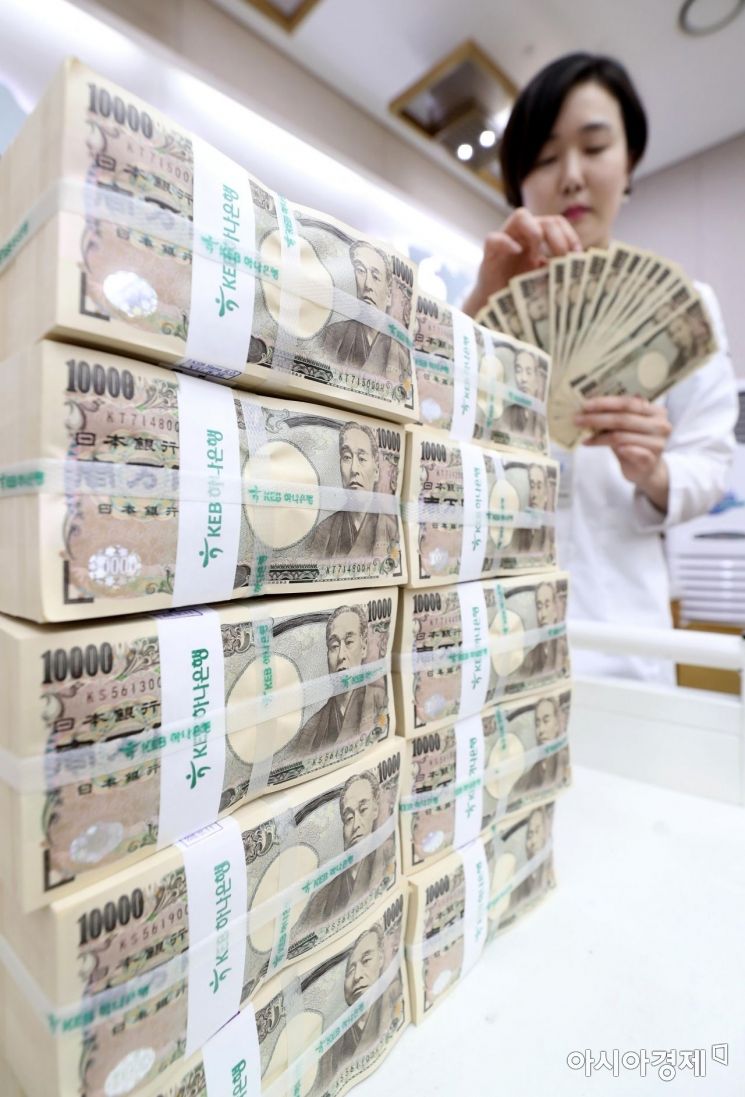 On the 26th, amid trade tensions between the United States and China, the value of the Japanese yen rose intraday to 104 yen, its highest level since 2016. At the KEB Hana Bank Counterfeit Response Center in Euljiro, Seoul, an employee is organizing yen currency. Photo by Moon Honam munonam@
According to the "Trends in Resident Foreign Currency Deposits in March 2025" released by the Bank of Korea on the 23rd, resident foreign currency deposits at foreign exchange banks stood at $96.94 billion at the end of last month, down $1.59 billion from the previous month. This marks the second consecutive month of decline. Resident foreign currency deposits include foreign currency deposits held domestically by Korean nationals, domestic companies, foreigners who have resided in Korea for more than six months, and foreign companies operating in Korea.
By currency, dollar deposits, which account for the largest share (85.7%) of resident foreign currency deposits, decreased by $1.42 billion compared to the end of the previous month. Euro deposits also fell by $50 million over the same period. A Bank of Korea official explained, "Dollar deposits declined mainly due to a decrease in corporate deposits ($1.12 billion), as a result of overseas direct investment and payments for import settlements." The official added, "Euro deposits decreased due to profit-taking by residents following a rise in the won-euro exchange rate." The won-euro exchange rate jumped from 1,497.0 won at the end of February to 1,587.9 won at the end of March, a rise of 90.9 won. Yen deposits increased by $110 million, mainly due to the temporary deposit of yen-denominated dividends received by some companies.
By depositor type, corporate deposits decreased by $1.23 billion to $83.39 billion, while individual deposits fell by $360 million to $13.55 billion. By bank type, domestic banks saw a decrease of $1.92 billion, bringing their total to $82.82 billion, while foreign bank branches posted an increase of $330 million, reaching $14.12 billion.

© The Asia Business Daily(www.asiae.co.kr). All rights reserved.


















