FSC Holds Fifth Meeting of "ESG Finance Task Force"
Focus on Consolidated ESG Disclosure Scope and Temporary Deferral for Scope 3
Global Trends Show Easing of ESG Disclosure Requirements and Extended Grace Periods
The Financial Services Commission is reviewing a plan to set the scope of domestic sustainability disclosures (ESG disclosures) on a consolidated basis, while allowing subsidiaries to be excluded depending on their financial materiality. In addition, for Scope 3 (indirect emissions such as those from the supply chain), the commission is considering a temporary deferral of disclosure, taking into account the usefulness of the information, international alignment, and the burden on companies.
The Financial Services Commission announced on the 23rd that it had held the fifth meeting of the "ESG Finance Task Force." The "ESG Finance Task Force" was established in February 2023 to systematically promote a wide range of policy initiatives across ESG disclosure, evaluation, and investment, together with companies, investors, academia, experts, and related organizations.
At the meeting, the Korea Accounting Standards Board introduced the progress of the review of the ESG disclosure standards being developed by the Korea Sustainability Standards Board (KSSB). The review reflects a comprehensive analysis of feedback from domestic and international stakeholders on the draft sustainability disclosure standards released in April of last year.
Regarding the scope of disclosure, the commission is considering applying the consolidated basis, but allowing the exclusion of subsidiaries that are not financially material in terms of sustainability. For Scope 3, the commission is reviewing the option of temporarily deferring disclosure, taking into account the usefulness of the information, international alignment, and the burden on companies, as well as permitting estimates in cases where data measurement is difficult.
The KSSB plans to prioritize climate-related disclosures in consideration of companies' ability to comply. The board is also reviewing the maintenance of key elements from the draft, such as including industry-based indicators and the price per ton for internal carbon pricing as optional disclosures. After a resolution, the final disclosure standards will be announced, along with educational materials and key Q&A resources to help stakeholders understand the standards.
In addition, the Korea Exchange introduced trends in ESG disclosure initiatives in major countries, including the European Union's Omnibus Package, Japan's announcement of its final disclosure standards, and developments in the United Kingdom, the United States, and Canada.
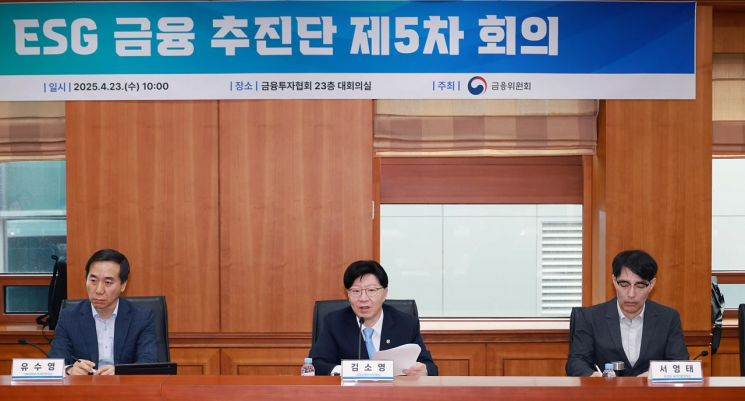
Kim Soyoung, Vice Chairman of the Financial Services Commission, explained that there is a global trend of postponing or easing ESG disclosures. Kim Soyoung stated, "After the EU established the Corporate Sustainability Reporting Directive (CSRD), disclosures began this year in 19 countries, including France," adding, "In February this year, the European Commission (EC) announced the Omnibus Package to ease sustainability-related regulations in order to reduce the burden on companies."
According to the Omnibus Package, the scope of application has been reduced (exempting companies with fewer than 1,000 employees from disclosure), and the timing of disclosure has been deferred in stages (a two-year deferral for companies subject to disclosure in 2026). Additionally, further simplification of disclosure standards is under consideration.
He added, "Japan announced its final disclosure standards based on the International Sustainability Standards Board (ISSB) standards in March. Japan is reviewing a phased disclosure schedule starting in 2027, beginning with companies listed on the Prime Market with a market capitalization of 3 trillion yen or more."
He emphasized that, globally, ESG disclosure systems have not yet been finalized, and that in Korea, where manufacturing represents a significant portion of the economy, in-depth discussion is necessary.
He said, "In many major countries such as the United Kingdom, the United States, and Canada, disclosure systems have not yet been finalized. Considering the high proportion of manufacturing in Korea's industrial structure, it is necessary to continue in-depth discussions on disclosure standards and roadmaps while closely monitoring trends in major countries before making decisions."
He also explained that a sufficient grace period is needed for Scope 3. He said, "For Scope 3, we will provide a sufficient grace period, taking into account cases in the EU and Japan as well as companies' preparedness, and allow for some estimation in order to reduce the burden on companies, while ensuring that investors receive adequate information. We will coordinate detailed disclosure standards accordingly."
The government and related agencies plan to review and coordinate disclosure standards and roadmaps, reflecting the opinions presented and closely monitoring disclosure trends in major countries such as the EU.
© The Asia Business Daily(www.asiae.co.kr). All rights reserved.
![Clutching a Stolen Dior Bag, Saying "I Hate Being Poor but Real"... The Grotesque Con of a "Human Knockoff" [Slate]](https://cwcontent.asiae.co.kr/asiaresize/183/2026021902243444107_1771435474.jpg)












