Most Common in Convenience Stores, Cafes, and Bakeries
One in Five Workers in South Korea is Self-Employed
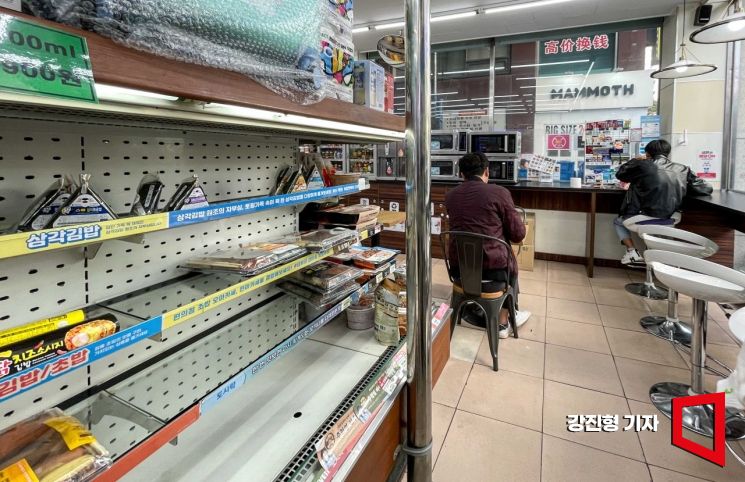 A convenience store scene in downtown Seoul, unrelated to the article content. Photo by Kang Jinhyung
It has been found that there are as many as 170,000 franchise stores in South Korea that do not have a single annual regular closing day. These are mostly businesses that operate nearly 24 hours a day, such as convenience stores and cafes.
According to the National Statistical Office’s KOSIS portal and a franchise (franchisee) survey released on April 23, as of 2023, 169,364 out of franchisees in 15 major business sectors (excluding others) had no regular closing days. This accounts for 62.7% of all franchise stores (270,086 locations).
A regular closing day refers to a day when a franchise store routinely closes, excluding public holidays and national holidays. The proportion of franchisees without a regular closing day was highest among convenience stores. Due to their 24-hour operation, nearly all of the 54,828 convenience stores?specifically, 54,392 (99.2%)?operated without any regular closing days.
In the coffee and other non-alcoholic beverage sector, 26,234 out of 32,241 franchise stores (81.4%) had no regular closing days. The proportion was also high for bakeries, with 78.3% operating without regular closing days. More than half of pizza, hamburger, sandwich, and similar restaurants (59.5%) as well as draft beer and other pubs (56.8%) also did not have regular closing days.
In contrast, only a small proportion of franchises in automobile repair (2.8%) and pharmaceutical and medical supply retail (12.1%) operated without regular closing days.
The average daily operating hours are also quite long. Among all franchise stores, 72,972 locations (27.0%) operated for an average of 14 hours or more per day. In particular, 99.7% of convenience stores operated for 14 hours or more daily, meaning that most convenience stores are open for at least 14 hours every day without regular closing days.
This was followed by bakeries (34.3%), household laundry services (24.3%), coffee and other non-alcoholic beverage shops (19.1%), and stationery and art supply retail (18.8%).
Experts point out that, given that one in five employed people in South Korea is self-employed, the high reliance on self-employment has led to “no days off” operations becoming the norm in order to survive intense competition. Most of these businesses are small-scale, and taking days off would inevitably lead to operating losses.
Additionally, they are struggling with sluggish domestic demand and weakened consumer sentiment. According to the Bank of Korea’s “Financial Stability Situation” report released last month, the average income of self-employed people rose slightly from 41.31 million won at the end of 2022 to 41.57 million won at the end of last year. However, this still has not recovered to the pre-COVID-19 level of 42.42 million won at the end of 2019.
A Bank of Korea official stated, “As the recovery of self-employed income is delayed, the delinquency rate on loans remains high, especially among vulnerable borrowers,” and added, “It will be more effective for self-employed support policies to be differentiated according to each individual’s repayment capacity and willingness, by applying financial support, debt adjustment, or restart assistance as appropriate.”
© The Asia Business Daily(www.asiae.co.kr). All rights reserved.

















