First Observation by Lee Seunghyun, a First-Year Student at Ulsan Jeil High School on April 10
During Breeding Season Migration, Over Ten Black Pigeons Pass Through Ulsan Each Year
The Ulsan city government announced that the black pigeon, classified as a Class II endangered wild species and a natural monument, was discovered on the branches of Japanese black pine trees along the coast of Dong-gu.
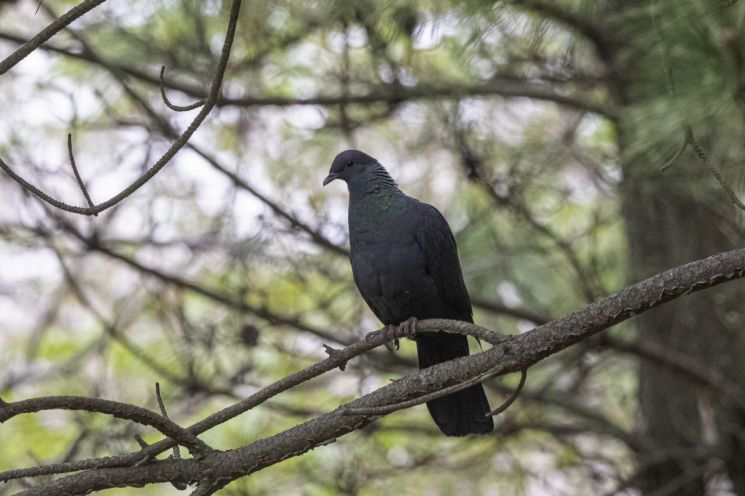
This observation was first made on April 10, when Lee Seunghyun, a first-year student at Ulsan Jeil High School, spotted a single black pigeon while birdwatching along the coast. Hong Seungmin, CEO of Jjaekjjaek Rest Area, photographed the bird, and the observation continued for a total of three days until April 12.
Although there have been records of black pigeon sightings every year, this is the first time the observation has been documented with photographs.
The Ulsan Wildlife Rescue Center previously rescued one black pigeon along the coast of Seosaeng, Ulju-gun in October 2012, and another along the coast of Buk-gu in May 2014, both due to accidents.
The black pigeon discovered this time is the largest among the pigeon species inhabiting Korea. Its cere (the swollen part at the base of the beak) is very small, making the beak and entire head appear slender. While the bird appears mostly black, it also shows a purple and green sheen.
Unlike other pigeons, which typically lay two white eggs, the black pigeon is characterized by laying only one white egg.
The black pigeon mainly inhabits camellia and Machilus thunbergii forests on islands and coastal regions of Korea and Japan.
The species was first introduced to academia in 1936 when a female specimen was collected on Ulleungdo. In 1968, a black pigeon breeding site in Sadong, Nam-myeon, Ulleungdo, was designated as a natural monument.
Designated as a Class II endangered wild species by the Ministry of Environment in 2012, the black pigeon is also classified as Near Threatened (NT) on the IUCN Red List.
Hong Seungmin, CEO of Jjaekjjaek Rest Area, who photographed the bird, stated, "It is highly likely that the bird was observed while migrating to Japan for the breeding season. There have been no cases of black pigeons wintering or breeding in Ulsan. It is estimated that more than ten individuals pass through each year, from Sinmyeong Beach in Buk-gu to Jujeon in Dong-gu, Sinmyeong in Buk-gu, and the Seosaeng coast in Ulju-gun."
An official from Ulsan city said, "Many birds are temporarily staying or entering the evergreen coastal forests for breeding. We plan to promote habitat protection and share information about their presence so that citizens can participate in observation and conservation efforts."
In February, two white-bellied green pigeons, migratory birds that visit inland areas adjacent to the coast, were observed foraging at Ulsan Grand Park.
© The Asia Business Daily(www.asiae.co.kr). All rights reserved.

















