Global Economic Slowdown Expected Due to Trump Tariffs
Georgieva: "Uncertainty Is Extremely High"
Warning of Further Growth Decline If Tariff Issues Persist
As President Donald Trump wages a tariff war against the world, the International Monetary Fund (IMF) has sharply downgraded its economic growth forecasts for both the United States and the global economy for this year and next. In particular, the IMF lowered its U.S. growth outlook for this year by nearly 1 percentage point, forecasting that the Trump-initiated tariff war will boomerang back as a slowdown in the U.S. economy. IMF Managing Director Kristalina Georgieva warned that if the extremely high uncertainty surrounding tariffs persists, the global economy could slip into recession.
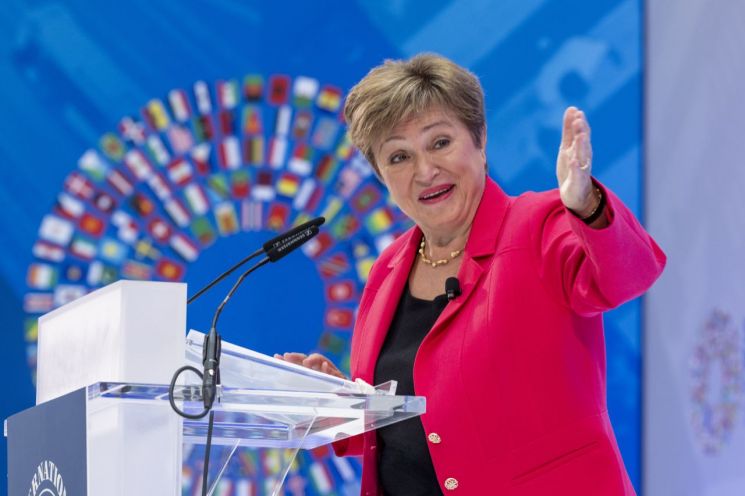
In its World Economic Outlook (WEO) report released on April 22 (local time), the IMF projected global economic growth of 2.8% for this year. This is a 0.5 percentage point downgrade from its January forecast. It marks the lowest growth rate since the COVID-19 pandemic in 2020, and the second lowest since 2009.
The IMF also lowered its global growth forecast for next year to 3.0%, a reduction of 0.3 percentage points.
The growth outlook for advanced economies is 1.4% for this year and 1.5% for next year, down 0.5 percentage points and 0.3 percentage points, respectively, from January. For developing economies, the IMF now projects growth of 3.7% this year and 3.9% next year, which are also down 0.5 percentage points and 0.4 percentage points, respectively, compared to January.
By country, the IMF expects U.S. growth to be 1.8% this year, down 0.9 percentage points from its previous forecast. Next year’s U.S. growth is projected at 1.7%, a 0.4 percentage point downgrade. For China, which is engaged in a trade war with the U.S. involving mutual tariffs of 125%, the growth rate is forecast at 4.0% for both this year and next, down 0.6 percentage points and 0.5 percentage points, respectively, from previous forecasts.
The IMF lowered South Korea’s growth outlook for this year to 1.0%, a reduction of 1.0 percentage point. Other countries also saw downgrades compared to January: Germany 0% (down 0.3 percentage points), Japan 0.6% (down 0.5 percentage points), the United Kingdom 1.1% (down 0.5 percentage points), Canada 1.4% (down 0.6 percentage points), India 6.2% (down 0.3 percentage points), and Mexico -0.3% (down 1.7 percentage points).
The IMF also warned of tariff-induced inflation. It projects inflation for advanced economies such as the United States, United Kingdom, and Canada to be 2.5% this year, up 0.4 percentage points from January. U.S. inflation is forecast at 3%, a 1.0 percentage point increase from the previous estimate.
The IMF’s decision to lower growth forecasts and raise inflation projections for the U.S. and other countries in this World Economic Outlook is due to increased uncertainty stemming from President Trump’s tariff policies. The IMF explained that U.S. tariff offensives and retaliatory measures by trading partners are causing supply shocks, which in turn are leading to higher prices and lower productivity. As a result of the tariff war, the IMF cut its forecast for global trade growth this year from 3.2% to 1.7%.
The IMF stated that the effective U.S. tariff rate has soared to its highest level in a century. While the IMF predicts the U.S. will avoid a recession this year, it sharply raised the probability of a recession from 27% last October to 40%.
Managing Director Georgieva issued a warning about the risk of recession due to tariff-related uncertainty.
In an interview with Bloomberg TV, she noted that the threat of tariffs has sent uncertainty “off the charts,” saying, “If this cloud of uncertainty continues to thicken and makes it increasingly difficult for businesses and households to make decisions, it will be self-inflicted and something we will regret.” She added, “If we fail to ease trade tensions and uncertainty remains extremely high, the tariff issue will become prolonged and global growth will fall further,” warning that “the risk of recession could increase further.”
Pierre-Olivier Gourinchas, the IMF’s Chief Economist, diagnosed that “risks to the global economy have increased and are clearly tilted to the downside.” He added, “We are entering a new era,” and assessed that “the global economic system that has operated for the past 80 years is being reset.”
Additionally, the IMF warned that the decline in U.S. stock and bond prices since the announcement of reciprocal tariffs on April 2 could undermine the stability and soundness of the financial system. The IMF also suggested that the all-encompassing tariff policy could shake the dollar’s status as the world’s key currency.
Chief Economist Gourinchas analyzed, “If financial conditions deteriorate rapidly, the U.S. dollar would typically be expected to be welcomed, but the international monetary system could suddenly be reset,” adding, “This could have a significant impact on the dollar, which serves as the main currency base.”
© The Asia Business Daily(www.asiae.co.kr). All rights reserved.