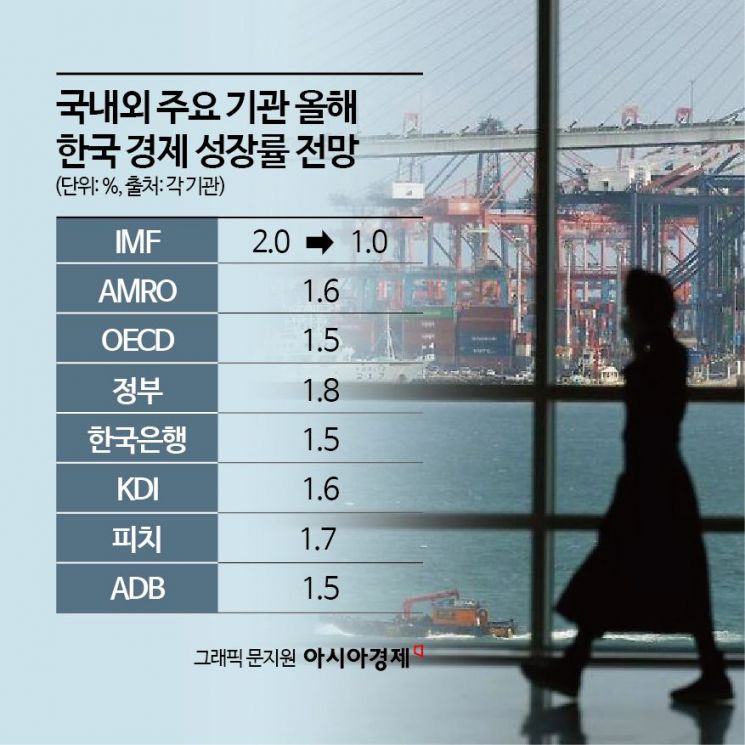
The International Monetary Fund (IMF) has sharply lowered its forecast for South Korea's economic growth rate this year to 1.0%, which is half of its projection from three months ago (2.0%).
According to the Ministry of Economy and Finance on April 22, the IMF, in its World Economic Outlook released on this day, projected South Korea's real gross domestic product (GDP) growth rate for this year at 1.0%. The IMF publishes its World Economic Outlook for all member countries every April and October, and releases revised forecasts for the 30 major economies in January and July. This latest projection is a downward revision of 1.0 percentage point compared to the previous forecast in January (2.0%).
The IMF's forecast is significantly lower than those of other major domestic and international institutions, including the South Korean government (1.8%), the Korea Development Institute (KDI, 1.6%), the ASEAN+3 Macroeconomic Research Office (AMRO, 1.6%), the Organisation for Economic Co-operation and Development (OECD, 1.5%), and the Bank of Korea (1.5%).
The IMF also sharply lowered its growth forecast for next year to 1.4%, which is 0.7 percentage points below the previous projection (2.1%).
Although the IMF did not specify the reasons for lowering South Korea's growth outlook, it is believed that the revision reflects export setbacks caused by the US-initiated tariff war. This figure also incorporates, for the first time, the impact of the martial law situation that occurred in South Korea at the end of last year.
The IMF also lowered its global growth forecast for this year by 0.5 percentage points, from 3.3% to 2.8%. The IMF projected, "This year, the effect of the 90-day mutual tariff suspension will be offset by declining growth rates in the United States and China, resulting in 2.8% global growth."
In this outlook, the IMF also provided supplementary forecasts that take into account the rapidly changing uncertainty of US tariff policy, including the imposition of mutual tariffs by the United States and the US-China tariff war. The IMF expects that next year, as the losses in the United States and China will outweigh the gains in other countries, global growth will reach 2.9%, which is slightly below the baseline forecast of 3.0%.
In particular, the IMF expects the US economy to grow more weakly than previously anticipated. The US economic growth rate forecast was revised down significantly, from 2.7% to 1.8%, a decrease of 0.9 percentage points.
The IMF diagnosed that this year's growth rate will drop sharply due to policy uncertainty, trade tensions, and delayed recovery in consumption. In addition, most European countries, including the United Kingdom (1.1%), Germany (0.0%), and France (0.6%), as well as Japan (0.6%), also saw downward revisions.
The growth rate for emerging and developing economies was revised down by 0.5 percentage points from the January forecast, to 3.7%. Despite stronger-than-expected fourth-quarter results last year and fiscal expansion, China's growth forecast for this year was lowered from 4.6% to 4.0% due to the negative impact of recent tariff measures.
In the case of Mexico, reflecting sluggish economic activity since the end of last year, the imposition of US tariffs, geopolitical tensions, and a tightening financial environment, the IMF projected negative growth of 0.3% for this year, which is a sharp downward revision of 1.7 percentage points from the previous forecast.
© The Asia Business Daily(www.asiae.co.kr). All rights reserved.
![Clutching a Stolen Dior Bag, Saying "I Hate Being Poor but Real"... The Grotesque Con of a "Human Knockoff" [Slate]](https://cwcontent.asiae.co.kr/asiaresize/183/2026021902243444107_1771435474.jpg)
















