WSJ Cites Bespoke Investment Group Data for Analysis
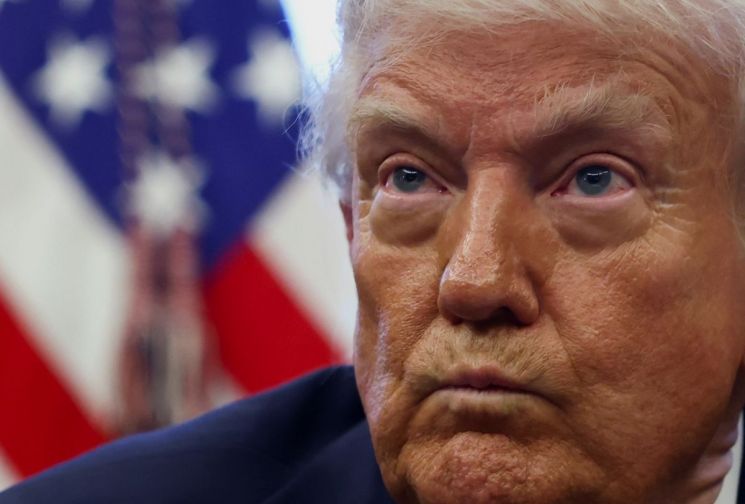
The Wall Street Journal has reported that, based on the same period from each president's inauguration day, the performance of the Standard & Poor's (S&P) 500 Index since President Trump's inauguration is the worst since 1928.
On the 21st (local time), the U.S. daily Wall Street Journal (WSJ), citing data from Bespoke Investment Group, reported that the S&P 500 Index has plunged by 14.0% since President Trump's inauguration on January 20.
The WSJ also reported that "the Dow Jones Industrial Average is expected to record its worst April since 1932." Since the beginning of this month through the 21st, the Dow has fallen by 9.1%.
After a four-day closure for Good Friday (the Friday before Easter) on April 18, the New York Stock Exchange reopened, reflecting concerns over President Donald Trump's continued pressure on the Federal Reserve. On this day, the Dow fell by 2.48% compared to the previous trading day. The S&P 500 Index and the tech-heavy Nasdaq Composite Index also dropped by 2.36% and 2.55%, respectively.
Typically, when stock prices fall, the preference for safe-haven assets increases, causing U.S. mid- to long-term Treasury prices to rise. However, this month, both U.S. Treasury prices and the value of the dollar have declined alongside falling stock prices.
The WSJ reported that the dollar's status as a safe-haven asset is being shaken. The dollar index, which measures the value of the dollar against six major currencies, stood at 98.29 as of 3:27 p.m. Eastern Time, down 1.1% from the previous trading day.
As the dollar's weakness continued, the dollar index dropped as low as 97.9 during the day. This is the lowest level since March 2022.
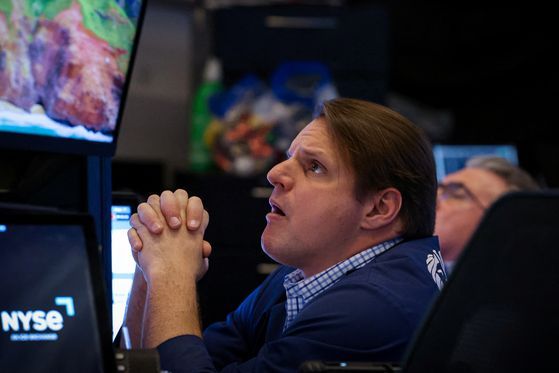 A stockbroker watching the stock price decline at the New York Stock Exchange on the 21st (local time). Photo by Reuters
In contrast, the yield on the 10-year U.S. Treasury rose by 8.2 basis points (1bp = 0.01 percentage points) from the previous session to 4.413%. Bond yields and prices move in opposite directions.
Scott Ladner, Chief Investment Officer of Horizon Investments, which reduced its U.S. equity allocation several weeks ago, said, "Because of the policy structure, it is impossible to deploy capital into an unstable and unpredictable (U.S.) economy." The WSJ also reported that, according to the American Association of Individual Investors' weekly survey, the proportion of retail investors expecting a decline in stock prices has exceeded 50% for eight consecutive weeks, marking the longest streak since 1987.
Carol Schleif, Chief Investment Officer at BMO Private Wealth, commented on the broad-based decline, saying, "It is concerning," and added, "The bigger issue people want to know is whether the 'U.S. exceptionalism trade' will end in the short term or become a mid- to long-term factor."
Meanwhile, as trust in the U.S. market is shaken due to the Trump risk, stocks, the dollar, and Treasuries all experienced a triple decline. Gold prices surpassed $3,400.
The Trump administration has long argued that other countries have been free-riding on America's dollar, consumer market, and security, and has vowed to change this. It has blamed problems such as the decline of U.S. manufacturing, national debt, and unemployment on "unfair" trade practices.
However, after President Trump announced reciprocal tariffs on all global trading partners on the 2nd of this month, capital has instead been flowing out of U.S. asset markets.
© The Asia Business Daily(www.asiae.co.kr). All rights reserved.


















