Investment Standby Funds: Demand Deposits Usually Fluctuate by 5 to 20 Trillion Won
Unprecedented Outflow of 42 Trillion Won in Just Fifteen Days
Funds Flow into Domestic and Overseas Stock Markets
Concerns Rise Over Higher Lending Rates as Banks Struggle to Secure Low-Cost Deposits
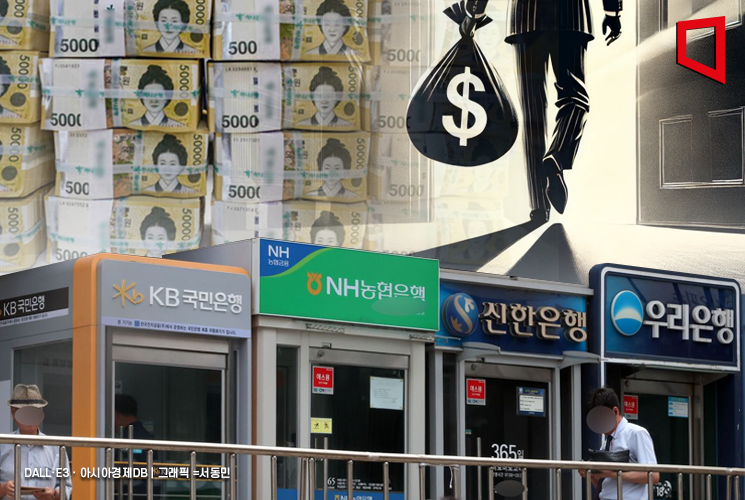
It has been revealed that over 42 trillion won in demand deposits have flowed out of the five major commercial banks (KB Kookmin, Shinhan, Hana, Woori, and NH Nonghyup) in just fifteen days. Compared to the usual monthly fluctuation of 5 to 10 trillion won, this is an exceptional change in less than a month. Analysts attribute this to two main factors: first, the appeal of savings and installment deposits as investment destinations is waning amid the onset of a full-fledged interest rate cut cycle; second, more investors are turning to alternative investment destinations such as stocks, following the shockwaves from Trump-era tariffs.
According to the financial sector on the 23rd, the combined demand deposits (including MMDA, as of the 18th) of the five major commercial banks stood at 607.3011 trillion won. This is a decrease of 42.823 trillion won from the previous month’s total of 650.1241 trillion won. Demand deposits, with an interest rate of around 0.1%, serve as a primary source of low-cost funds for banks, while for investors, they are considered "investment standby funds" due to their liquidity. Typically, demand deposits fluctuate by 5 to 20 trillion won per month, but a change of over 42 trillion won in just fifteen days is highly unusual.
The dominant assessment is that the mass outflow of demand deposits in just fifteen days was driven by increased stock market volatility caused by Trump-era tariffs, prompting investors to engage in bottom-fishing. According to the Korea Securities Depository, by the 19th of this month, Korean retail investors’ net purchases of U.S. stocks reached approximately $3.7 billion (5.2528 trillion won). This amount is about 90% of the net purchases in March ($4.1 billion) and surpasses the figure for February ($3 billion). Net buying continues in the domestic stock market as well. From the 1st to the 18th of this month, individual investors recorded net purchases of 5.5818 trillion won. This contrasts sharply with March, when individual investors were net sellers of over 3 trillion won in KOSPI stocks.

The declining attractiveness of savings and installment deposit interest rates, amid the start of a full-scale interest rate cut cycle, is also believed to have fueled the outflow of demand deposits. According to the Korea Federation of Banks, the upper and lower bounds of 12-month term deposit rates (simple interest) at the five major commercial banks currently range from 2.15% to 2.73%. This is a decrease of 0.46 percentage points at the upper bound and 0.21 percentage points at the lower bound compared to last month's average rates (2.61% to 2.94%). The interest rate for ultra-short-term, one-month fixed deposits has already fallen into the 1% range. For example, Shinhan Bank's "Solpyeonhan Fixed Deposit" and KB Kookmin Bank's "KB Star Fixed Deposit" offer rates of about 1.80% for a one-month term.
There are also concerns that this rapid outflow of demand deposits could trigger a rise in bank lending rates. This is because the more demand deposits a bank holds, the lower its funding costs for lending. A large-scale outflow of demand deposits could increase banks’ funding costs, which in turn could lead to a rise in the COFIX, the benchmark for determining variable rates on products such as mortgage loans and jeonse loans. COFIX reflects changes in the interest rates of deposit products and bank bonds handled by banks.
An official from the banking sector said, "Typically, during the quarterly settlement period in March, companies temporarily park funds in demand deposits for accounting purposes, so demand deposits tend to increase in March and then decrease somewhat in April due to seasonal factors." The official added, "However, even when taking such seasonal factors into account, the increase in products such as household credit loans, in addition to the decrease in demand deposits, suggests that funds are moving to investment destinations outside of banks."
© The Asia Business Daily(www.asiae.co.kr). All rights reserved.
![Clutching a Stolen Dior Bag, Saying "I Hate Being Poor but Real"... The Grotesque Con of a "Human Knockoff" [Slate]](https://cwcontent.asiae.co.kr/asiaresize/183/2026021902243444107_1771435474.jpg)

















