Global Symposium Held to Foster Cooperation
Among Top-Tier Research Institutions
A symposium was held to share the content of joint research projects conducted by top-tier domestic and international research institutions, and to discuss strategies for building mid- to long-term cooperative relationships between these institutions in the future.
The Ministry of Science and ICT announced on April 22 that it hosted a global symposium at the Westin Chosun Hotel in Seoul, bringing together leading domestic and international researchers participating in the 'Top-Tier Research Institution Cooperation Platform Establishment and Joint Research Support' program, as well as young scientists who will lead the next generation of Korea's science and technology sector.
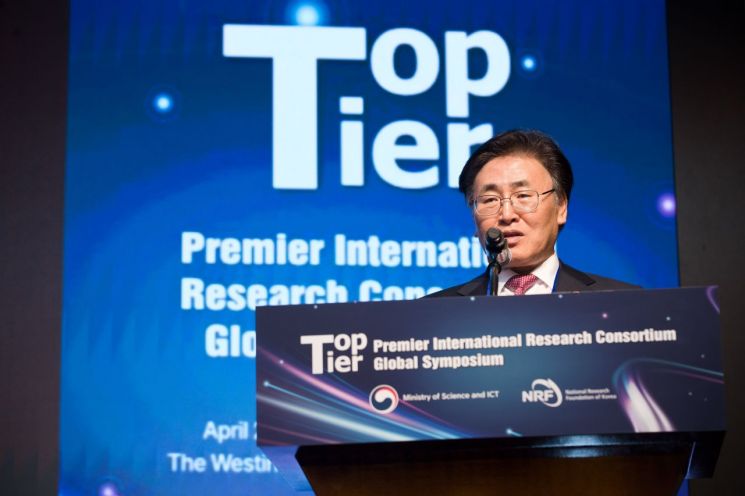 Science and ICT Minister Sangim Yoo delivers a welcome speech at the 'Top-Tier Project Global Symposium' held on the afternoon of the 22nd at the Westin Chosun Hotel in Jung-gu, Seoul. Photo by Ministry of Science and ICT
The Top-Tier program, which began last year, is an international cooperation initiative designed to help top-level research institutions at home and abroad generate world-class research outcomes through joint research, and to foster strong bonds between researchers from both countries through personnel and information exchanges.
Four research projects are currently underway, involving collaborations between the Korea Advanced Institute of Science and Technology (KAIST) and the Massachusetts Institute of Technology (MIT); the Institute for Basic Science (IBS) and RIKEN in Japan; Seoul National University and Stanford University in the United States; and the Korea Research Institute of Chemical Technology and the REGA Institute for Medical Research in Belgium.
At the symposium, principal investigators from each country explained the details of their research projects. The KAIST-MIT research team announced that they are leading the development of innovative materials for future energy by utilizing an autonomous driving laboratory for collaborative research. The Korea Research Institute of Chemical Technology and the REGA Institute stated that they are establishing a rapid response platform to prepare for potential future pandemics.
Seoul National University and Stanford University outlined their plans to develop integrated technologies encompassing carbon dioxide capture, conversion into hydrogen storage materials, and hydrogen production and utilization. The Institute for Basic Science and RIKEN explained their goal to leverage the distinct characteristics of their respective large-scale accelerator research facilities to become world-leading institutions in advanced nuclear physics research.
Experts participating in the symposium shared strategies for effectively carrying out comprehensive collaborative activities such as joint research, which is the focus of the Top-Tier program. They also discussed the necessity of international joint research, as well as their research experiences and knowledge.
Harry Tuller, a globally renowned scholar in the field of materials engineering and a professor at MIT, stated, "I gain a great deal of inspiration from collaborating with young researchers in Korea," adding, "I expect that through the Top-Tier program, young Korean researchers will develop world-leading, first-of-its-kind technologies and contribute to solving global challenges through science and technology."
Sangim Yoo, Minister of Science and ICT, said, "As the importance of global joint research increases, it is crucial not only to build competitive research capabilities, but also to establish trust and confidence with outstanding overseas research institutions and researchers." He added, "Through the Top-Tier Cooperation Platform Establishment Program, we will support world-class research institutions in maintaining long-term exchanges and cooperation."
© The Asia Business Daily(www.asiae.co.kr). All rights reserved.

















