Third Military Reconnaissance Satellite (SAR) Successfully Enters Target Orbit
As part of the military reconnaissance satellite project (hereafter referred to as the 425 Project), South Korea's fourth reconnaissance satellite and third Synthetic Aperture Radar (SAR) satellite has been launched. SAR is a radar system that sequentially emits radar waves from the air toward land and sea, then synthesizes the minute time differences of the reflected radar waves from various surfaces to create detailed topographical maps. This system enables precise imaging of the ground regardless of day or night, or adverse weather conditions.
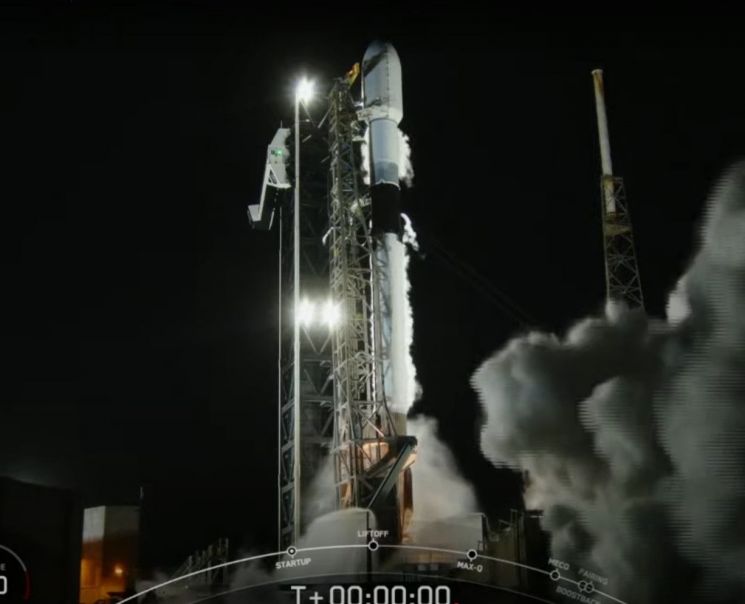
On April 22, the Ministry of National Defense announced, "The fourth military reconnaissance satellite, launched from Cape Canaveral Space Force Station in Florida at 10:03 a.m. (Korean time), successfully separated from the launch vehicle and entered its target orbit as planned."
Earlier, the Falcon 9 rocket from U.S. space company SpaceX, carrying the fourth reconnaissance satellite, was launched at 9:48 a.m. The Falcon 9, which consists of two stages, saw its first-stage booster separate 2 minutes and 18 seconds after launch, followed by the separation of the fairing (satellite protective cover) 19 seconds later. The fourth reconnaissance satellite was completely separated from the launch vehicle and entered orbit just 15 minutes after launch.
The 425 Project, led by the Defense Acquisition Program Administration and the Agency for Defense Development, aims to secure a total of five surveillance and reconnaissance satellites for monitoring the Korean Peninsula and surrounding areas. This includes one EO/IR (Electro-Optical/Infrared) satellite and four SAR (Synthetic Aperture Radar) satellites. The name "425" is derived from the similar pronunciation of SAR and EO, and refers to the project to secure a total of five high-resolution reconnaissance satellites, from the EO/IR satellite (No. 1) to the four SAR satellites (Nos. 2 to 5). The first satellite was launched in December 2023, the second in April 2024, and the third in December 2024.
Hanwha Systems manufactured the most critical component of the satellite, the "SAR payload." Like the previously launched SAR satellites (Nos. 2 and 3), the fourth satellite orbits the Earth in an "inclined orbit," capturing images of the Korean Peninsula four to six times a day. An inclined orbit, which is tilted at a certain angle from the equator, enables the satellite to revisit and capture images of a specific region multiple times a day due to its short revisit cycle.
With the successful launch of the fourth satellite, it is assessed that South Korea is on the verge of completing the "eyes" of the Kill Chain, a next-generation space weapon system and one of the core strategic assets of the military. The Kill Chain is an offensive defense system that detects and identifies enemy missile threats in real time, determines whether and how to respond, and selects the appropriate means of attack.
The SAR satellite can capture images from space without restriction, day or night, and regardless of adverse weather. It consists of a "payload" that performs the satellite's main missions, such as real-time detection of enemy threats and strategic target surveillance using ultra-high-resolution radar, and a "bus," which manages the entire satellite and includes power and fuel tanks.
© The Asia Business Daily(www.asiae.co.kr). All rights reserved.

















