Natural Rubber-Based Eco-Friendly Technology
A natural rubber-based electrolyte additive has been developed that can improve the performance and lifespan of supercapacitors.
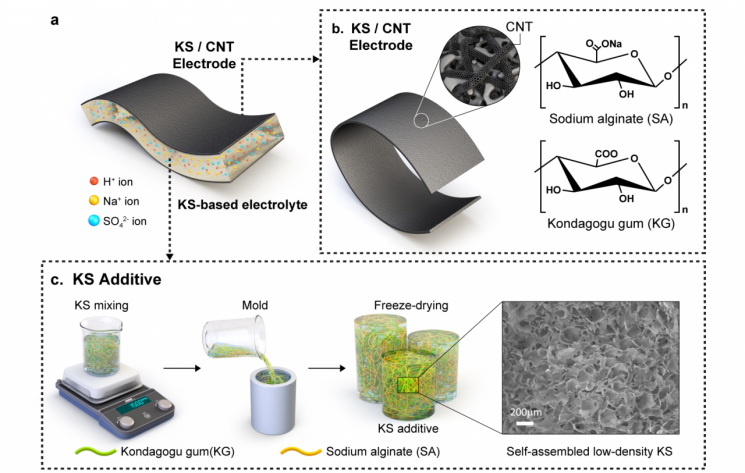 Reference image material for performance development research of supercapacitors by Ajou University research team.
 Ajou University announced on the 22nd that the research team led by Professor Yoon Taekwang (Department of Applied Chemistry, Graduate School of Molecular Science and Technology) has succeeded in significantly enhancing the performance and lifespan of supercapacitors by developing a new electrolyte additive using bio-polymers.
Supercapacitors are next-generation energy storage technologies with immense potential for development. They are attracting attention from both industry and academia because they do not use lithium, making them environmentally friendly, and they are capable of storing large amounts of electrical energy.
The Ajou University research team developed a conjugated KS additive by utilizing environmentally friendly natural rubber extract, kondagogu gum, and sodium alginate, an extract from seaweed, in order to address the instability at the electrode-electrolyte interface in conventional supercapacitor systems.
This additive boasts excellent solubility in aqueous electrolytes. It improves ion conductivity and mobility, resulting in a dramatic performance enhancement compared to existing electrolytes.
Electrolytes based on the KS additive offer a simpler process and lower cost compared to conventional chemically synthesized electrolytes, increasing their potential for industrial application.
The KS additive, as a bio-polymer based on natural polysaccharides, has high scalability due to its abundant and recyclable raw materials, low cost, and ease of mass production and process expansion.
This research was supported by the Ministry of Science and ICT, the National Research Foundation of Korea, the University of Glasgow Startup Fund, and the AMRITA Seed Grant. The results were published in the April online edition of "Energy Storage Materials."
© The Asia Business Daily(www.asiae.co.kr). All rights reserved.

















