Passed Away on the Morning of the 21st
Emphasized a Life of Simplicity and Caring for the Marginalized
Dedicated to Reforming Entrenched Interests
Opposed Exclusion of Sexual Minorities, Stressed Inclusiveness
Pope Francis, who passed away on the morning of the 21st (local time), was known for his lifelong commitment to integrity, often repeating the phrase, "There are no pockets in a shroud." He dedicated his life to reforming entrenched interests and standing by the marginalized. After being hospitalized with pneumonia for 38 days and discharged on the 23rd of last month, there was speculation that he might resign from the papacy. However, true to his long-held belief that "the mission of the pope continues until the very end of life," he fulfilled his duties until his last breath.
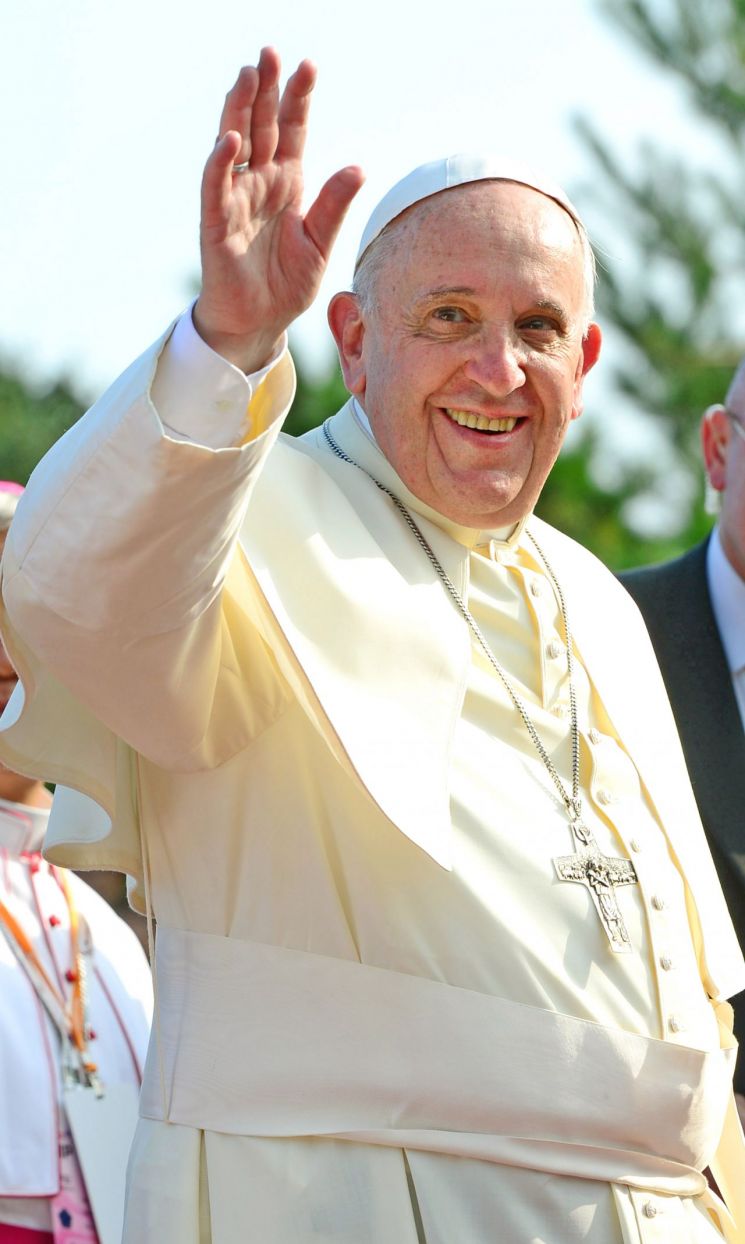 The photo shows Pope Francis raising his hand in greeting to the faithful at Solmoe Holy Site in Dangjin, Chungnam, on August 15, 2014. Photo by Yonhap News.
From his election to his actions as pope, Francis was unconventional in many ways. He was the first pope from the New World and the first non-European pope in 1,282 years. Pope Francis was born in December 1936 to an Italian immigrant family in Buenos Aires, Argentina. In his youth, he was passionate about soccer and tango like many young people, and even fell in love with a beautiful woman. He later chose the path of priesthood, joined the Jesuits, and served as Archbishop of Buenos Aires, the largest diocese in Argentina. In 2013, after the resignation of Benedict XVI, he was elected pope in the conclave. He later recalled that he bought a round-trip plane ticket to Rome and never imagined he would become pope. Francis is considered the most progressive pope in history.
He was also the first pope to take the name "Francis." Unlike previous popes who chose names after various saints, he took his name from Francis of Assisi (1182-1226), known as the "saint of the poor." It is said that this decision was prompted when Cardinal Claudio Hummes of Brazil embraced him after his election in 2013 and urged him, "Do not forget the poor." In 2016, he established the World Day of the Poor, to be observed annually on the 33rd Sunday in Ordinary Time (mid-November).
The pope also broke with tradition in his attire, setting aside symbols of authority. Instead of the traditional red papal shoes, he continued to wear the black shoes he had worn since his days as a cardinal. He chose to live in the Casa Santa Marta, a guesthouse used as temporary accommodation, rather than the luxurious official papal residence. After his election, he celebrated his first Mass as pope and asked the clergy of his native Argentina not to attend, but to use the money they would have spent on travel to help the poor?a story that well illustrates his humility. His emphasis on poverty and humility even drew criticism from some who labeled him a "Marxist."
His inclusive attitude toward minorities and the vulnerable was also notable. He showed warmth toward children of single mothers, immigrants, and refugees. On the sensitive issue of homosexuality within the Catholic Church, he took an open stance, saying, "God loves everyone, especially sinners." Accordingly, he allowed blessings for homosexual priests, but maintained the Church's traditional position on same-sex marriage and the baptism of sexual minorities.
He also implemented reforms in finance and personnel, breaking with established practices. Instead of appointing cardinals from traditional centers like Paris or Milan, he chose cardinals from more peripheral regions, such as Lazarus You Heung-sik, Bishop of Daejeon in Korea. Outsourcing accounting audits was one of the reforms he initiated immediately after taking office, and since 2021, the Diocese of Rome has also been subject to audits. During sweeping reforms of the Vatican's finances and investments in stocks and real estate, he often clashed with vested interests. In 2014, he publicly excommunicated the southern Italian mafia group 'Ndrangheta for its veneration of evil.
During his lifetime, he also requested that his funeral break with tradition and be simple. According to his publicly released will, he wished to rest not in the Vatican but at the Basilica of Santa Maria Maggiore, with only a single inscription on his tomb and no special decorations. His funeral is expected to be much simpler than those of previous popes.
© The Asia Business Daily(www.asiae.co.kr). All rights reserved.

















