154 Sinkholes in the Past 7 Years: 13 Cases of Injuries and Property Damage
Concentrated Near Subway Stations... "Need to Establish a Prevention System"
City: "Authority to Designate Priority Management Zones Lies with District Mayors"
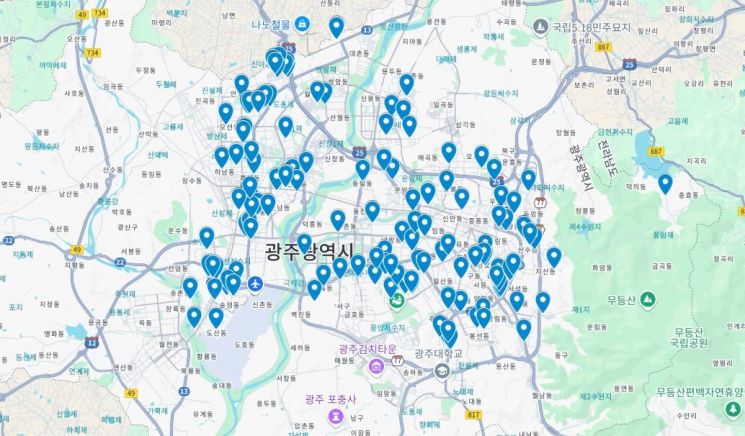
On April 21, Park Pilsun, a member of the Gwangju City Council (Democratic Party of Korea, Gwangsan District 3), released the "Gwangju Sinkhole Map," which was created based on sinkhole incidents that occurred from 2018 to 2024. The sinkhole map of Gwangju, disclosed by Councilor Park, can be accessed via a dedicated website.
This initiative is drawing attention as a proactive response at the local council level, at a time when a series of sinkholes have recently occurred throughout Gwangju, heightening public anxiety over safety.
According to data submitted to Councilor Park by Gwangju City, there were a total of 154 sinkholes (ground subsidence incidents) in Gwangju during this period, resulting in 2 cases of personal injury and 11 cases of vehicle damage.
By region, Gwangsan District recorded the highest number with 61 cases (39.6%), followed by Dong District with 31 cases, Seo District with 27 cases, Buk District with 22 cases, and Nam District with 13 cases. Notably, sinkholes were found to be concentrated near subway stations such as Namgwangju Station (9 cases) and Geumnamno 4-ga Station (4 cases), as well as in old city areas including Wolgok-dong in Gwangsan District (10 cases), Biadong (9 cases), and Hwajeong-dong (9 cases).
According to the Special Act on Underground Safety Management (Underground Safety Act), the mayor is required to designate and manage areas with a high risk of sinkhole accidents as "priority management zones." However, it was confirmed that Gwangju City has not designated a single such zone to date.
Councilor Park stated, "Politics that only mourns and takes follow-up measures after an accident is not fulfilling its responsibility," adding, "Even now, we must protect citizens' lives and safety by implementing effective preemptive measures for high-risk areas and designating priority management zones."
Councilor Park also pointed out, "Gwangju is particularly vulnerable to ground subsidence due to the overlap of aging sewage pipes and underground subway construction," and emphasized, "We should focus on managing vulnerable locations based on accurate data, and shift to a system where we work together with citizens using publicly available safety maps."
In response, a city official explained, "It is incorrect to state that the mayor of Gwangju has not designated priority management zones," clarifying, "The designation and public notice of sinkhole management zones is the responsibility of the heads of basic local governments, so in Gwangju, this authority lies with the district mayors."
© The Asia Business Daily(www.asiae.co.kr). All rights reserved.

















