Domestic Tourism Spending Drops by 5% in Q1 to 9.1 Trillion Won
Jeju Sees a 20% Decline... Domestic Tourist Numbers Down 15% This Year
Regional Tourism Hubs Needed to Revitalize Local Tourism
Measures Needed to Eliminate Price Gouging
Korean citizens continue to turn away from domestic tourist destinations. In the first quarter of this year, spending by Koreans at domestic tourist sites decreased for the second consecutive year, following a decline last year. This drop in domestic tourism demand is attributed to the economic downturn, as well as a series of incidents and accidents that occurred around the end of last year and the beginning of this year. However, as demand and spending on overseas travel continue to rise steadily regardless of economic conditions, some argue that the competitiveness of domestic tourist destinations needs to be strengthened.
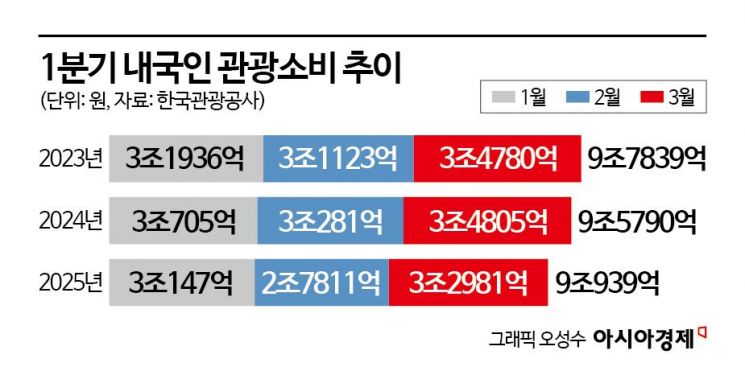
According to the Korea Tourism Organization on April 21, domestic tourism spending by Koreans in the first quarter of this year totaled 9.0939 trillion won. This represents a 5.1% decrease compared to the same period last year (9.579 trillion won), marking the second consecutive year of decline since 2023 (9.7839 trillion won).
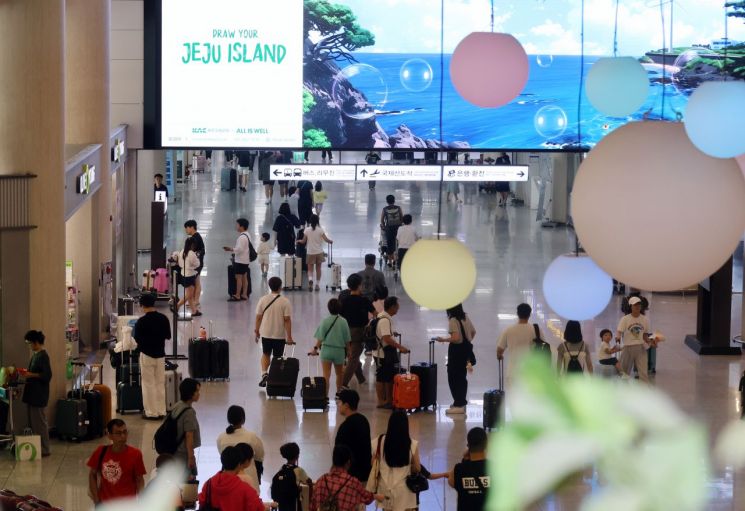
By region, Jeju Island saw a particularly notable drop. In the first quarter, domestic tourists spent 175.4 billion won in Jeju, a 19.0% decrease from 216.5 billion won a year earlier. The recent decline in the number of domestic tourists visiting Jeju appears to have led to decreased spending. In fact, according to the Jeju Tourism Organization, the number of domestic tourists who visited Jeju last year was 11.88 million, a 6.4% decrease from 12.68 million in 2023. As of February this year, 1.58 million people visited Jeju, a 14.9% decrease compared to 1.86 million during the same period last year.
Meanwhile, Seoul, which accounts for the largest share of tourism spending, saw domestic tourism spending drop to 2.717 trillion won, a 5.0% decrease from 2.8604 trillion won in the same period last year. Gangwon Province also recorded a similar decline, with spending falling by 4.7% to 261.2 billion won. In contrast, Busan recorded 759.8 billion won in spending, a relatively small decrease of 0.4% compared to the same period last year.
Despite the decrease in spending by domestic tourists, the number and spending of foreign tourists increased. In the first quarter, foreign tourists spent 1.8769 trillion won in Korea, a 10.6% increase from 1.697 trillion won in the same period last year. The number of foreign tourists visiting Korea also rose to 2,255,651 as of February, an 18.0% increase (344,526 people) compared to 1,911,125 during the same period last year.
As the economic downturn continues, the slowdown in domestic tourism spending by Koreans has persisted into this year, following last year. High inflation, a strong dollar, and high interest rates have dampened consumer sentiment, causing people to close their wallets when it comes to domestic travel. Additionally, incidents such as the Jeju Air passenger plane accident and the 12·3 emergency martial law at the end of last year further reduced tourism demand. Last month, large-scale wildfires in the Yeongnam region led to the cancellation or postponement of more than ten regional festivals scheduled for March and April, compounding the situation.
However, it is unreasonable to attribute the recent slump in domestic tourism solely to economic conditions. While Koreans are reluctant to spend on domestic travel, they remain willing to spend on overseas trips. In fact, by February this year, 5,598,550 Koreans traveled abroad, a 6.0% increase (315,575 people) compared to 5,282,975 during the same period last year. Overseas spending during this period also rose by 7.6% to $4.956 billion (about 7.035 trillion won), compared to $4.065 billion in the same period last year.
Ultimately, most experts believe that the fundamental reason for Koreans turning away from domestic tourism lies in the lower competitiveness of domestic destinations compared to overseas alternatives, rather than economic conditions. In fact, Korea’s major tourist destinations have remained largely limited to Seoul, Busan, and Jeju for decades, while other regions are generally considered less accessible or less attractive as tourist sites. In particular, regional tourist destinations tend to be developed in a uniform manner, featuring attractions such as rail bikes, suspension bridges, and skywalks. This trend makes it difficult for visitors from outside the region to expect differentiated experiences in specific areas.
Experts point out that in order to expand domestic travel demand among Koreans, it is necessary to establish regional tourism hubs. Lee Kwanyoung, Associate Research Fellow at Yanolja Research, said, "Fostering hubs based on the unique attractions and resources of each region can provide tourists with new experiences and a wider range of choices." He added, "By leveraging the unique and beautiful nature of Jeju and Gangwon, the culinary culture of Jeolla, and the historical and cultural heritage of Gyeongsang and Chungcheong, it is important to create interconnected tourism courses that span multiple regions." Establishing regional tourism hubs will allow tourists to experience a variety of tourism resources, thereby encouraging repeat visits.
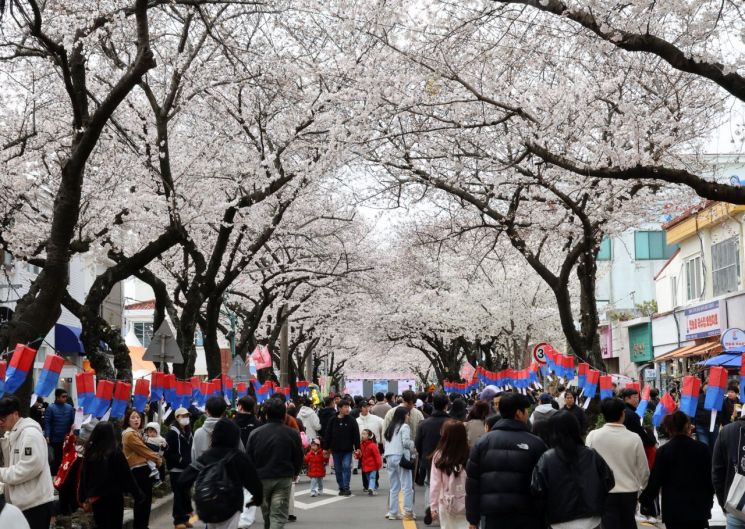
Addressing negative perceptions, such as excessive pricing, is also an important task. Jeju, Korea’s representative tourist destination, faced public criticism this year after reports of price gouging by some street vendors at the Jeonnong-ro Cherry Blossom Festival spread online. As Jeju’s image suffered, Jeju Governor Oh Younghoon announced plans to introduce recommended prices by industry and establish a system for reporting price complaints. Governor Oh stated, "Complaints about high prices and unfriendly service are repeatedly raised among tourists visiting Jeju," adding, "We will establish a price complaint reporting system through a tourism inconvenience reporting center." Other tasks to enhance the value of regional tourist destinations include providing convenient transportation infrastructure to reduce the burden of traveling to local areas and expanding the supply of high-quality accommodations.
© The Asia Business Daily(www.asiae.co.kr). All rights reserved.