Growing Concerns Over Trump's Actions
Dollar Value Down 8.83% Year-to-Date
Threat to Dismiss Powell Raises Fears of Further Decline
The fallout from U.S. President Donald Trump's unrestrained economic policies has resulted in aftershocks in the form of "dollar selling pressure." Although the Trump administration shifted course on April 2, moving to a 90-day grace period following the implementation of reciprocal tariffs, persistent doubts regarding U.S. assets?including U.S. Treasury bonds?have continued to influence the market. As global capital, which had supported the strong dollar trend, moved toward Europe and Japan, demand for the dollar declined. Additionally, concerns have emerged that the value of the dollar could be irreparably damaged after President Trump suggested the possibility of dismissing Federal Reserve Chair Jerome Powell.
Dollar Value Down 8.83% Year-to-Date
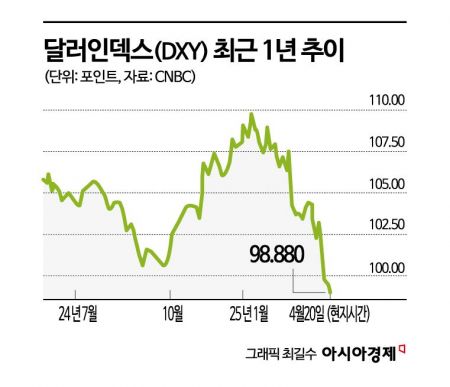
According to U.S. financial media outlet CNBC, the Dollar Index (DXY)?which measures the value of the U.S. dollar against six major currencies, including the euro?stood at 98.85 as of 7:46 p.m. on the 20th (local time), down 0.53% from the previous session. This is the lowest level in the past year, with a year-to-date decline of 8.83%. This drop exceeds the negative 8.5% decline reported on the 16th, which was described as the worst in 40 years.
The fundamental cause of the dollar's weakness is distrust toward the Trump administration and the accompanying outflow of global capital from the United States. Japan's Nikkei newspaper assessed that the keyword "decentralizing from the U.S." has emerged as a symbol of the magnitude of dollar selling pressure. Analyses point to President Trump's tariff policies and concerns over a U.S. economic slowdown as triggers. Citigroup in the United States also predicted a weak dollar in its global asset allocation report released on the 17th, stating, "The dollar will continue to fall due to structural capital outflows from U.S. assets."
In the U.S. Treasury market, which is valued at $29 trillion (about 4,000 trillion won), signs of a pullout by China?the second-largest holder?have been detected. Lillian Tao, Head of China Macro and Global Emerging Market Sales at Deutsche Bank, said in an interview with Bloomberg on the 18th, "Some Chinese investors are diversifying their portfolios away from U.S. assets," adding, "There is growing interest in other markets, especially those in Europe."
Europe and Japan as Investment Alternatives... Unstable Moves by Trump
Capital leaving the United States has rapidly flowed into Europe and Japan. According to research firm EPFR, in the week ending April 16, U.S. equity funds saw a net outflow of $5.7 billion (8.1168 trillion won), while European equity funds recorded a net inflow of $6 billion (8.544 trillion won). This is the largest weekly net inflow so far this year. It can be inferred that demand for currency exchange for investment purposes has increased. Nikkei analyzed that this has contributed to the strength of European currencies such as the euro and Swiss franc.
Japan has similarly benefited. During the same period, Japanese equity funds also saw inflows exceeding $2 billion (2.837 trillion won). The yen has also shown relative strength. The Trump administration, which is negotiating tariffs with global trading partners, is attempting to shift away from a strong dollar policy. This has created upward pressure on the yen and downward pressure on the dollar. For example, in the New York foreign exchange market on the 18th, the dollar-yen exchange rate closed at 142 yen per dollar. The rate, which was at 158 yen on January 8, has fallen by about 10% so far this year. This decline in the exchange rate indicates a strengthening of the yen.
The bigger issue is the instability of President Trump, who is the main figure behind the damage to the dollar's value. U.S. news agencies such as Reuters have reported that President Trump is considering dismissing Fed Chair Powell, who has been critical of his policies. On April 17, Trump hinted at Powell's dismissal via his own social media platform, Truth Social. Kevin Hassett, Chairman of the White House National Economic Council (NEC), is also reportedly reviewing whether the president can legally dismiss the Fed chair.
French Finance Minister Eric Lombard warned that if President Trump were to dismiss Powell, the credibility of the U.S. dollar and the stability of the U.S. economy would be severely undermined. In an interview with the French daily newspaper La Tribune Dimanche, he stated, "President Trump's aggressive tariff policies have already damaged the credibility of the dollar, and dismissing Chair Powell would further erode that trust."
© The Asia Business Daily(www.asiae.co.kr). All rights reserved.

















