One Year of Collaboration with UCSD and Seetree
11,046 Corals Planted and 10,705 Square Meters Restored
Development of Galaxy "Ocean Mode" to Support Activities
17 3D Coral Reef Restoration Maps Created
Recycled Plastic from Discarded Fishing Nets Applied
On April 21, Samsung Electronics announced the one-year achievements of its marine ecosystem restoration project, "Coral in Focus," which utilizes Galaxy camera technology.
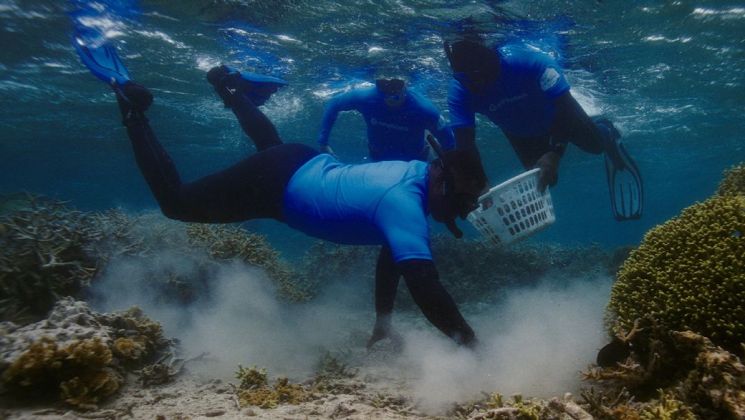 Samsung Electronics planting coral reefs for the marine ecosystem restoration project "Coral in Focus," which utilizes Galaxy camera technology to protect the ocean. Photo by Samsung Electronics
Since last year, Samsung Electronics has been conducting a coral reef restoration project in collaboration with the Scripps Institution of Oceanography at the University of California, San Diego (UCSD), and the U.S. nonprofit organization Seetree. Scripps, established in 1903, is a specialized marine research institute. Seetree, founded in 2011 to protect the marine environment and ecosystem, collaborates with various local organizations in the United States, Mexico, Kenya, Indonesia, Australia, and other regions to carry out diverse activities for the protection of marine and aquatic plants.
The "Coral in Focus" project involves photographing coral reefs with Galaxy smartphones in key habitats where destruction has recently become severe, such as Florida in the United States, Bali in Indonesia, and Viti Levu Island in Fiji. These photos are used to monitor the current state of the coral reefs and contribute to restoration efforts.
Samsung Electronics has recycled discarded fishing nets?either expired or abandoned in the ocean?into precision smartphone component materials, first applying this material to the Galaxy S22 series. Since then, the company has expanded the use of these materials to a variety of Galaxy products, including tablets, PCs, and wearables. Taking it a step further, Samsung continues its technological innovation efforts for marine ecosystem restoration through the coral reef restoration project.
For this project, Samsung Electronics also developed "Ocean Mode," a camera mode for Galaxy smartphones optimized for underwater photography of coral reefs. As a result, local organizations are using Galaxy S24 Ultra devices equipped with this mode to photograph coral reefs in their respective regions.
Previously, underwater photography required divers to carry large cameras with additional equipment, making it difficult to take pictures due to complicated controls and limited mobility. With the support of Galaxy's Ocean Mode, research has become much easier. The lightweight and slim design allows divers to descend up to 10 meters below the surface and enables close-up shots of coral reefs. The coral reef photos taken in Ocean Mode are sent to the Scripps Institution, where a total of 17 3D coral reef restoration maps have been created, forming the foundation for coral colony regeneration. In addition, by monitoring the underwater ecosystem, a total of 11,046 new coral reefs have been planted, and 10,705 square meters of coral reef area?equivalent to 25 basketball courts?have been restored in the ocean.
The photos are also being used in various research initiatives and restoration projects led by local organizations. Local activists, using Samsung's Ocean Mode, are able to reduce excessive blue tones that occur during underwater photography, capture the true colors of coral reefs, and minimize motion blur in photos thanks to optimized shutter speed and multi-frame video processing technology. Furthermore, the interval function enables the capture of thousands of high-quality coral reef photos at once.
Coral reefs provide essential habitats for marine life and play a crucial role in protecting the marine environment and supporting carbon cycling. Coral reef restoration is vital to ensuring the sustainability of marine ecosystems.
© The Asia Business Daily(www.asiae.co.kr). All rights reserved.

















