KAIST announced on April 21 that a research team led by Professor Lee Jeongho from the Graduate School of Medical Science and Engineering has, for the first time in the world, identified the 'precancerous cell' that is the origin of glioblastoma evolution, recurrence, and therapeutic resistance.

Glioblastoma is a representative malignant brain tumor known for its aggressive nature and poor prognosis. Even after standard treatments such as extensive brain resection, the disease is known to recur in most cases within one year, resulting in a very low survival rate.
In 2018, the research team was the first to reveal that glioblastoma originates from mutant stem cells located deep within the brain, and their findings were published in the journal Nature.
The focus of the current study was to determine the origin of the 'precancerous cell,' which acts as the seed of cancer, and to elucidate how the cell of origin with mutations differentiates.
During the research process, the team discovered that precancerous cells serve as the central axis for cancer recurrence by generating various subtypes of cancer cells within the tumor.
In malignant brain tumors like glioblastoma, cancer cells coexist in highly diverse forms, and each cancer cell responds differently to treatment. This phenomenon is referred to as 'intratumoral heterogeneity.' Such heterogeneity is considered the greatest obstacle to the treatment of glioblastoma.
The significance of the team's research lies in being the first in the world to reveal that precancerous cells are the root cause of intratumoral heterogeneity.
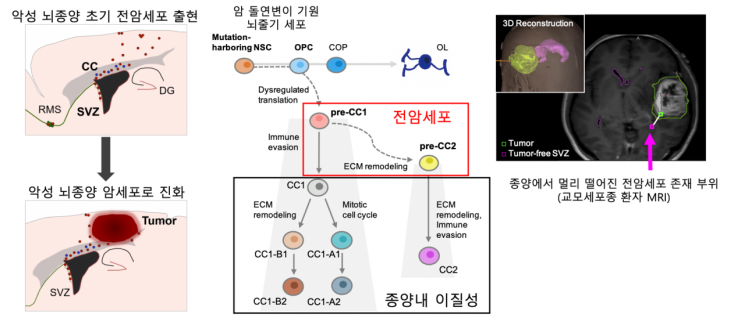 A schematic diagram illustrating the process in which brain stem cells with tumor mutations differentiate into precancerous cells, playing a key role in the evolution, recurrence, and intratumoral heterogeneity formation of glioblastoma. Provided by KAIST
The research team expects that this study will lay the foundation for a new therapeutic paradigm that targets precancerous cells in glioblastoma to effectively suppress cancer evolution and recurrence.
This approach is evaluated as a shift from conventional therapies targeting cancer cells themselves, enabling precision and personalized treatment by proactively eliminating precancerous cells, which are the root of malignant brain tumors, to prevent cancer evolution and recurrence.
Dr. Kim Hyunjung, the sole first author of the paper from the KAIST Graduate School of Medical Science and Engineering and currently a professor at Korea University College of Medicine, stated, "Precancerous cells are like the 'seeds of cancer heterogeneity' that drive tumors to evolve into more complex and aggressive forms. Understanding and targeting the characteristics of these precancerous cells could be the key to fundamentally overcoming glioblastoma."
This research was supported by the National Research Foundation of Korea, the Suh Kyungbae Science Foundation, and others. The results were published on April 16 in Cancer Discovery, a leading international journal in the field of oncology.
© The Asia Business Daily(www.asiae.co.kr). All rights reserved.


















