Impact of China's Rare Earth Export Controls
Extends Beyond Automobiles to Medical Fields
As the Chinese government has moved to control rare earth exports in response to the "tariff bomb" imposed by the Trump administration, major international media outlets have predicted that the impact will extend beyond automobile manufacturing to include fields such as cancer treatment and other areas of medicine.
On April 20, major foreign media outlets such as The New York Times (NYT) and The Washington Post (WP) warned that China's rare earth export controls could cause problems across various industrial sectors.
On April 4, the Chinese government announced that it would impose export controls on seven types of domestically produced medium and heavy rare earths and rare earth magnets, in retaliation for President Trump's announcement of reciprocal tariffs. The seven items include samarium, used in cobalt magnets; gadolinium, used as a contrast agent; terbium, a raw material for phosphors; dysprosium, added to magnets for motors and electric vehicles; lutetium, used in radiation therapy; scandium, used in aluminum alloys for aircraft parts; and yttrium, used in the manufacture of solid-state lasers.
China has mandated that special export permits be obtained for these items before they can be shipped abroad. This process can take up to 45 days and applies not only to the United States but also to other countries. The NYT reported that China has not yet established a system for issuing rare earth export permits, effectively halting exports. Notably, it is known that 90% of rare earth-containing magnets used in electric vehicle motors are produced in China.
In a recent report, the NYT stated, "If powerful rare earth magnets run out at factories in Detroit and other regions, it may become impossible to assemble cars and other products that require electric motors using these magnets," adding, "Because the size of emergency inventories held by each company varies greatly, it is difficult to predict when production disruptions might occur."
There is also analysis suggesting that the supply chain for rare earths needed in the medical sector will be affected. The WP reported, "If Americans suffering from brain tumors, liver cancer, or heart attacks lose access to rare earth minerals used in healthcare due to the trade war, medical services could be interrupted." This is because the rare earths used for cancer treatment and magnetic resonance imaging (MRI) scans are also subject to the latest Chinese export controls.
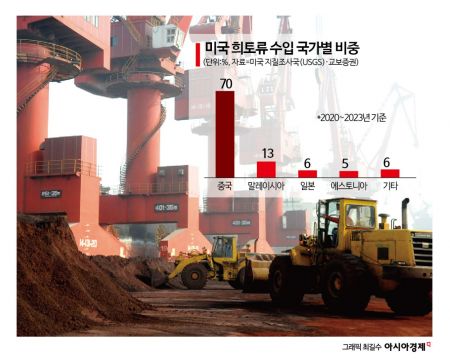
Citing experts, the WP stated, "Rare earth elements are essential to many medical technologies used not only for diagnosis but also for treatment," and "ultimately, this affects the ability to receive cancer treatment and diagnosis." The same applies to lutetium, used in radiation therapy, and yttrium, used in medical devices such as lasers that shrink tumors. According to the United States Geological Survey, 93% of yttrium compounds imported by the U.S. between 2020 and 2023 were sourced from China.
© The Asia Business Daily(www.asiae.co.kr). All rights reserved.


















