Ministry of Environment Considers Subsidies for Converting Internal Combustion Motorcycles to Electric
Significant Benefits: Reduction in Greenhouse Gases, Air Pollutants, and Exhaust Noise
Indonesia Offers 850,000 Won Support for Conversion
Short Driving Range Remains a Limitation... "Will Continue to Review"
The Ministry of Environment has announced that it will consider providing subsidies for converting internal combustion engine motorcycles to electric motorcycles, following its existing subsidy programs for forklifts and 1-ton trucks.
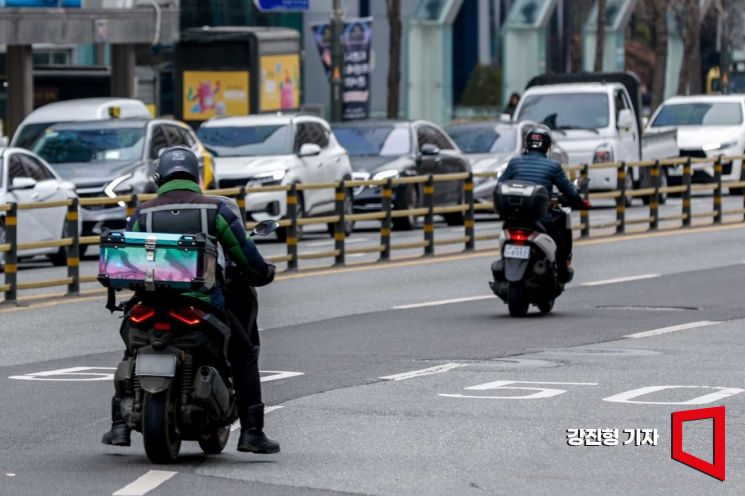
According to the government on April 20, the Ministry of Environment has begun a feasibility study, including an economic analysis, on policies to convert (electrify) internal combustion engine two-wheeled vehicles. The ministry also plans to carry out pilot projects to convert small- and medium-sized internal combustion engine motorcycles, which are widely used for business and delivery purposes, into electric motorcycles with maximum rated outputs of 4kW and 7kW.
With online ordering, such as food delivery, becoming a part of daily life, the number of two-wheeled vehicles has also increased significantly. The number of registered two-wheeled vehicles nationwide rose from 2,097,143 in March 2013 to 2,319,194 in July 2021, during the height of the COVID-19 pandemic, before slightly decreasing to 2,244,680 as of March this year.
The government has been promoting policies to distribute electric two-wheeled vehicles, including providing purchase subsidies, to improve air quality and reduce greenhouse gas emissions. However, it is reported that the results have not met expectations. Since motorcycles frequently travel through narrow alleys, the benefits of electrification are expected to be even more pronounced. In addition to reducing greenhouse gas and air pollutant emissions, electrification would also eliminate exhaust noise.
There are reportedly still few cases of government support for electrifying internal combustion engine two-wheeled vehicles. In Indonesia, the number of internal combustion engine motorcycles converted with subsidy support increased 7.7 times, from 145 in 2023 to 1,111 in 2024. Furthermore, some analysts suggest that if the domestic market is expanded with government support, there may be opportunities to enter overseas markets, such as Southeast Asia, where two-wheeled vehicles are a primary mode of transportation. Market research firm Precedence Research projects that the global electric two-wheeled vehicle market will grow to $61.73 billion (approximately 87.5948 trillion won) by 2034.
However, the main reason electric two-wheeled vehicles have not become widespread is cited as their "short driving range relative to charging time." The typical driving range per charge for an electric motorcycle is about 70 to 80 kilometers. This is insufficient for delivery riders who travel more than 100 kilometers per day. According to a report titled "Development of Digital Electric Two-Wheeled Vehicles for Collecting Various Urban Information and Reducing Vehicle-to-Vehicle Accidents," commissioned by the Korea Agency for Infrastructure Technology Advancement under the Ministry of Land, Infrastructure and Transport in May last year, the average daily driving distance for full-time delivery riders was about 108 kilometers.
An official from the Ministry of Environment stated, "We believe there is economic feasibility in converting internal combustion engine two-wheeled vehicles to electric two-wheeled vehicles," adding, "We will continue to review technical limitations and other factors."
© The Asia Business Daily(www.asiae.co.kr). All rights reserved.
!["The Woman Who Threw Herself into the Water Clutching a Stolen Dior Bag"...A Grotesque Success Story That Shakes the Korean Psyche [Slate]](https://cwcontent.asiae.co.kr/asiaresize/183/2026021902243444107_1771435474.jpg)
















