"Choosing the Humanities Track for Lower Admission Cutoffs Even at the Same School"
Strategies of Mid- and Lower-Tier Students
While the trend of top-performing students favoring medical schools has continued to drive a concentration in the natural sciences track, it has been found that the number of third-year high school students choosing the humanities track has increased this year. This is interpreted as a new strategy by mid-tier students who feel pressured by the dominance of high-performing students in the natural sciences.
Jongro Academy analyzed the results of the "March National Unified Academic Assessment" held on March 26 and released its findings on April 20. The March assessment is an exam administered by the Office of Education and serves as the first nationwide mock exam of the year for third-year high school students.
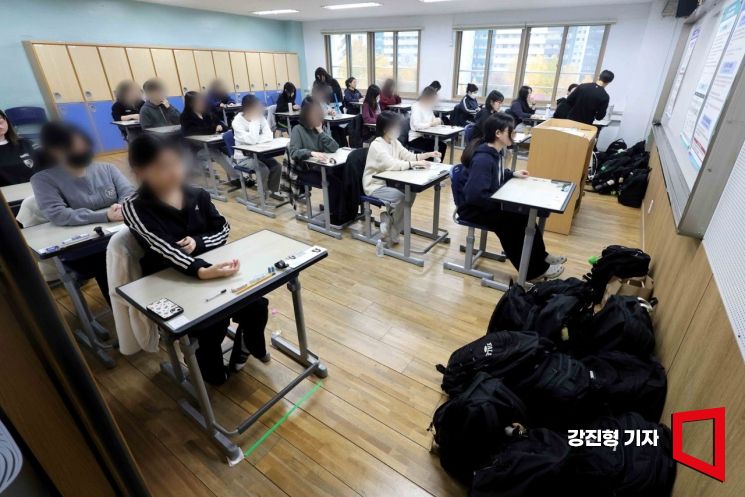 Examinees are waiting for the exam to start at Yeouido Girls' High School in Yeongdeungpo-gu, Seoul. Photo by Joint Press Corps
The percentage of students taking Probability and Statistics, a subject mainly chosen by humanities-track students, was 59.5%. This is an increase of 5.6 percentage points from 53.9% the previous year. In contrast, the percentage of students taking Calculus and Geometry, subjects mainly chosen by natural sciences-track students, dropped by 5.6 percentage points from 46.1% to 40.5%. This is the first time since the introduction of the integrated college entrance exam in the 2022 academic year that the Calculus and Geometry participation rate in the March Office of Education assessment has fallen compared to the previous year.
A similar trend was observed in Korean language subjects. The proportion of students taking Language and Media, a subject mainly selected by natural sciences-track students, decreased by 3.6 percentage points from 37.4% last year to 33.8% this year. Meanwhile, the percentage of students taking Speech and Media increased from 62.6% last year to 66.2% this year.
Jongro Academy explained, "Based on the participation rates for mathematics and Korean language elective subjects, it is interpreted that the number of natural sciences-track students has unusually decreased, while the number of humanities-track students has increased."
In the social studies section as well, the participation rate for social studies reached 64.6%, the highest since the introduction of the integrated college entrance exam in the 2022 academic year. The participation rates for social studies in the March academic assessment were 56.2% in 2022, 54.7% in 2023, 52.8% in 2024, and 55.1% in 2025. Jongro Academy analyzed that the increase in the proportion of students taking social studies was due both to the rise in the number of humanities-track students and to a significant increase in the so-called "satan-run" phenomenon, where natural sciences-track students also take social studies subjects.
The total number of examinees for the nine social studies subjects increased by 98,976. The number of students taking "Society and Culture" increased by 46,083 compared to last year, marking the largest increase. In addition, all nine subjects, including "Life and Ethics" (up by 23,616) and "World Geography" (up by 7,743), saw an increase in examinees compared to last year. In contrast, the number of examinees for the four science subjects decreased by 38,979. The March academic assessment does not include Science II subjects.
Jongro Academy stated, "The increase in humanities-track students is presumed to be because the recent preference for medical schools has led top-performing students to concentrate in the natural sciences track, and the admission cutoffs for universities in Seoul are higher for natural sciences than for humanities, causing mid- and lower-tier natural sciences students to switch to the humanities track." The academy added, "With the increase in humanities-track students, they may have a slight advantage in the college entrance exam, while natural sciences-track students are at a disadvantage due to the decrease in examinee numbers. If, in the future, the number of science subject examinees decreases even more significantly as repeat test-takers join the pool, science subjects could become a major variable in the college admissions process."
© The Asia Business Daily(www.asiae.co.kr). All rights reserved.

















