SME Loan Market Share Hits 24.18% in Q1
Up 0.53 Percentage Points from Last Year
Commercial Banks See Decline
Impacts from Tariff War, Exchange Rate, and Economic Downturn
IBK to Strengthen SME Funding This Year
Due to the tariff war and exchange rate volatility, IBK Industrial Bank of Korea's market share (MS) in small and medium-sized enterprise (SME) loans reached an all-time high in the first quarter of this year.
According to IBK on April 21, the bank's SME loan MS for the first quarter of this year was 24.18%. This figure is 0.53 percentage points higher than at the end of last year (23.65%).
IBK's outstanding balance of SME loans in the first quarter stood at 252.4936 trillion won, marking a 2.14% increase (5.3015 trillion won) compared to the end of last year (247.1921 trillion won). In contrast, the combined outstanding balance of SME loans at the four major commercial banks (KB Kookmin, Shinhan, Hana, and Woori) was 540.7312 trillion won in the first quarter of this year, down 0.23% from last year (542.0091 trillion won).
The reason IBK can actively expand SME lending is due to its identity as a state-run bank. Under the Industrial Bank of Korea Act, IBK is required to allocate at least 70% of its total loans to SMEs. Last year, the proportion of SME loans exceeded 80%. If the tariff war continues for an extended period, IBK's share of SME loans this year is expected to increase compared to last year.
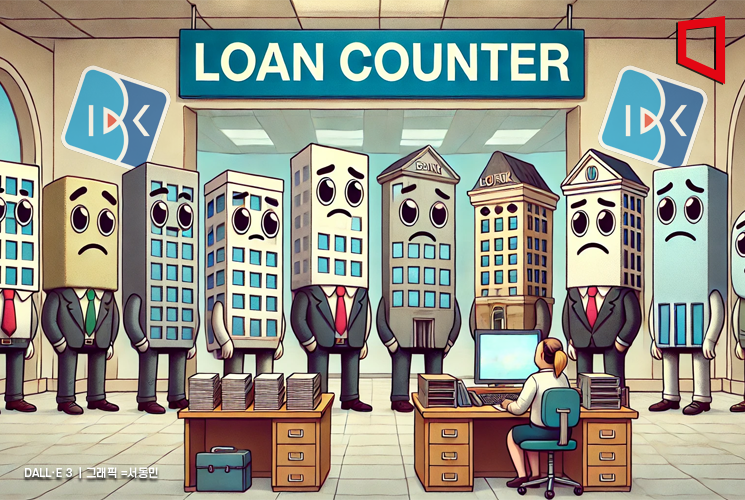
Commercial banks also wish to expand SME lending, but the situation is not favorable. They have had no choice but to strengthen asset quality management since last year's emergency martial law situation. From December of last year to early April of this year, domestic political uncertainty and the tariff war caused the won-dollar exchange rate to surge, which in turn increased the won-converted value of foreign currency-denominated assets such as foreign currency liabilities. As a result, capital ratios fell, and commercial banks became more cautious about corporate lending in order to maintain soundness.
According to the Bank for International Settlements (BIS), the risk-weighted asset (RWA) weighting varies depending on the assets held by a bank. For safe government bonds, the risk weight is set at 0%, but for home mortgage loans secured by apartments, it rises to 35%. The risk weights for stocks, foreign currency liabilities, and corporate loans are even higher. In particular, for companies with low credit ratings, the risk weight can exceed 150%. This is why commercial banks tend to focus on lending to large corporations, which are considered to have relatively lower risk.
A bank official explained, "In order to manage the Common Equity Tier 1 (CET1) ratio, we need to reduce risk-weighted assets, so we have no choice but to be more flexible with corporate lending compared to state-run banks."
IBK plans to increase financial support for SMEs this year. This is because an economic downturn is inevitable, and external variables such as the tariff war are expected to further exacerbate the difficulties faced by companies.
An IBK official stated, "We plan to monitor the economic situation in real time, identify sectors and industries vulnerable to foreign exchange risk and asset quality issues, and develop customized support measures for each company through special inspections."
© The Asia Business Daily(www.asiae.co.kr). All rights reserved.


















