A pilot project that enables immediate reporting to the fire department when signs of fire are detected in electric vehicle batteries will begin on April 21. The initiative will target 40,000 electric vehicles from Hyundai, Kia, BMW, and MINI, which are among the most widely sold models in Korea.
On April 20, the Ministry of Land, Infrastructure and Transport announced that it will launch the pilot project for detecting abnormalities in electric vehicle batteries and reporting fires, in cooperation with the National Fire Agency, Korea Transportation Safety Authority, and major manufacturers and importers. The project aims to establish a detection and reporting system that allows for rapid notification to the National Fire Agency when a potential fire situation is detected.
The vehicles included in the pilot are 10,000 units each of the Hyundai IONIQ 5 and Kia EV6, and 20,000 units of BMW (seven models including the iX1) and MINI (three models including the MINI Cooper). The ministry plans to gradually expand the pilot project by including additional manufacturers and vehicle models.
The vehicles selected for this pilot project are equipped with a Battery Management System (BMS) that enables battery status monitoring and communication alerts while parked. Vehicle owners must consent to the provision of their personal and location information to third parties, including fire-related agencies.
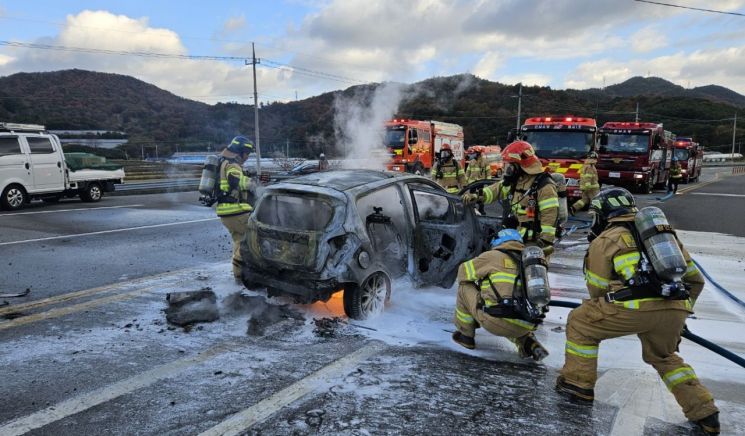
The high-voltage battery status is automatically monitored in all situations, including driving, charging, and parking. If signs of fire are detected, the system is set up to automatically notify the customer service center, which will then report the situation by phone to the local fire station.
When the fire station receives a report, information such as the vehicle owner's contact details, vehicle model, license plate number, and location is provided, enabling 119 firefighters to be dispatched quickly and establish a system for effective fire suppression. The vehicle owner is also notified of the risk situation by phone and text message at the time of reporting.
Based on the data collected during the pilot period, the National Fire Agency and automobile manufacturers have agreed to continuously update relevant manuals. This is intended to ensure a more systematic response in the field. Various scenarios, including special cases where the battery does not catch fire even after dispatch, will be incorporated.
The Ministry of Land, Infrastructure and Transport and the Korea Transportation Safety Authority also plan to analyze the empirical data and use it to help establish international safety standards for electric vehicles. Kim Hongmok, Director of the Mobility and Automotive Policy Division at the Ministry of Land, Infrastructure and Transport, stated, "We will work to establish a rapid response system for electric vehicle fires and enhance the speed and accuracy of reporting to alleviate public concerns."
© The Asia Business Daily(www.asiae.co.kr). All rights reserved.
![Clutching a Stolen Dior Bag, Saying "I Hate Being Poor but Real"... The Grotesque Con of a "Human Knockoff" [Slate]](https://cwcontent.asiae.co.kr/asiaresize/183/2026021902243444107_1771435474.jpg)
















