Operation of Pediatric Intensive Care Unit and Introduction of Infection Control Facilities
Ttuntun Children's Hospital in Uijeongbu has launched an emergency pediatric care system to treat pediatric emergency and semi-critical patients in response to the collapse of the pediatric medical system.
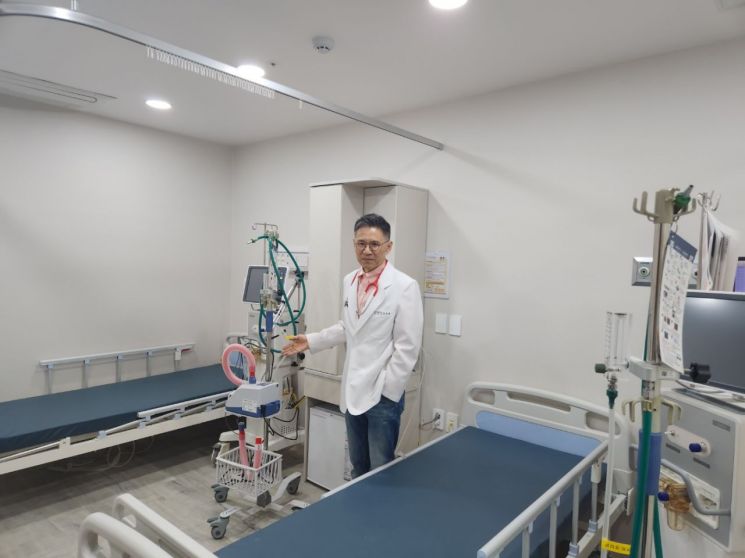 Choi Yongjae, director of Ttuntun Children's Hospital, is introducing the newly established pediatric intensive care unit inside Ttuntun Children's Hospital in Uijeongbu, Gyeonggi Province on the 18th. Ttuntun Children's Hospital
Choi Yongjae, director of Ttuntun Children's Hospital and president of the Korean Pediatric and Adolescent Hospital Association, announced this at a press conference held at Ttuntun Children's Hospital in Uijeongbu, Gyeonggi Province on the 18th. The emergency pediatric care system established by Ttuntun Children's Hospital consists of a pediatric intensive care unit and a system to completely block in-hospital infections caused by outbreaks of pediatric infectious diseases. This system is designed to treat pediatric emergency and semi-critical patients.
Director Choi stated, "In emergency situations, it is common for us to spend hours on the phone trying to transfer patients to higher-level hospitals, only to be told in most cases that transfers are not possible. As this situation repeats itself, children's lives are put at risk during the wait. As a last resort, we have set up a pediatric intensive care unit with three beds equipped with high-flow oxygen therapy devices and ventilators on the third floor of the hospital."
He added, "Various pediatric infectious diseases such as influenza, mycoplasma pneumonia, and lobar pneumonia continue to occur in succession. To address concerns from patients' guardians about in-hospital infections and related complaints, we have installed state-of-the-art air purification systems using a total heat exchange method in all hospital rooms."
A precision medicine center has also been established to manage chronic diseases in children and adolescents. It is known that the longer pediatric chronic diseases persist, the higher the risk of complications such as heart disease and precocious puberty, and they can also lead to issues such as short stature and depression. The precision medicine center plans to manage pediatric chronic diseases such as obesity, hyperlipidemia, and type 2 diabetes?which have previously been treated as individual conditions?as integrated diseases.
Director Choi emphasized, "Although the establishment of the pediatric intensive care unit was done without any government support, it is an emergency measure to protect the lives of our precious children from the deteriorating medical and treatment environment caused by the collapse of the pediatric medical system. Even now, when a pediatric emergency patient arises, it is heartbreaking to receive messages that transfers to higher-level hospitals are not possible. Strong government measures are absolutely necessary."
He further stressed, "It is obvious that pediatric and adolescent hospitals without any government support are operating at a loss. Running a pediatric intensive care unit to care for pediatric emergency patients in such circumstances is a temporary measure driven by our sense of duty as a pediatric and adolescent medical institution and our commitment to filling the long-standing gap in pediatric healthcare. I hope that this reality will be recognized and that appropriate measures will be taken without neglect."
© The Asia Business Daily(www.asiae.co.kr). All rights reserved.

















