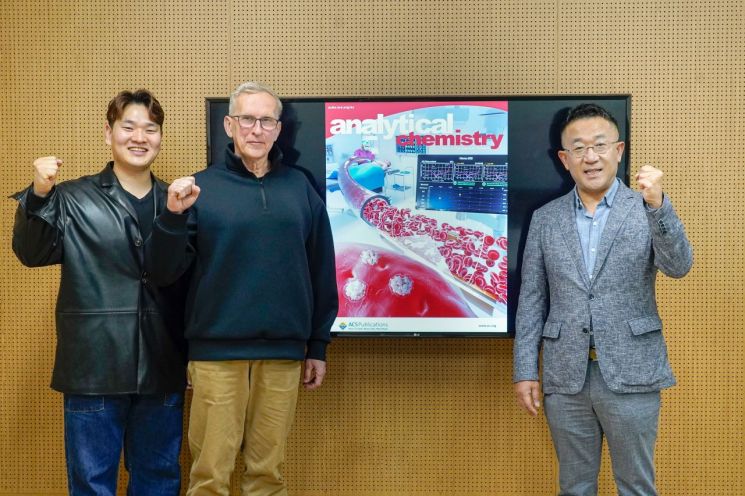
A technology has been developed that can measure and analyze the genetic characteristics of blood components in real time, enabling highly precise results.
On April 18, the Gwangju Institute of Science and Technology (GIST) announced that the research team led by Professor Yang Sung of the Department of Mechanical Robotics Engineering has developed a new sensor technology capable of analyzing the arrangement of red blood cells and the hydration structure of hemoglobin within red blood cells in a flowing blood environment.
This technology combines electrochemical impedance spectroscopy (EIS) with microfluidic technology, making it possible to precisely measure the alignment of red blood cells and the internal water structure of cells while actual blood is flowing.
Conventional blood component analysis methods use stationary blood as a sample, which leads to limitations such as red blood cell aggregation or sedimentation, resulting in reduced measurement accuracy.
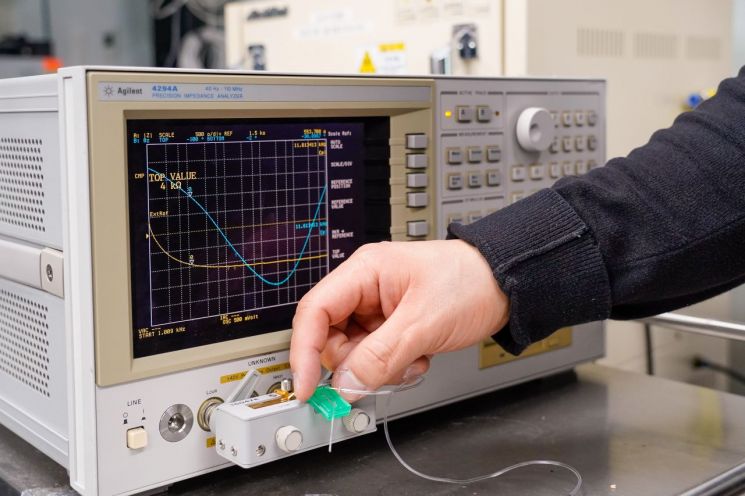 A photo of an electric impedance measurement device equipped with a sensor for extracting blood test indicators, measuring impedance. Photo by GIST
To address these issues, the research team measured blood impedance in a microfluidic channel that simulates real blood flow conditions and analyzed the results by combining them with an effective medium theory that reflects anisotropic dielectric properties.
In particular, by introducing the concept of a 'preferred alignment index' to quantify the arrangement of red blood cells, the analysis revealed that approximately 34% of all red blood cells are aligned in the direction of flow, while the remaining 66% are arranged randomly.
Furthermore, by modeling the interior of red blood cells not as a simple solution but as a hemoglobin colloid with a double hydration shell, the team enabled more precise EIS analysis that takes into account the physical properties inside the cells.
Professor Yang Sung stated, "This research is significant in that it not only measures the impedance of flowing blood, but also presents an analytical method that quantitatively interprets the alignment characteristics of red blood cells and the hydration structure of hemoglobin. We expect it to be widely applicable in various medical fields, including smart healthcare devices and real-time blood analyzers for hospitals."
© The Asia Business Daily(www.asiae.co.kr). All rights reserved.


















