AMCHAM Hosts Energy Innovation Forum in Seoul
U.S. LNG Imports Seen as Alternative Amid Tariff War
At a time when trade uncertainty has been heightened by the "tariff war" initiated by the Trump administration, there are expectations that Korea's increased imports of U.S. liquefied natural gas (LNG) will play a role in strengthening the bilateral trade relationship in a balanced manner. In particular, with the rapid rise in demand for data centers and electricity driven by the development of the artificial intelligence (AI) industry, some analysts suggest that this could also be a positive strategy for Korea in terms of securing renewable energy.
James Kim, Chairman and CEO of the American Chamber of Commerce in Korea (AMCHAM), stated at the Energy Innovation Forum held on the morning of April 18 at the Grand Hyatt Seoul in Yongsan-gu, Seoul, "The energy sector is emerging as a strategic pillar of Korea-U.S. cooperation," and added, "At a time when global uncertainty is deepening, the governments and companies of Korea and the United States must intensify efforts to ease non-tariff barriers, expand cross-border investment, and enhance regulatory alignment."
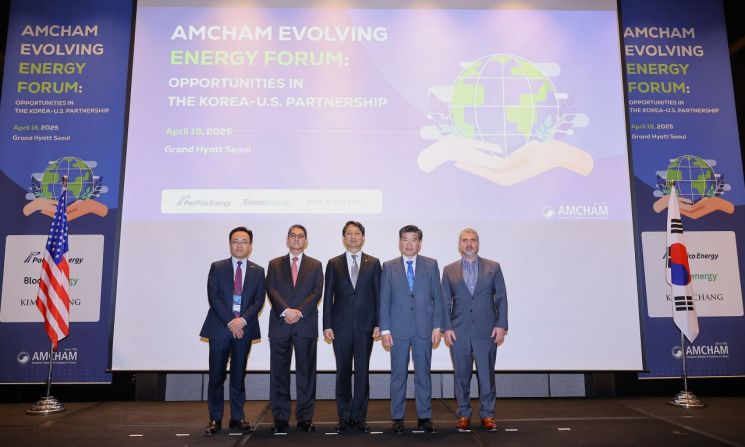 The American Chamber of Commerce in Korea (AMCHAM) held an Energy Innovation Forum on the morning of the 18th at the Grand Hyatt Seoul in Yongsan-gu, Seoul, to discuss Korea-US energy cooperation measures. American Chamber of Commerce in Korea
At the event, discussions took place on changes in global energy policy and other topics under the theme of Korea-U.S. energy industry cooperation. Attendees included Anduk Geun, Minister of Trade, Industry and Energy, while Mike Dunleavy, Governor of Alaska, and Tommy Joyce, Acting Deputy Assistant Secretary for International Affairs at the U.S. Department of Energy (DOE), delivered video messages.
Discussions on strategic cooperation between Korea and the United States focused on the energy sector, particularly renewable energy. This is interpreted in the context of the United States inviting Korea to participate in the Alaska LNG project.
Governor Dunleavy emphasized, "We are not simply exporting gas; we are strengthening our relationship," and added, "I believe the Alaska LNG project will further reinforce the Korea-U.S. partnership." At the end of last month, he visited Korea and met with Acting President and Prime Minister Han Ducksoo and Minister Anduk Geun. He also met with major energy and steel companies such as SK Group, POSCO Group, Hanwha Group, and SeAH Group. However, it is reported that no significant progress has been made with the Korean government or companies regarding the Alaska LNG project.
Minister Anduk Geun stated, "For Korea, which has a high dependence on energy imports, it is extremely important to strengthen close cooperation systems with major countries around the world, including the United States," and added, "Given the deep trust and long-standing partnership between Korea and the United States, I hope that forward-looking cooperation measures will be developed."
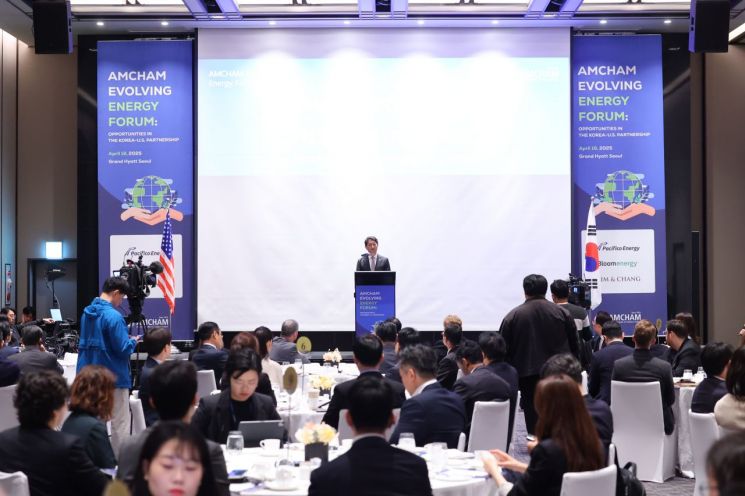 Anduk Geun, Minister of Trade, Industry and Energy, delivered a congratulatory speech at the Energy Innovation Forum hosted by the American Chamber of Commerce in Korea (AMCHAM) on the morning of the 18th at the Grand Hyatt Seoul in Yongsan-gu, Seoul. Photo by American Chamber of Commerce in Korea
According to the Ministry of Trade, Industry and Energy, Korea's energy dependence stands at 94%, with most of its energy being imported. As a result, energy policy is inevitably vulnerable to external factors such as international fuel prices, supply and demand changes, and geopolitical risks.
Cho Ikno, Director of the Energy Policy Division at the Ministry of Trade, Industry and Energy, said, "U.S. energy policy can help Korea's energy security by reducing dependence on specific countries and alleviating import price pressures. However, strategic responses are needed to issues such as possible amendments to the Inflation Reduction Act (IRA) and potential tariff increases."
Tommy Joyce, Acting Deputy Assistant Secretary for International Affairs at the U.S. Department of Energy (DOE), also stressed the importance of supply chain security through energy cooperation. He stated, "Korea-U.S. cooperation will play a key role in building resilient supply chains and ensuring stable and affordable energy access across the Indo-Pacific region." He further added, "The Trump administration aims to export 20 million tons of LNG annually, which represents a fantastic opportunity for Asia."
© The Asia Business Daily(www.asiae.co.kr). All rights reserved.


















