Toward 50 Trillion Won in Cultural Exports
Announcing Region-Specific Pledges
Former Democratic Party leader Lee Jae Myung has begun targeting public sentiment in Daegu and North Gyeongsang (TK) ahead of the Yeongnam region primary scheduled for the 20th. In Daegu, he met with the content industry to present pledges on culture and the arts, as well as policies for the secondary battery industrial belt and the Busan-Ulsan-Gyeongnam (Bu-Ul-Gyeong) megacity region.
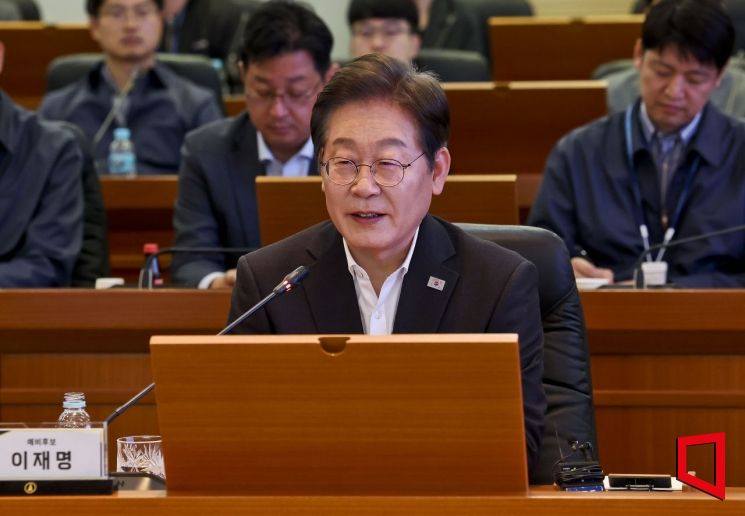 Former Democratic Party leader Lee Jae Myung is speaking at an on-site meeting held on the 17th at the Agency for Defense Development (ADD) in Yuseong District, Daejeon. Photo by the National Assembly Press Photographers Association
On the morning of the 18th, at the Soylab Cooperative in Buk-gu, Daegu, Lee held a roundtable with representatives from the content and webtoon industries, including Naver Webtoon, Kakao Entertainment, and Netflix. During the meeting, he outlined his vision to make Korea a powerhouse in K-content and soft power, and discussed strategies for building a virtuous infrastructure cycle and strengthening self-sufficiency.
On Facebook that day, Lee stated, "We will become a cultural powerhouse and one of the global top five in soft power," adding, "By 2030, we will expand the market size to 300 trillion won and usher in an era of 50 trillion won in cultural exports." He continued, "This year, our cultural budget accounts for only 1.33% of total national expenditure," and pledged, "We will drastically increase it to match the level of a true cultural powerhouse. We will fully support the global expansion of K-food, K-beauty, K-pop, K-drama, and K-webtoon."
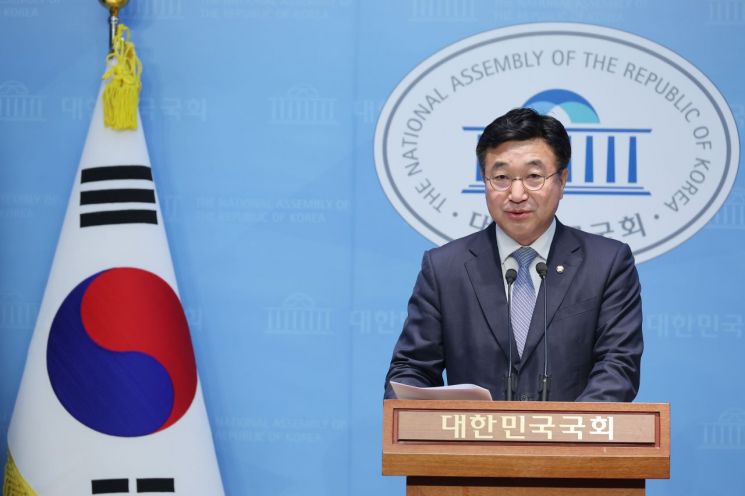 On the 18th, Yoon Hojung, the head of the election committee, is briefing on former Democratic Party leader Lee Jaemyung's pledges related to the Yeongnam region at the National Assembly Communication Office in Yeongdeungpo-gu, Seoul. Photo by Yonhap News
For the Yeongnam region, tailored pledges included the secondary battery industrial belt and the Bu-Ul-Gyeong megacity. Yoon Hojung, head of the election committee, stated during a briefing at the National Assembly Communication Office, "We will reignite the engine of growth to lead a new era of economic development for Korea and a resurgence for Daegu and North Gyeongsang," and added, "We will establish a secondary battery industrial belt and a future-oriented automotive parts cluster." He also promised to create a Korean-style bio and vaccine industry cluster, foster AI robot and hydrogen industries, promote the high value-added textile industry, and push for the integration of Daegu-Gyeongbuk New Airport and Ulleung Airport.
The plan also includes making the Busan-Ulsan-Gyeongnam megacity the maritime capital of Korea. Yoon stated, "To help Korea become a leading maritime nation and to implement field-oriented policies, we will relocate the Ministry of Oceans and Fisheries to Busan. This will strengthen the execution of advanced maritime industry policies, including shipbuilding, logistics, and the development of Arctic routes." He further pledged, "We will attract the headquarters and R&D centers of major domestic and international shipping and logistics companies to form a maritime cluster and create quality jobs favored by young people." Additional pledges included: establishing a land-sea-air 'Triport' forward base; expanding electric and hydrogen vehicle infrastructure; revitalizing the petrochemical industry; making the region a hub for space, aviation, defense, and smart shipbuilding industries; expediting the opening of the double-track railway between Bujeon Station and Masan Station; and constructing the Busan-Yangsan-Ulsan line.
Speaking to reporters that day, Yoon said, "I don't consider the Yeongnam region a weak spot. Centrist voters are discovering Lee Jae Myung and the Democratic Party in a new light," adding, "After this presidential election, it will be clear that the Democratic Party is no longer a weak party in Yeongnam."
© The Asia Business Daily(www.asiae.co.kr). All rights reserved.


















