Capybara Population Triples in Two Years
Residents Report Surge in Complaints
The capybara, an animal popular for its cute appearance, is considered a nuisance in a wealthy neighborhood in Argentina. This is due to a rapid increase in their population, which has led to growing complaints from local residents.
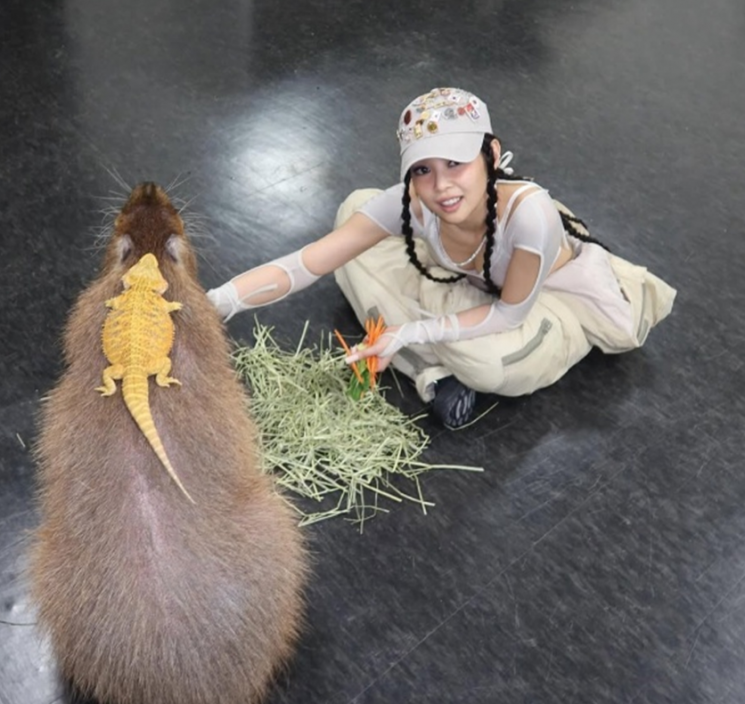 Recently, a capybara appeared in singer Jennie's "Like Jennie" music video, sparking attention. Screenshot from Jennie's Instagram
On the 17th (local time), according to the US daily The New York Times (NYT) and the Argentine daily La Naci?n, Nordelta, a wealthy suburb in the Buenos Aires metropolitan area, recently began a pilot program administering a 'sterilization vaccine' to control the capybara population. This initiative was launched as more frequent appearances of capybaras caused increasing inconvenience to residents in their daily lives.
Capybaras are rodents primarily native to South America. Adult capybaras exceed 1 meter in length and can weigh over 60 kg. Despite their large size, they are known to be gentle and sociable animals, gaining attention for these traits. Goods such as keyrings and dolls modeled after the capybara's appearance are popular among children and teenagers in countries including the United States, Mexico, South Korea, China, and Japan. Recently, they also gained attention by appearing in the music video for singer Jennie's "Like Jennie."
However, in Nordelta, complaints related to capybaras have significantly increased. Groups of capybaras have been involved in fights with dogs and have caused traffic accidents. Additionally, some residents have experienced inconvenience due to capybaras gnawing on their gardens.

The NYT reported, "Biologists estimate that the capybara population in Nordelta has tripled over the past two years, reaching nearly 1,000 animals," adding, "This presents a challenging case study of urban coexistence between humans and wildlife."
After receiving complaints from residents, a real estate development company in Nordelta, with approval from the local government, has hired veterinarians to administer the 'sterilization vaccine' on a trial basis. This company also manages the residential complex, which restricts access to outsiders.
Among residents opposing the sterilization vaccine, there are claims that the root cause of the problem is the destruction of the ecosystem due to the development of Nordelta, which was originally a capybara habitat. Built on the Paran? River wetlands, Nordelta was once home to pumas, jaguars, and caimans, but since the late 1990s, roads, mansions, and shopping centers have been constructed in the area.
Local resident Silvia Soto emphasized that human intervention in animal reproduction is inappropriate, stating, "The cuteness of capybaras is a survival strategy of the species itself, and securing alternative habitats should be the priority."
© The Asia Business Daily(www.asiae.co.kr). All rights reserved.
![Clutching a Stolen Dior Bag, Saying "I Hate Being Poor but Real"... The Grotesque Con of a "Human Knockoff" [Slate]](https://cwcontent.asiae.co.kr/asiaresize/183/2026021902243444107_1771435474.jpg)

















