Expansion of 23 Smart Shade Shelters
Automatic System Operates by Temperature and Wind Speed
Benches Installed to Prevent Heat-Related Illnesses
'Smart Rainwater Drain Management System' Using QR Codes to Be Introduced in the First Half of the Year
Quick Response to Complaints and Long-Term Flood Prevention Measures Expected
According to the Korea Meteorological Administration, the average temperature during last summer in South Korea reached 25.6 degrees Celsius, setting a record high.
With this summer also expected to have higher-than-average temperatures, Gwanak-gu (District Mayor Park Junhee) will expand the installation of 'Smart Shade Shelters' to 23 locations to prevent heat-related illnesses among pedestrians and outdoor travelers.
Last year, the district installed 21 Smart Shade Shelters around crosswalks with heavy foot traffic. In May, an additional 23 Smart Shade Shelters will be installed, bringing the total to 119 shelters in operation.
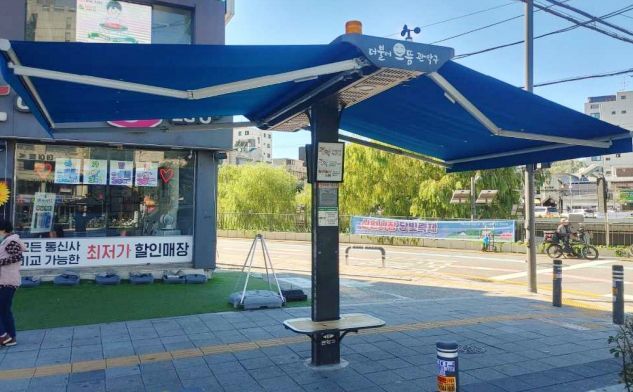
The 'Smart Shade Shelter' system autonomously operates by detecting temperature and wind speed; the shelter unfolds when the temperature exceeds a certain level and folds during strong winds, enabling efficient management based on weather conditions. LED lighting is installed on top of the shelters, contributing to a safe nighttime walking environment.
In particular, the district is focusing on minimizing heatwave damage by installing benches at the bottom of the shelters within areas that do not obstruct pedestrian movement. It is expected that vulnerable groups such as the disabled and elderly, who wait at crosswalk signals during extreme heat, can rest on these benches and prevent heat-related illnesses.
Due to frequent heavy summer rains caused by recent years' abnormal weather patterns, the district plans to establish a 'Smart Rainwater Drain Management System' within the first half of the year.
Out of approximately 27,000 rainwater drains in the area, 1,700 drains located in commercial zones and near subway stations?where complaints frequently occur?will be tagged with QR codes. Residents can easily report issues by scanning these QR codes with their phone cameras and can also check the processing status.
Through this system, the district can accurately identify reported drains and respond promptly to safety incidents and complaints. Additionally, systematic maintenance via the system will allow analysis of 'complaint concentration areas' and 'occurrence periods,' enabling the formulation of long-term flood prevention measures.
District Mayor Park Junhee stated, "The introduction of smart systems is essential to prevent unpredictable disasters and safety accidents," adding, "We will continue to do our best to protect the lives and safety of residents through 'life-centered smart administration' utilizing advanced technologies such as artificial intelligence (AI) and information and communication technology (ICT)."
© The Asia Business Daily(www.asiae.co.kr). All rights reserved.
![Clutching a Stolen Dior Bag, Saying "I Hate Being Poor but Real"... The Grotesque Con of a "Human Knockoff" [Slate]](https://cwcontent.asiae.co.kr/asiaresize/183/2026021902243444107_1771435474.jpg)
















