Competition for Frequencies in a Saturated Sky
Over 12,000 Satellites Currently Orbiting Earth;
More Than 80,000 Expected After 2030
'Launching satellites into a seamless sky.'
This is the reality faced by companies and countries competing in the low Earth orbit (LEO) satellite communication market. Indeed, the era of the Warring States in low Earth orbit satellite communication has begun.
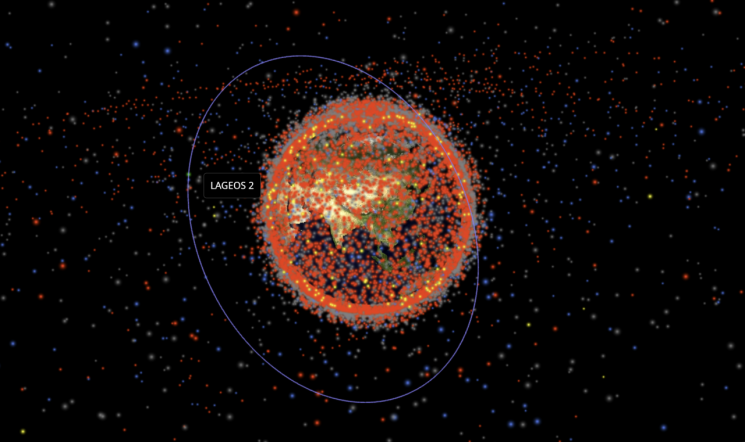 An illustration showing a 3D representation of satellites orbiting the Earth. It includes both satellites and space debris. The blue line indicates the orbit of one satellite. One of the reasons for orbit-decay satellites deviating from their normal orbit or suddenly falling to Earth is collisions with space debris. Provided by Rogue Space Systems.
Representative players include SpaceX's 'Starlink,' which has already established itself as the absolute market leader; Eutelsat OneWeb's 'OneWeb,' which aims to secure global coverage through international cooperation; Telesat's 'Lightspeed'; Amazon's 'Kuiper Project'; and China's government-led 'Guowang (國網) Project.' Additionally, some companies from Korea and Australia are attempting to enter the market through collaboration or component supply.
According to the International Telecommunication Union (ITU), the world is witnessing an unprecedented surge in satellite launches. In particular, the number of low Earth orbit (LEO) satellites has increased tenfold from around 1,000 in 2014 to approximately 10,000 in 2024.
Mario Maniewicz, Director of the ITU Radiocommunication Bureau, stated, "The number of projects submitted to the ITU for low Earth orbit satellite communication over the past decade has increased 5.5 times compared to the previous ten years. This demonstrates the potential of the rapidly growing space economy but also reminds us that we face complexity and challenges."
Number of Satellites Orbiting Earth: 12,166
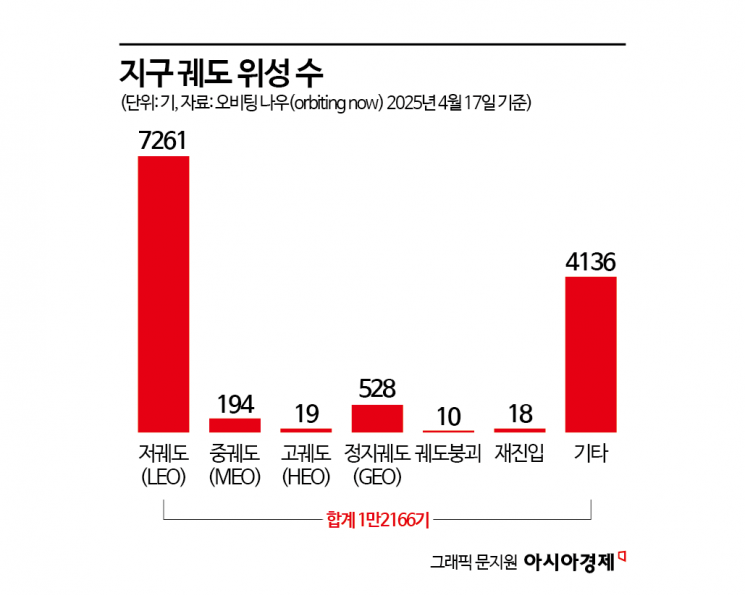
According to the satellite tracking website Orbiting Now, as of the 17th, there are an estimated total of 12,166 satellites operating in Earth's orbit, including 7,261 LEO satellites, 194 medium Earth orbit (MEO) satellites, 19 highly elliptical orbit (HEO) satellites, 528 geostationary orbit (GEO) satellites, and numerous unspecified satellites.
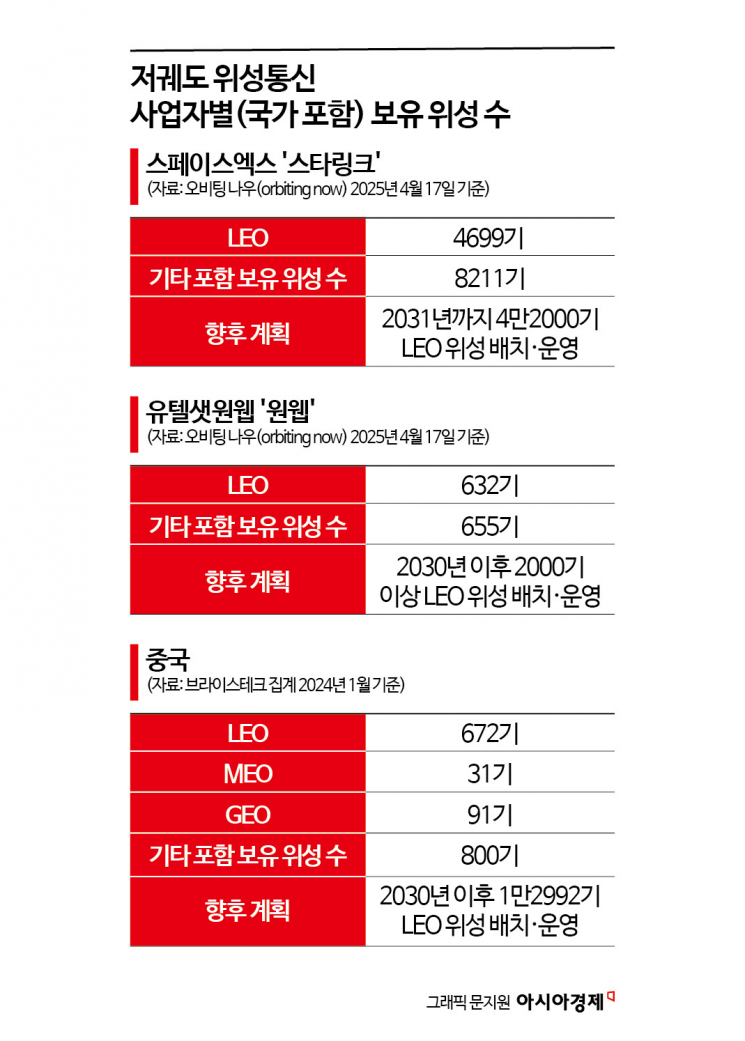
More than half of these are LEO satellites. Starlink has launched 8,211 satellites to date, of which 4,699 are LEO satellites. OneWeb has launched 655 satellites, including 632 LEO satellites.
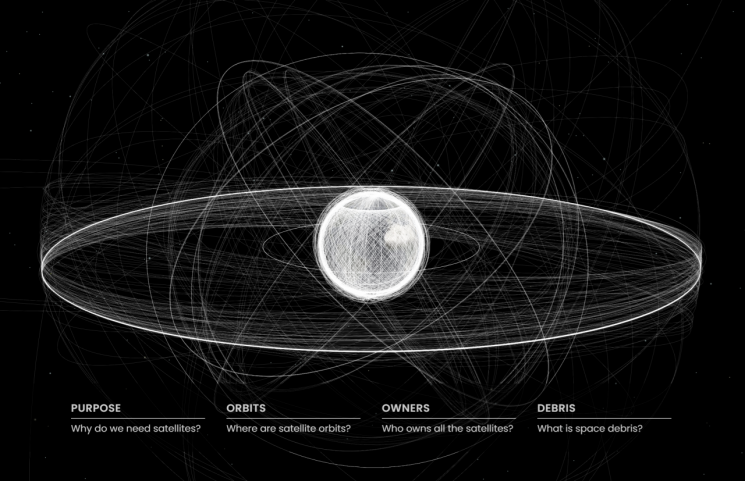 An illustration showing the orbits of satellites orbiting the Earth represented by white lines. All the white lines indicate the orbits of currently operational satellites. The elliptical orbits in high Earth orbit appear to have some space, but the circular orbits in low Earth orbit, which is closer to Earth, show no gaps. New satellites must be launched by finding new orbits through the gaps in these white lines. Provided by the Geo Experience Center at ESRI
Nevertheless, Starlink plans to operate a total of 42,000 LEO satellites by 2031, and OneWeb intends to deploy more than 2,000 additional satellites after 2030.
According to a report released in July last year by Bryce Tech, a U.S.-based space-related new technology consulting firm, China operates a total of 800 satellites as of January last year, including 672 LEO satellites, 31 MEO satellites, 91 GEO satellites, 5 lunar mission satellites, and 1 Mars mission satellite. The Chinese government plans to deploy and operate 12,992 LEO satellites after 2030 under the Guowang Project.
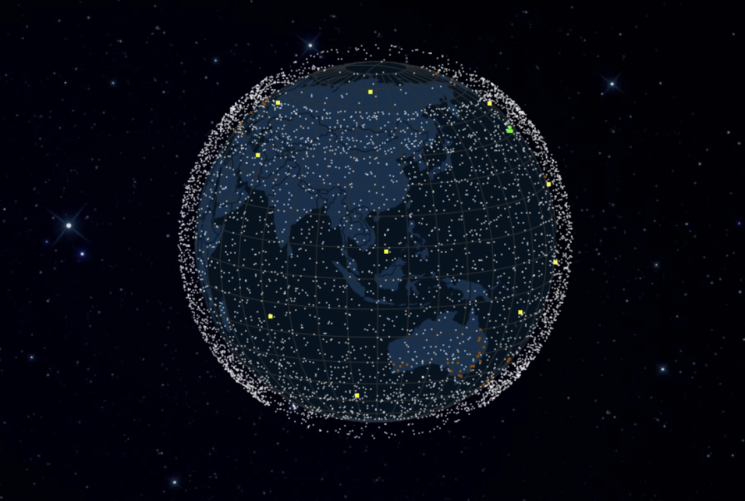 A 3D representation of Starlink's low Earth orbit satellite operations. Provided by SatelliteMap (satellitemap.space).
China Operates a Total of 800 Satellites Including 672 LEO Satellites
Telesat's 'Lightspeed,' which has currently launched 2 satellites, plans to deploy 198 more in the future, while Amazon's 'Kuiper Project' aims to operate 3,236 additional satellites in LEO within 10 years, starting with 2 test satellites.
Alan Chang, an analyst at Goldman Sachs' Greater China Technology Analysis Team, forecasts, "Approximately 70,000 LEO satellites are expected to be launched over the next five years, with about 53,000 of those likely to be launched from China."
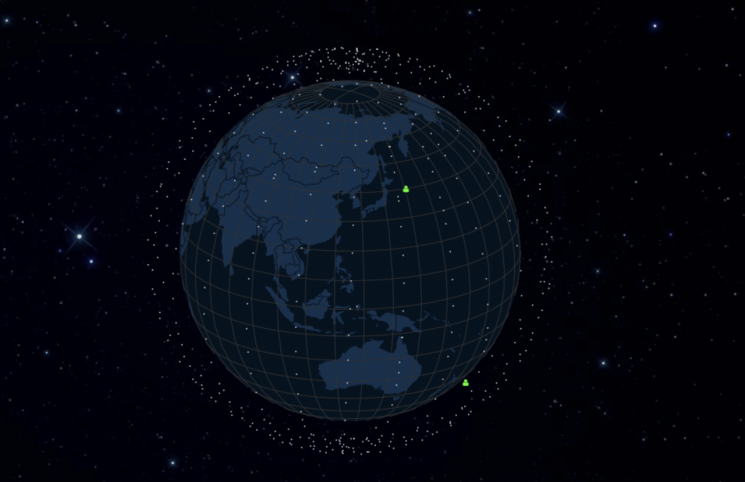 A 3D representation of the low Earth orbit satellite operation status of Utelsat OneWeb's 'OneWeb'. Provided by SatelliteMap (satellitemap.space)
He explained, "Satellite companies tend to believe there is enough space in the sky, but since the best orbits with the most ideal altitudes are limited, satellite companies are rushing to submit launch applications to the ITU."
In fact, global satellite operators have submitted or announced plans for about 70,000 satellites to be launched into LEO between 2025 and 2031 to the ITU. Chinese companies are particularly active, with at least three operators reportedly submitting applications to the ITU for mega satellite constellations consisting of more than 10,000 satellites each.
ITU: Over 70,000 Satellites Scheduled for LEO Launch Between 2025 and 2031
The competition in the LEO satellite communication market does not consider the sky's capacity. Demand is also certain. According to the World Economic Forum (WEF), about 2.5 billion people, or 31% of the global population, still lack internet access. These individuals are likely to become the most immediate demand base as LEO satellite communication services expand. Satellite networks can facilitate inter-country connections more efficiently than existing undersea cables.
The sharp decline in launch costs is also fueling competition among satellite communication companies. Goldman Sachs predicts that launch costs will fall to $100?$200 per kilogram for LEO satellites in the future, compared to the current $12,000 per kilogram.
Accordingly, subscription fees for LEO satellite communication services are expected to drop from $148 in 2023 to $105 in 2025, $46 in 2029, and $16 by 2035.
In this context, Korea is now taking its first steps. The Ministry of Science and ICT plans to launch two LEO satellites by 2030. While more than 500 LEO satellites are needed to cover the entire country, the initial goal is to secure domestic technological capabilities with just two satellites and demonstrate independent capabilities to the international community.
Korea to Launch Two Satellites to Secure Domestic Technology; Separate Operation Plan for Security Satellites
Song Young-geun, Director of the Future Strategy Research Office at the Electronics and Telecommunications Research Institute (ETRI), emphasized, "Although Starlink has already established a monopoly, it is necessary to launch at least two satellites to show the international community that our technology is not lacking. While we can borrow Starlink's communication network, we must independently secure networks for defense and disaster safety."
Accordingly, the Ministry of National Defense is currently planning to launch between a minimum of 10 and a maximum of 100 satellites. The government is preparing with a two-track approach for commercial and security purposes.
Satellite communication companies argue that 460,000 satellites are needed to allow half of the world's population to use LEO satellites simultaneously, while a Goldman Sachs analyst claims that 10,000 satellites are the limit for smooth orbital utilization.
The satellite communication market is also on a growth trajectory. Alan Chang predicted, "The satellite market will grow from the current $15 billion to $108 billion by 2035."
The competition to secure orbits and frequencies will inevitably continue. The positions in the sky are limited, and the movements of countries around this are accelerating. Finding the appropriate altitude for smooth orbital operation and launching satellites into the tiny gaps in the sky is becoming an increasingly 'impossible mission.'
© The Asia Business Daily(www.asiae.co.kr). All rights reserved.



















