Announcement of Defense, Unification, and Diplomacy Policy Pledges
Expansion of Volunteer Military System and Introduction of Military Service Bonus Points
Hong Joon-pyo, the People Power Party's presidential candidate and former mayor of Daegu, pledged on the 17th to address the North Korean nuclear issue through a South-North nuclear balance strategy. He also expressed his intention for the Blue House to take on the role of control tower and lead negotiations with the United States in trade talks.
On the same day, Hong announced 17 policy tasks in the fields of defense, unification, and diplomacy at his campaign office in Yeouido, Seoul. His core principles included ▲ South-North nuclear balance and armed peace policy ▲ regime competition theory ▲ and pragmatic diplomacy prioritizing national interests.
First, he proposed a South-North nuclear balance strategy based on the principle of "responding to nuclear weapons with nuclear weapons." To this end, he plans to consider NATO-style nuclear sharing programs or the redeployment of tactical nuclear weapons by the U.S. Forces Korea. He also aims to strengthen nuclear capabilities, considering the possibility of developing an independent nuclear arsenal. Additionally, he suggested revising the Korea-U.S. Atomic Energy Agreement to practically secure nuclear fuel reprocessing and uranium enrichment technologies.
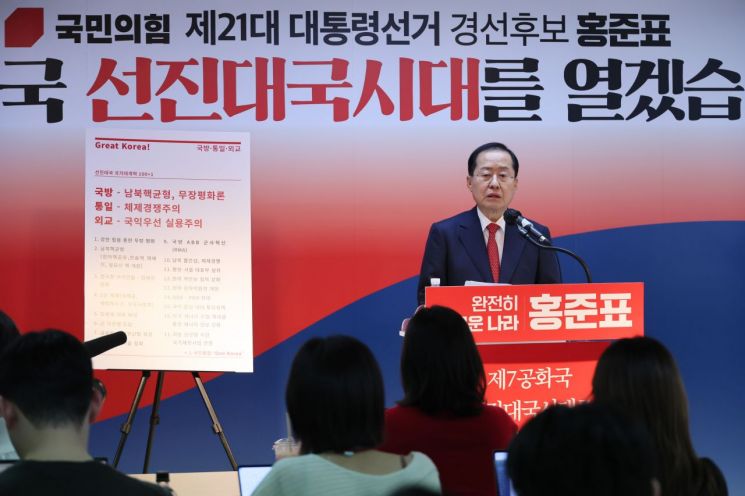
The military will be reorganized into a five-branch system consisting of the Army, Navy, Air Force, Marine Special Forces, and the Republic of Korea Space Command. He explained that the Marine Special Forces, created by integrating the Marines and Special Warfare Command, will respond to North Korean special operations units. Furthermore, the establishment of the Republic of Korea Space Command will secure combined space operation capabilities with the United States.
The volunteer military system will be significantly expanded. In preparation for the low birthrate era, the plan is to cultivate an elite force centered on professional soldiers. Military service bonus points will also be introduced. Regardless of gender, all military service members will receive benefits, and the bonus points will be adjusted reasonably.
He also presented ideas regarding U.S. trade policy. Hong stated that to respond to the rapidly changing international situation following the re-election of the Trump administration, he would immediately hold talks with President Trump. He plans for the Blue House to act as the control tower and lead negotiations with the U.S. in trade talks. Hong emphasized, "A strong man with determination and courage must confront Trump's strong man strategy," adding, "We will coordinate defense costs, trade, and technological cooperation based on thorough pragmatic diplomacy."
To counter U.S. trade pressure, he plans to expand the import of U.S. energy and promote investment in the Alaska natural gas project. Hong believes that shifting energy imports from the Middle East to the U.S. will facilitate smooth negotiations with America. He said, "We import $140 billion worth of energy from the Middle East, so even if we bring in only half from the U.S., it will suffice," and added, "We can negotiate to balance the Korea-U.S. relationship without suffering losses."
Other pledges include ▲ fostering a global K-defense industry ▲ establishing a Pyongyang-Seoul representative office ▲ strengthening a Korean-style Iron Dome and kill chain ▲ and converting local military airport relocations into national financial projects.
© The Asia Business Daily(www.asiae.co.kr). All rights reserved.
![From Hostess to Organ Seller to High Society... The Grotesque Scam of a "Human Counterfeit" Shaking the Korean Psyche [Slate]](https://cwcontent.asiae.co.kr/asiaresize/183/2026021902243444107_1771435474.jpg)
















