CNN: "US Tariff Policy Places Greater Burden on Women"
"Clothing Prices Could Rise by Up to 64 Percent"
"Likely to Exert Significant Pressure on Low-Income Groups"
Analysis suggests that Donald Trump's tariff war will place a greater burden on female consumers.
On the 16th (local time), US CNN reported, "The 10% base tariff imposed by President Trump on trading partners and the high tariffs on specific countries such as China, Canada, and Mexico could significantly increase the cost of clothing purchases for female consumers."
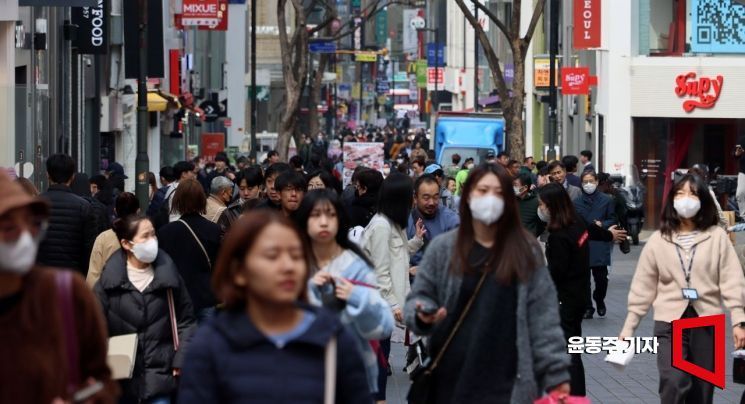 Seoul's Myeongdong Shopping Street in Jung-gu is bustling with foreign tourists and citizens. Photo by Yoon Dong-ju
The US tariff system has long been criticized for being designed disadvantageously for women compared to men. According to Edward Saero, director of the progressive think tank Progressive Policy Institute (PPI), as of 2022, the average tariff rate on women's clothing was 16.7%, which is 2.9 percentage points higher than the 13.6% average tariff rate on men's clothing. For suits, women's suits had a tariff rate of 15.1%, while men's suits were subject to 13.3%. Similarly, women's underwear faced a 12.8% tariff, compared to 8.6% for men's underwear, showing a significant difference.
As a result, female consumers pay on average $1 more per clothing item, with the total annual cost estimated to exceed $2 billion (approximately 2.8 trillion won). This burden is commonly referred to as the 'Pink Tariffs.' It is a structure similar to the 'Pink Tax,' where the same product is priced higher simply because it is for women.
Lori Taylor, a professor in the Department of Public Service and Administration at Texas A&M University, analyzed, "With President Trump's new policy applying a certain level of tariffs to men's clothing as well, the tariff gap between men and women may unintentionally narrow. However, since women spend an average of $655 annually on clothing compared to $406 for men, the actual burden of tariff increases may fall more heavily on women."
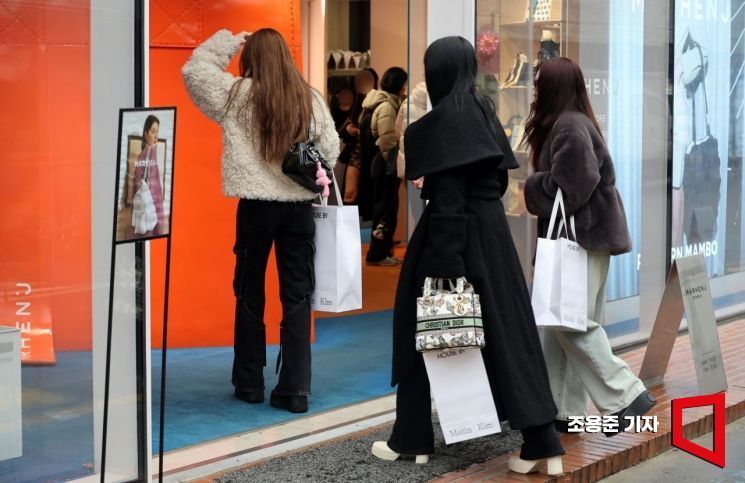
There is also analysis that President Trump's tariff policy could place greater pressure on low-income groups. The Yale University Fiscal Studies Institute projected, "Clothing prices could rise by up to 64% due to Trump's tariffs." Since imported clothing accounts for the majority of the US clothing market, this impact directly affects consumer prices. Especially for low-income groups, the proportion of income spent on clothing and essential goods is higher than that of high-income groups, so tariffs on these items can become an immediate burden on households.
Additionally, the fact that relatively higher tariffs are imposed on low-priced clothing compared to luxury clothing is also seen as a factor increasing the burden on low-income groups. In the US, different tariff rates are applied depending on the fabric, with tariffs on luxury fabrics such as wool, cashmere, and silk being lower than those on cotton, polyester, and nylon used in low-priced clothing or sneakers, explained Sheng Lu, a professor in the Department of Fashion and Apparel Studies at the University of Delaware.
Previously, US clothing companies filed a lawsuit against the government in 2007 to eliminate tariffs to address such gender and class-based tariff discrimination, but the court dismissed the case, stating that the policy did not have discriminatory intent. Although related discussions decreased afterward, recently Democratic lawmakers have reignited the debate by introducing the 'Pink Tariffs Study Act.'
© The Asia Business Daily(www.asiae.co.kr). All rights reserved.


















