To Improve Financial Performance, Seat Thickness Halved
Up to 20 Additional Seats Possible with New Installation
A Chinese airline has sparked controversy by introducing 'ultra-thin seats.' While passengers have expressed mixed reviews about these seats, experts have raised concerns about their safety. On the 17th, local media including China Nengyuan Network reported that China Southern Airlines recently unveiled 'ultra-thin seats' that reduce the thickness of existing aircraft seats by half.
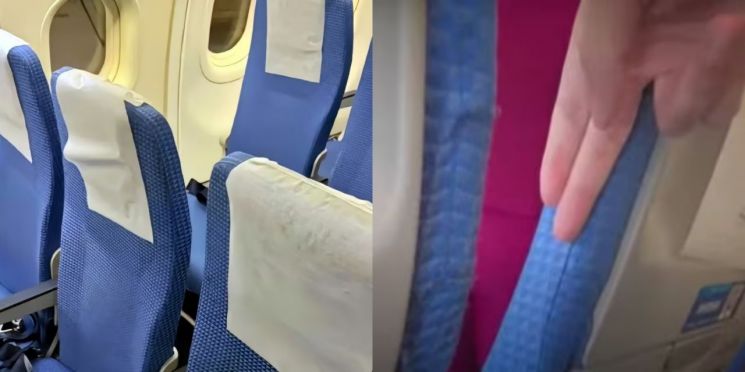 A Chinese airline has sparked controversy by introducing "ultra-thin seats." While passengers have expressed mixed reviews about these seats, experts have raised concerns regarding their safety. X (X)
The reason China Southern Airlines introduced the ultra-thin seats is to improve financial performance. By installing these thinner seats, the airline can add 14 to 28 more seats on board, potentially increasing annual revenue by up to 300 million yuan (approximately 58.3 billion KRW). However, some experts worry that excessively thin aircraft seats may not adequately absorb external shocks. Hiroshi Sugie, a former Japanese pilot and aviation commentator, told Fuji TV, "If the plane encounters turbulence or experiences a strong impact during landing, I am concerned whether the thin seats can absorb the shock," adding, "If the shock is not absorbed, it could affect passengers' heads, backs, and waists."
Passenger reactions to the seats have been mixed. Many passengers left negative reviews such as "It feels like a torture chair," "My back hurts, so long flights are unbearable," and "These seats are like those on low-cost carriers (LCCs)." However, some opinions were more positive, stating, "Short distances are tolerable," and "It wasn't as bad as I thought."
Along with China Southern Airlines' introduction of ultra-thin seats, there is a growing trend in the Chinese aviation industry to simplify in-flight services. Some Chinese airlines are implementing cost-cutting measures by reducing onboard services to address severe financial downturns. Airlines such as China Eastern Airlines and Xiamen Airlines have eliminated in-flight meals on certain routes, offering only water and bread.
As airline service quality declines, criticism has emerged that major airlines have effectively been reduced to LCC-level standards. Wei Xian, a researcher at the Economic Strategy Research Institute of the Chinese Academy of Social Sciences, pointed out, "Even if airlines pursue cost reductions, they should prioritize ensuring safety, convenience, and service quality within limited budgets." Regarding the controversy, China Southern Airlines stated, "The seats were manufactured with safety in mind," and added, "Since the distance between seats remains the same, passengers have more space, which also offers convenience."
© The Asia Business Daily(www.asiae.co.kr). All rights reserved.
!["The Woman Who Threw Herself into the Water Clutching a Stolen Dior Bag"...A Grotesque Success Story That Shakes the Korean Psyche [Slate]](https://cwcontent.asiae.co.kr/asiaresize/183/2026021902243444107_1771435474.jpg)
















