Korea National Institute of Health analyzes 3,088 female adolescents and adults
"Menstrual disorders should be recognized as a health issue affecting mental health"
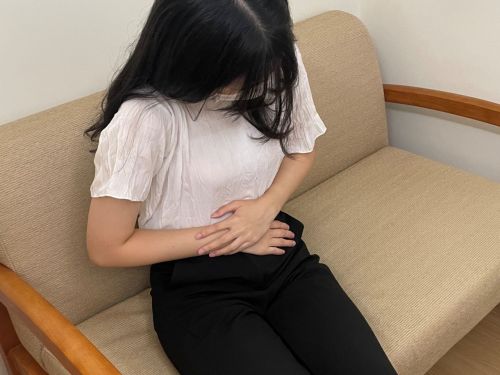
Women who experience menstrual disorders such as dysmenorrhea, premenstrual syndrome, and abnormal uterine bleeding have a higher rate of depressive symptoms compared to those who do not, and these symptoms are more pronounced in female adolescents, according to a research finding.
The Korea Disease Control and Prevention Agency's National Institute of Health announced on the 17th that it published these research results in the Journal of Korean Medical Science, the academic journal of the Korean Medical Association.
Menstrual disorders, one of the most common gynecological problems among women of reproductive age, affect daily life by causing physical pain and activity limitations, thereby lowering women's quality of life. Symptoms such as dysmenorrhea, premenstrual syndrome, abnormal uterine bleeding (including menorrhagia and hypomenorrhea), and amenorrhea are all included in menstrual disorders.
Using data from the 2022 Korean Women's Life Cycle Sexual and Reproductive Health Survey conducted by the National Institute of Health, an analysis of the association between menstrual disorders and depressive symptoms among 3,088 Korean women aged 13 to 55 showed that 91% of the total participants experienced menstrual disorders.
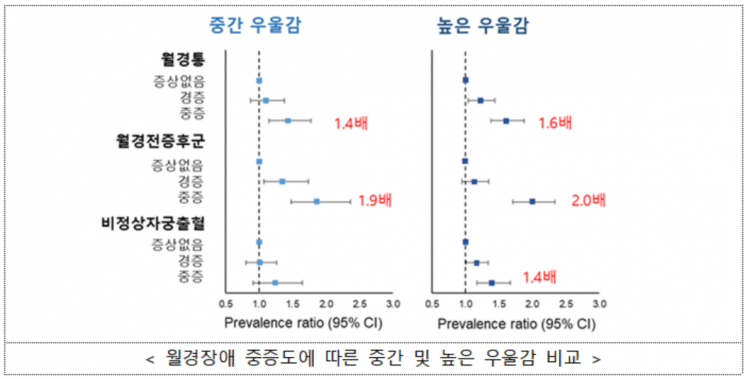
Among them, 57% of women experienced severe menstrual disorders. Compared to women without menstrual disorder symptoms, the rate of experiencing high depressive symptoms was 1.6 times higher in women with severe dysmenorrhea, 2.0 times higher in those with severe premenstrual syndrome, and 1.4 times higher in those with severe abnormal uterine bleeding.
Furthermore, the more severe menstrual disorders experienced, the significantly higher the rate of depressive symptoms, and this association was especially pronounced during adolescence.
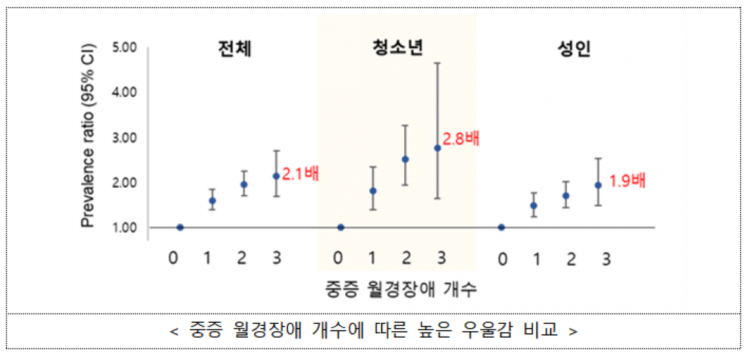
Compared to women without severe menstrual disorders, the presence of 1 to 3 severe symptoms increased the likelihood of high depressive symptoms by 1.6, 2.0, and 2.1 times respectively. In particular, during adolescence, experiencing just one severe menstrual disorder increased depressive symptoms by 1.8 times, and experiencing three severe disorders increased it by about 2.8 times, which is higher than the 1.5 and 1.9 times observed in adult women.
Park Hyun-young, director of the National Institute of Health, stated, "Menstrual-related symptoms should be recognized not simply as physiological discomfort but as a major health issue that can affect women's mental health." She added, "Through the Women's Health Research Project at the National Institute of Health, we plan to continue nationwide surveys to understand the status of sexual and reproductive health and key health issues among Korean women."
© The Asia Business Daily(www.asiae.co.kr). All rights reserved.



















