Full Statement of the April Monetary Policy Board Decision
On April 17, the Monetary Policy Board of the Bank of Korea decided to keep the base interest rate unchanged, stating, "While downside risks to growth have increased, there is significant uncertainty regarding the growth outlook due to changes in U.S. tariff policy and the government's economic stimulus measures." The Board also noted, "It is necessary to closely monitor the high volatility of the exchange rate and the trends in household lending."
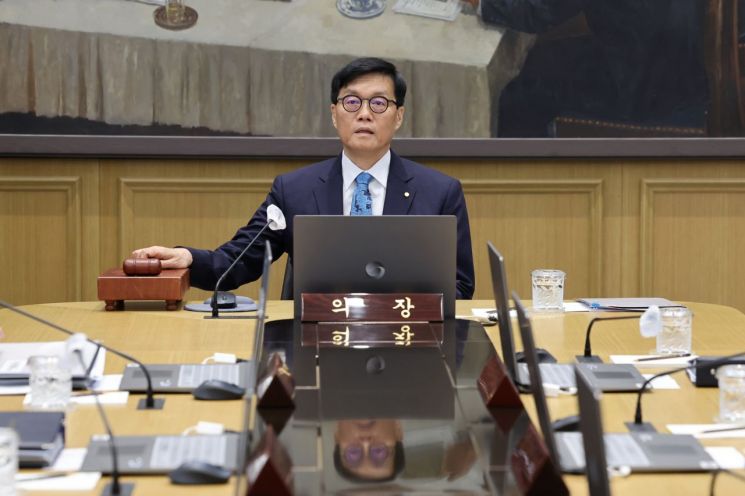 Lee Changyong, Governor of the Bank of Korea, strikes the gavel to declare the opening of the Monetary Policy Committee meeting held at the Bank of Korea headquarters in Jung-gu, Seoul on the 17th. Photo by Yonhap News Agency Joint Press Corps
In the statement released after the monetary policy meeting held earlier that morning, the Board said, "We judged that it is appropriate to maintain the current base rate while monitoring changes in both domestic and external conditions."
Regarding the outlook for the Korean economy this year, the Board stated, "While domestic demand is expected to partially recover, exports will likely continue to slow due to persistent uncertainty in trade conditions," adding that the growth rate is expected to fall short of the February forecast of 1.5%. However, the Board emphasized that "there is considerable uncertainty in the growth trajectory, particularly regarding the development of trade negotiations and the timing and scale of the supplementary budget."
On inflation, the Board commented, "Although the higher exchange rate will act as an upward factor, falling oil prices and weak demand pressure are expected to keep inflation stable at around 2%." The Board added, "Going forward, the inflation path will be influenced by domestic and global economic trends, exchange rate and international oil price movements, and the government's price stabilization measures."
Regarding financial and foreign exchange markets, the Board noted, "The won-dollar exchange rate surged sharply in a short period and then retreated, while stock prices dropped significantly before partially rebounding, resulting in heightened volatility of key price variables." The Board also projected, "Although household lending continues to grow at a modest pace, the recent increase in housing transactions is expected to temporarily expand the scale of lending."
The following is the full text of the Monetary Policy Board’s decision statement.
Until the next monetary policy decision, the Monetary Policy Board will operate monetary policy by maintaining the Bank of Korea’s base rate at the current level of 2.75%. While price stability has continued, downside risks to growth have increased due to economic sluggishness in the first quarter and deteriorating global trade conditions. However, the Board judged that it is appropriate to maintain the current base rate and monitor changes in domestic and external conditions, given the significant uncertainty in the outlook due to changes in U.S. tariff policy and the government’s economic stimulus measures, as well as the need to closely observe the high volatility of the exchange rate and trends in household lending.
Globally, the world economy faces increased downside risks to growth and greater uncertainty in the inflation path due to intensifying global trade conflicts. In international financial markets, continued uncertainty over U.S. tariff policy has led to heightened volatility in major price variables. Concerns over a global economic slowdown have caused major stock markets to fall sharply before partially rebounding on mutual tariff suspensions. U.S. long-term Treasury yields also fell significantly before surging, and the U.S. dollar weakened substantially. Going forward, the global economy and international financial markets are expected to be affected by tariff negotiations between the U.S. and major economies, changes in major countries’ monetary policies, and developments in geopolitical risks.
Domestically, both domestic demand and exports have weakened more than expected due to ongoing political uncertainty and worsening trade conditions, resulting in slower growth. While total employment increased, key sectors such as manufacturing continued to see declines. Looking ahead, domestic demand is expected to partially recover, but exports will likely remain sluggish due to persistent uncertainty in trade conditions. As a result, this year’s growth rate is projected to fall short of the February forecast of 1.5%. However, there is significant uncertainty in the growth trajectory, particularly regarding the development of trade negotiations and the timing and scale of the supplementary budget.
As for domestic prices, both consumer price inflation and core inflation (excluding food and energy) remained stable in March, at 2.1% and 1.9% respectively. Short-term inflation expectations remained at the previous month’s level of 2.7%. Looking ahead, inflation is expected to remain stable at around 2%, with the higher exchange rate acting as an upward factor but offset by falling oil prices and weak demand pressure. This year’s consumer price and core inflation rates are expected to be broadly in line with the previous forecasts of 1.9% and 1.8%, respectively. The future inflation path will likely be influenced by domestic and global economic trends, exchange rate and international oil price movements, and the government’s price stabilization measures.
In financial and foreign exchange markets, volatility in major price variables has increased significantly. The won-dollar exchange rate surged sharply in a short period due to U.S. tariff policy, China’s response, and cross-border securities investment flows, before retreating. Stock prices dropped sharply on concerns over economic and corporate earnings slowdowns, then partially rebounded, while long-term government bond yields fell significantly. In the housing market, both prices and transaction volumes in Seoul rose sharply before slowing after the re-designation of land transaction permission zones. Although household lending continues to grow at a modest pace, the recent increase in housing transactions is expected to temporarily expand the scale of lending.
Going forward, the Monetary Policy Board will manage monetary policy to ensure that inflation remains stable at the target level over the medium term, while also paying attention to financial stability as it monitors the growth trend. Although domestic inflation remains stable, downside risks to growth have increased due to worsening global trade conditions, and uncertainty in the outlook has also risen significantly. From a financial stability perspective, it is necessary to monitor the impact of high exchange rate volatility on financial stability, as well as the potential for household debt to expand again under accommodative financial conditions. Therefore, future monetary policy will maintain a rate-cutting stance to mitigate downside risks to growth, while carefully monitoring changes in domestic and external policy conditions and the resulting trends in inflation, household debt, and the exchange rate, in order to determine the timing and pace of any further base rate cuts.
© The Asia Business Daily(www.asiae.co.kr). All rights reserved.

















