Korea Industrial Federation Forum Holds Discussion on Solutions to Electricity Rate Increases
Amid the Trump administration's second term in the United States imposing high tariffs on industries that require large amounts of electricity, such as automobiles, steel, and aluminum, there are concerns that an increase in industrial electricity rates could sharply deteriorate the profitability of these sectors. Experts have pointed out the need for institutional improvements, such as restructuring the electricity market and providing differentiated support for small and medium-sized enterprises, to minimize the burden on the industry.
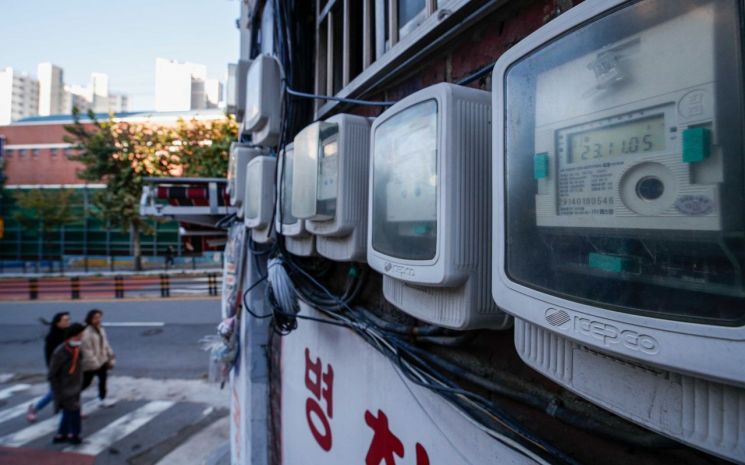 An electric meter is installed in a commercial building in Seoul. Photo by Kang Jin-hyung aymsdream@
On the 17th, the Korea Industrial Federation Forum held the 71st Industrial Development Forum under the theme "Electricity Rate Increase and Industrial Competitiveness: What is the Solution?"
Jeong Manki, chairman of the forum, stated, "The United States is imposing high tariffs on automobiles, steel, and aluminum to protect its domestic industries, significantly damaging the price competitiveness of Korean export industries. When the tariff burden overlaps with electricity rate increases in these sectors, profitability inevitably deteriorates." He added, "The government must urgently prepare policies to offset production costs, such as adjusting electricity rates, to maintain industrial competitiveness."
In particular, Jeong emphasized that in the semiconductor industry, where electricity costs account for 15% of total manufacturing costs, electricity rates pose a burden on price competitiveness.
Park Seowoo, senior researcher at the Korea Industrial Federation Forum, pointed out the need for institutional improvements such as restructuring the electricity market, introducing time-of-use flexible pricing, providing differentiated support for small and medium-sized enterprises, simplifying the third-party power purchase agreement (PPA) system, and encouraging self-generation to reduce the burden on the industry. Park stressed, "For power-intensive advanced industries such as artificial intelligence (AI) and data centers, stable power environments should be guaranteed through dedicated tariffs, long-term supply contracts, and priority access to transmission and distribution networks."
Professor Park Jooheon of Dongduk Women's University’s Department of Economics also expressed concern, saying, "Considering the high electricity dependence of the Fourth Industrial Revolution, including AI, and the trend toward electrification of industries due to carbon neutrality, distortions in industrial electricity rates could have a fatal impact on national competitiveness." He raised the need to control the speed of electricity rate increases, warning that rapid hikes combined with U.S. protectionist measures could accelerate the relocation of domestic companies overseas.
© The Asia Business Daily(www.asiae.co.kr). All rights reserved.

















