Security Issues Including Cost-Sharing for U.S. Forces in Japan Also on the Agenda
Exchange Rate Discussions Excluded from Negotiations That Day
Second Round of U.S.-Japan Talks Scheduled for End of This Month
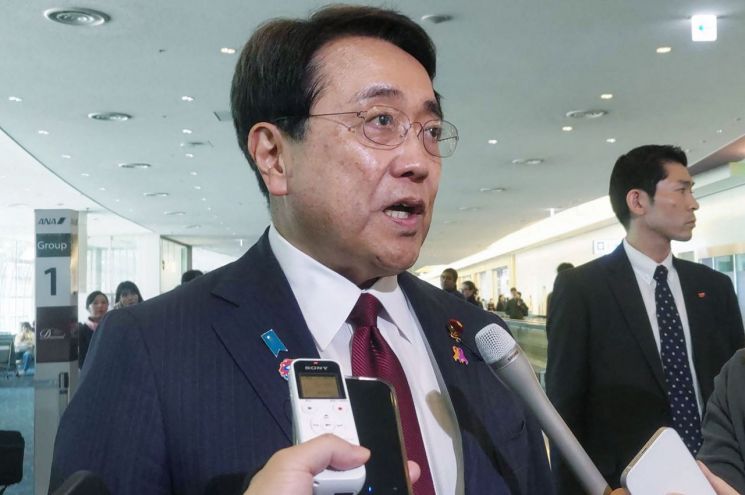 Japanese tariff official, Economic Revitalization Minister Ryosei Akazawa, is speaking with reporters on the 16th (local time) in Washington, USA, ahead of the first tariff negotiations between Japan and the United States. Photo by AFP Yonhap News
In the first tariff negotiations between the United States and Japan, which will serve as a gauge for the Korea-US tariff talks, both countries agreed to reach an early agreement within the 90-day mutual tariff suspension period and have their leaders announce the results. Unlike the negotiations with the European Union (EU) earlier this week, U.S. President Donald Trump, who unusually participated directly in the talks, is reported to have strongly pressured Japan to include not only simple trade and economic issues but also security matters such as the "cost-sharing for U.S. forces stationed in Japan" on the agenda. However, discussions on exchange rates aimed at weakening the dollar, which the Trump administration desires, were reportedly excluded from the negotiation table that day.
On the 16th (local time), Bloomberg News reported that Ryosei Akazawa, Japan’s Minister of Economic Revitalization in charge of tariffs, after conducting the first tariff negotiations with the U.S. in Washington D.C., stated, "Both sides agreed to reach an early agreement so that the leaders can announce it." He added, "The U.S. and Japan agreed to coordinate schedules to hold the next talks within this month and to continue consultations not only at the ministerial level but also at the working level." This suggests that the second round of negotiations will take place at the end of this month.
The spotlight of the day’s negotiations was on President Trump. Minister Akazawa was scheduled to negotiate with U.S. Treasury Secretary Steven Mnuchin and Jamie Greer, the U.S. Trade Representative (USTR) responsible for trade talks with Japan, along with officials from the Treasury Department. However, President Trump suddenly took part in a preliminary meeting himself, causing the negotiations to start earlier than planned. According to Japan’s Asahi Shimbun, at this meeting, President Trump made it clear that he intended to include security issues such as the "cost-sharing for U.S. forces stationed in Japan" on the agenda, in addition to tariffs and trade. Regarding this, Minister Akazawa only said, "President Trump mentioned that consultations with Japan would be a top priority during the meeting."
President Trump, who did not take a front role in the tariff negotiations with Europe that began on the 14th, unusually appeared directly in the talks with Japan. Before the main negotiations even started, he boasted on his social media, "It was an honor to meet with the Japanese trade delegation just now," adding, "There has been great progress." This fulfilled Treasury Secretary Mnuchin’s prediction on the 9th that "President Trump wants to personally engage in negotiations with various countries." In Japan, there were even concerns that if President Trump participated directly in the negotiations, Prime Minister Shigeru Ishiba might have to visit the U.S. earlier than planned.
Furthermore, the Japanese government expressed its "regret" to the U.S. regarding the tariff attacks against Japan. Minister Akazawa explained, "In this negotiation, we expressed deep regret over the U.S. tariff measures and requested a review of tariff policies." On the 2nd, the U.S. government announced reciprocal tariffs targeting so-called "worst countries" with trade surpluses against the U.S., and Japan was subjected to a 24% tariff. Although this rate is slightly lower than South Korea’s 25%, many had initially evaluated the summit between President Trump and Prime Minister Ishiba on the 7th as "successful," so there was a sense of bewilderment within Japan.
Minister Akazawa also stated, "There was no discussion on exchange rate issues," and added, "I believe the U.S. wants to reach an agreement within the 90-day suspension period." He refrained from commenting on whether security issues or non-tariff barriers were discussed but noted that both sides showed a willingness to continue negotiations. Previously, it was anticipated that the U.S. would demand three things from Japan: ▲ increased investment in the U.S. to strengthen American manufacturing, ▲ a shift to a weaker dollar, and ▲ cost-sharing for allied defense. Attention was also drawn to the fact that the U.S. has long criticized Japan’s non-tariff barriers in the automobile and agricultural sectors. Participation in liquefied natural gas (LNG) development in Alaska was also expected to be a topic in the negotiations. In his first joint session speech to Congress last month after taking office, President Trump pressured both Japan and South Korea by mentioning, without confirmation, that they want to invest trillions of dollars.
The outcome of the U.S.-Japan negotiations is expected to serve as an important "reference guideline" for South Korea as well. South Korea is set to begin negotiations next week. This is because the Trump administration designated South Korea as a top-priority negotiation partner along with Japan, the United Kingdom, Australia, and India. In particular, President Trump expressed in a phone call with Acting President and Prime Minister Han Duck-soo that he wants to conduct a "one-stop shopping" for tariffs and defense cost-sharing all at once. Next week, visits to the U.S. by Choi Sang-mok, Deputy Prime Minister and Minister of Economy and Finance, and others are also scheduled.
© The Asia Business Daily(www.asiae.co.kr). All rights reserved.

















