"We Will Designate and Process the Semiconductor Special Act as a Fast-Track Bill"
High Possibility of People Power Party Opposing the Dual Special Prosecutor Acts
The Democratic Party of Korea will attempt a re-vote on eight bills, including the Commercial Act amendment and the Special Investigation Act on Treason, which the Yoon Seok-yeol administration vetoed, at the National Assembly plenary session on the 17th. Since a two-thirds majority of the National Assembly members is required for a re-vote on vetoed bills, the passage in the plenary session remains uncertain.
Park Chan-dae, Acting Leader of the Democratic Party and Floor Leader, stated at the policy coordination meeting that day, "We will re-deliberate the eight livelihood bills, including the Special Investigation Act on Treason, the Special Investigation Act on Myeong Tae-gyun, the Commercial Act amendment, and the Broadcasting Act, which Prime Minister and Acting President Han Duck-soo vetoed."
The eight bills previously vetoed by the government are ▲the Commercial Act amendment ▲the Special Investigation Act on Treason ▲the Special Investigation Act on Myeong Tae-gyun ▲the Special Act on the Statute of Limitations for Inhumane State Crimes ▲the Act on the Establishment and Operation of the Korea Communications Commission amendment ▲the Broadcasting Act amendment ▲the Elementary and Secondary Education Act amendment ▲and the Local Education Finance Grant Act amendment.
The Special Investigation Acts on Treason and Myeong Tae-gyun respectively include proposals to introduce special prosecutors for the December 3 emergency martial law and the Myeong Tae-gyun gate. The Democratic Party emphasized, "In the ongoing situation of the treasonous faction's unrest, we can no longer delay the Special Investigation Acts on Treason and Myeong Tae-gyun." The amendment to the Korea Communications Commission operation law strengthens the standard for the full meeting of the Korea Communications Commission, currently operated by two members, to require three or more standing commissioners.
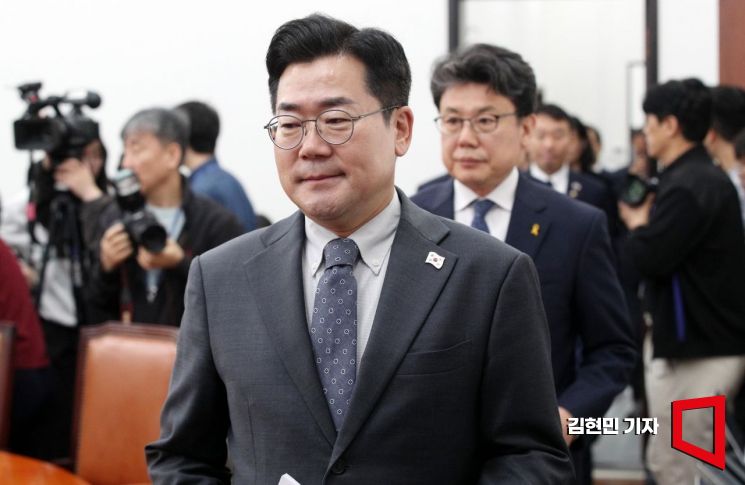 Park Chan-dae, floor leader of the Democratic Party of Korea, is attending the policy coordination meeting held at the National Assembly on the 17th. 2025.4.17 Photo by Kim Hyun-min
The Democratic Party plans to immediately reintroduce the related bills if they are rejected in the plenary session that day. In particular, regarding the Commercial Act amendment, they plan to include provisions such as the separation election of audit committee members and cumulative voting along with the proposal to expand the director's duty of loyalty from the 'company' to the 'shareholders' upon reintroduction.
They will also attempt to designate and process the Semiconductor Special Act, the Banking Act, and the Franchise Business Act amendments as fast-track bills. The Banking Act amendment includes regulations preventing banks from including insurance premiums and contributions in the interest rate surcharge, and the Franchise Business Act amendment requires franchisee business associations to register with the Fair Trade Commission to strengthen the rights and interests of franchise owners.
However, the possibility of these major bills passing the National Assembly is uncertain. For the Special Investigation Acts on Treason and Myeong Tae-gyun, it is expected to be difficult to secure the People Power Party's support in the re-vote. Regarding the Semiconductor Special Act, the two parties have yet to narrow their differences over the exemption of related research and development (R&D) personnel from the 52-hour workweek regulation.
© The Asia Business Daily(www.asiae.co.kr). All rights reserved.

















