13th in ODA Volume Among 32 Member Countries
Last year, South Korea's official development assistance (ODA) performance showed an increasing trend for the second consecutive year, reaching $3.94 billion. The ODA ratio to gross national income (GNI) recorded an all-time high of 0.21%.
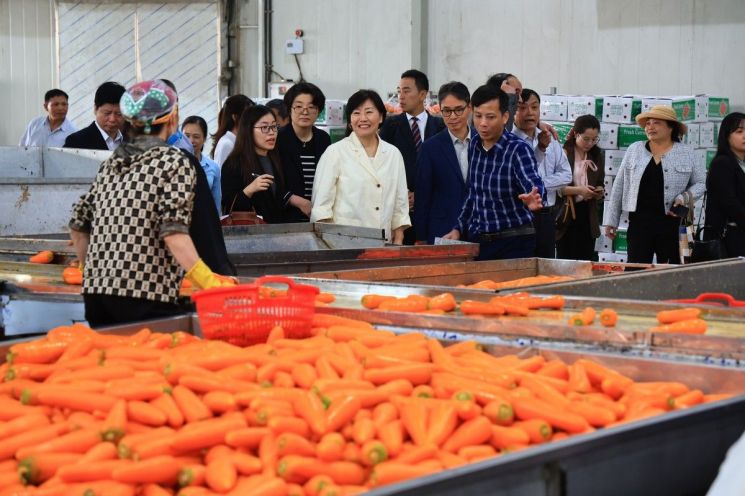 Agriculture, Food and Rural Affairs Minister Song Mi-ryeong visited Vietnam last month to tour an agricultural product processing facility established through the South Korean government's Official Development Assistance (ODA) project. Photo by Yonhap News
The Office for Government Policy Coordination announced this on the 17th based on provisional ODA statistics released on the 16th (local time) by the Development Assistance Committee (DAC) under the Organisation for Economic Co-operation and Development (OECD).
South Korea's ODA performance last year was $3.94 billion, an increase of $780 million (24.8%) compared to the previous year. Following a 12.5% increase in 2023 ($3.16 billion), it showed an upward trend for the second consecutive year. Among the 32 member countries, South Korea's ranking in terms of support volume rose by one place from the previous year to 13th.
The ODA ratio to GNI, which indicates the scale of ODA support relative to economic size, rose by 0.04 percentage points to 0.21% compared to the previous year. This is the highest figure since South Korea joined the DAC in 2010. Among all member countries, the ranking was 26th.
The government explained that despite increased fluctuations in the won-dollar exchange rate compared to the previous year, ODA support performance increased due to a 37.0% surge in bilateral aid ($3.18 billion) last year. In particular, both grant aid ($2.22 billion) and concessional loans ($960 million) within bilateral aid increased evenly, driving the growth trend.
Breaking down last year's ODA support performance, bilateral aid amounted to $3.18 billion, and multilateral aid was $760 million.
Bilateral aid increased by 37.0% compared to the previous year due to increases in ▲humanitarian aid to support vulnerable groups ($490 million), ▲social sector support such as water resources, sanitation, and public administration ($260 million), ▲and economic infrastructure support such as transportation and logistics ($70 million).
Multilateral aid decreased by 9.5% ($80 million). This was due to a reduction in World Bank (WB) contributions and grants, which had temporarily expanded the previous year to support low-income and vulnerable countries' COVID-19 response and economic recovery in developing countries. In fact, multilateral aid support in 2023 ($840 million) had surged by 41.9% compared to the previous year.
The government plans to continue its commitment to becoming a top 10 advanced ODA country globally this year while maintaining sound fiscal discipline. This year's ODA budget is 6.5 trillion won, an increase of 3.8% compared to the previous year, with the growth rate slowing compared to 2023 (21.3%) and last year (31.1%).
The Office for Government Policy Coordination stated, "We will actively respond to efforts to achieve the Sustainable Development Goals (SDGs) as a responsible member of the international community," and "through ODA promotion, we plan to establish a sustainable cooperation foundation and realize mutual national interests with key partner countries."
Meanwhile, the total ODA support volume of the 32 OECD DAC member countries was $212.1 billion, a 5.1% decrease compared to the previous year. Most member countries reduced the ODA support volume that had temporarily increased to overcome consecutive crises such as the COVID-19 pandemic and the Ukraine refugee situation, leading to an overall decrease.
© The Asia Business Daily(www.asiae.co.kr). All rights reserved.
![Clutching a Stolen Dior Bag, Saying "I Hate Being Poor but Real"... The Grotesque Con of a "Human Knockoff" [Slate]](https://cwcontent.asiae.co.kr/asiaresize/183/2026021902243444107_1771435474.jpg)
















