Algorithm Developed to Detect Particle Collisions in Complex 3D Fusion Reactors
Calculates Only for High-Risk Particles by Dividing Collision Zones; Published in Comput. Phys. Commun.
An algorithm has been developed to detect the collision of high-speed particles rushing toward the inner wall of a nuclear fusion reactor, using technology similar to that which determines whether a bullet hits an enemy in video games.
This algorithm can quickly predict collisions even in complex three-dimensional structures, which is expected to greatly enhance the safety and design efficiency of future fusion reactors.
The team led by Professor Yoon Euisung from the Department of Nuclear Engineering at UNIST announced on the 17th that they have developed an algorithm capable of rapidly identifying the collision points of high-speed particles within a virtual fusion device.
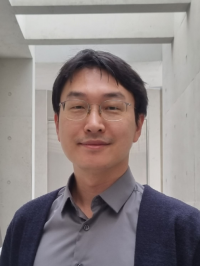 Professor Euisung Yoon, UNIST. Provided by UNIST
When this algorithm was applied to V-KSTAR, detection speed increased by up to 15 times compared to previous methods. V-KSTAR is a digital twin that replicates the Korean fusion experimental reactor KSTAR in a three-dimensional virtual space.
Nuclear fusion power, often referred to as the "artificial sun," injects high-speed neutral particles to heat the inside of the reactor to temperatures similar to the sun. If some of these particles go out of control and collide with the device's inner wall, it can damage the reactor wall or halt the fusion reaction.
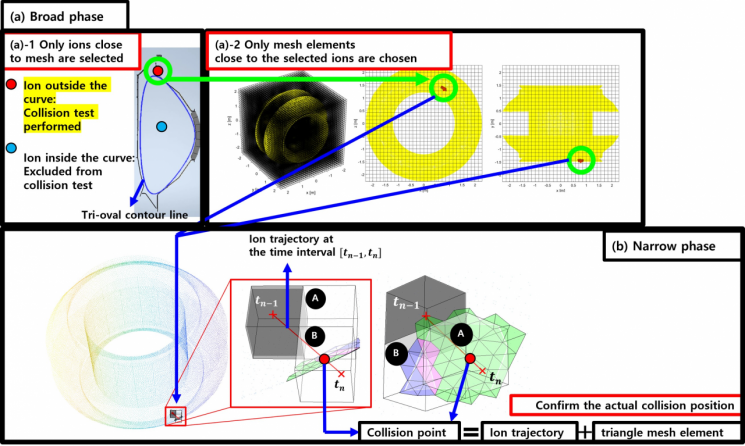
The research team integrated collision detection algorithms from the gaming industry to develop a new algorithm for detecting such particle collisions. This algorithm is 15 times faster than the Octree method. While Octree pre-divides space and checks each segment for the presence of particles, the new algorithm performs calculations only when necessary.
Previously, it was necessary to calculate at every moment whether 300,000 particles collided with a wall divided into 70,000 triangles. With the new algorithm, about 99.9% of calculations can be excluded using simple arithmetic. The triangular segmentation of the collision area also enables calculation of intersection points between particle paths and walls, even in the complex three-dimensional structures of fusion reactors.
This algorithm allows the areas of the inner wall where heat is concentrated from collisions to be displayed on the V-KSTAR screen, so even designers without specialized knowledge can intuitively identify risk zones.
Professor Yoon Euisung said, "With this algorithm, we have expanded the Korea Institute of Fusion Energy's neutral beam simulator into three dimensions, and it is also being used for three-dimensional visualization of optical diagnostic equipment's light path distribution and for analysis of three-dimensional magnetic field perturbations," adding, "This collision algorithm is not only essential for neutral beam tracking but is also one of the core technologies for the full 3D expansion of V-KSTAR."
Professor Yoon further stated, "We are planning additional research based on GPU supercomputers, which process data faster than CPU computers, to enable high-speed computation."
This research was supported by the Korea Institute of Fusion Energy, the Korea Institute of Energy Technology Evaluation and Planning, and utilized the KAIROS supercomputing resources of the Korea Institute of Fusion Energy.
The results of the study were published in the April issue of the international journal Computer Physics Communications.
© The Asia Business Daily(www.asiae.co.kr). All rights reserved.
![Clutching a Stolen Dior Bag, Saying "I Hate Being Poor but Real"... The Grotesque Con of a "Human Knockoff" [Slate]](https://cwcontent.asiae.co.kr/asiaresize/183/2026021902243444107_1771435474.jpg)
















