Nvidia Faces H20 Export Blockade Amid Intensifying Trade War
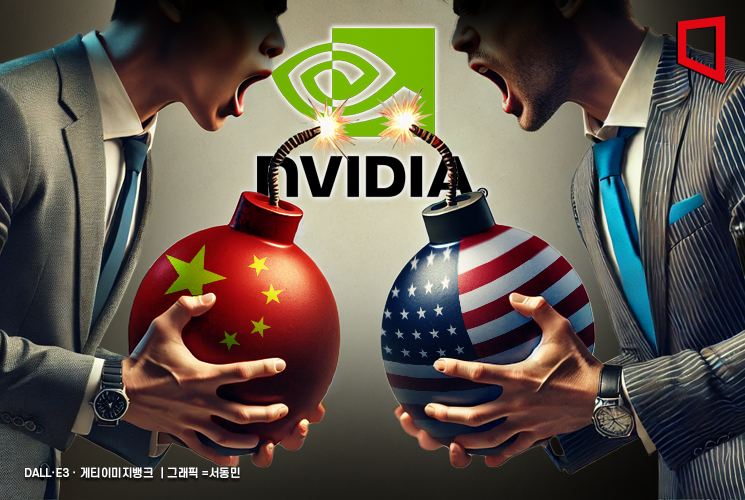
As the US-China trade war intensifies, Nvidia has become the biggest bargaining chip, the Wall Street Journal (WSJ) diagnosed on the 16th (local time). Amid fierce AI supremacy competition between the two countries, Nvidia announced a $500 billion (about 709 trillion won) investment plan due to strengthened export controls, but it ended up like a shrimp caught in a whale fight.
According to major foreign media such as the New York Times (NYT) the day before, the US Department of Commerce announced that new export licensing requirements will apply when exporting Nvidia's H20 chips to China. Nvidia also received notification from the US government that export of H20 chips to China requires government approval, and that this regulation will be applied indefinitely.
Following this news, Nvidia's stock price closed down 6.87% on the New York Stock Exchange that day.
The H20 chip is Nvidia's highest-spec AI chip that can be exported to China within the limits not regulated by the US government. In 2022, when the Biden administration blocked exports of cutting-edge semiconductors to China over security concerns, Nvidia created the H20 chip with downgraded performance from the existing H100 chip to avoid export restrictions. However, even this export route has now been blocked.
According to Joe Moore, a Morgan Stanley analyst, the performance of the H20 chip is about 75% lower compared to the H100 series, which was Nvidia's top-tier chip until two years ago.
This regulatory measure came amid escalating trade tensions between the US and China. When the Trump administration imposed a 145% tariff on Chinese imports, China retaliated with a 125% counter-tariff.
The WSJ stated, "Nvidia has built a strong position in AI computing, so even lower-spec chips have abundant demand. However, in the trade war context, this does not appear to be a positive sign," and added, "Nvidia is now caught between two powerful countries fiercely competing for AI development leadership." It further noted, "The inability to sell even low-performance chips in the Chinese market shows how the trade war is impacting Nvidia's business."
Nvidia announced that blocking exports of the H20 chip to China will result in a $5.5 billion cost this quarter. In the last fiscal year, Nvidia recorded $115.2 billion in sales in the data center segment, which includes the H20 chip. According to FactSet estimates, this segment is expected to generate about $182 billion in sales this year.
The WSJ predicted that although the H20 chip does not account for a large portion of Nvidia's revenue, export restrictions will hinder Nvidia from exceeding Wall Street expectations and raising earnings forecasts. The media highlighted, "Notably, just one day before the regulatory tightening, Nvidia announced plans to invest up to $500 billion to manufacture AI supercomputers in the US," adding, "This is clearly aimed at winning favor with President Trump, who is pushing for the reshoring of US corporate manufacturing plants."
Jensen Huang, Nvidia's CEO, also attended a dinner held earlier this month at President Trump's Mar-a-Lago residence. Following this, there were media reports suggesting that the White House might withdraw plans to ban sales of H20 chips in China.
The WSJ concluded, "The escalating trade war is not a favorable environment for America's top semiconductor company to sell its products in large quantities to China," and added, "These days, even $500 billion does not seem sufficient."
© The Asia Business Daily(www.asiae.co.kr). All rights reserved.

















