Despite 2022 Index Revision, First Decline Recorded
Ministry to Support Women's Economic Activities Throughout Life Cycle
From Youth to Career-Interrupted and Middle-Aged and Older Women
The 2023 National Gender Equality Index scored 65.4 points, marking the first decline in history. The Ministry of Gender Equality and Family stated that it is difficult to simply compare with previous indices due to changes in the scoring system after the 2022 index revision, but lower scores in gender equality awareness and care sectors influenced the overall index decline.
The Ministry held the 18th Gender Equality Committee meeting and announced the '2023 National Gender Equality Index' and the '4th Basic Plan for Promoting Women's Economic Activities and Preventing Career Interruptions (2025?2029)' on the 17th.
Down 0.8 Points from 66.2 in 2022
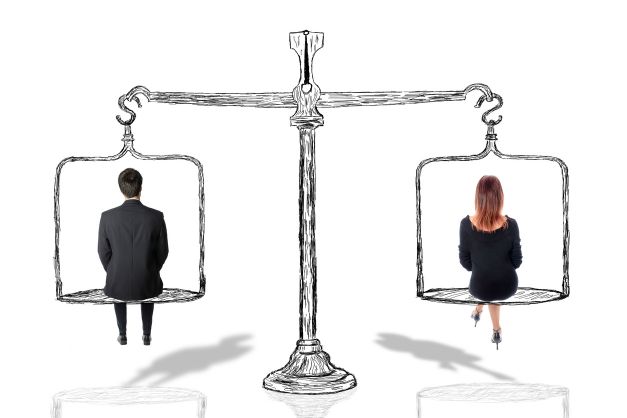
The National Gender Equality Index, calculated annually since 2010, dropped from 66.2 points in 2022 to 65.4 points in 2023, marking the first decline. The index had been increasing every year from 66.1 points in 2010 to 75.4 points in 2021. The Ministry of Gender Equality and Family noted that comparisons along a continuous timeline are difficult due to changes in the 2022 indicator system, but the score shows the first downward trend.
By sector, education scored the highest at 95.6 points, followed by health at 94.2 points, income at 79.4 points, employment at 74.4 points, gender equality awareness at 73.2 points, care at 32.9 points, and decision-making at 32.5 points.
Scores increased in most sectors such as decision-making, employment, income, and education, but decreased in gender equality awareness and care. In the gender equality awareness sector, the score for 'gender role stereotypes within the family' dropped sharply from 60.1 to 43.7 points. In the care sector, the decrease in male parental leave usage (7.5%) was greater than that of female parental leave usage (1.4%), which affected the score.
Regarding the decline in the gender role stereotype score, researchers stated, "In 2023, there was a temporary decrease in parental leave users, and factors such as the closure of care institutions after COVID-19, remote classes, which increased household care within families, and the fact that childcare support systems like parental leave are mainly used by women, are believed to have broadly influenced the results."
The Ministry plans to make policy efforts to improve sectors with low scores. A Ministry official said, "We will continue to identify policy tasks focusing on sectors with low gender equality levels such as care and decision-making, and strengthen efforts to raise the level of gender equality in our society."
The regional gender equality index, reflecting regional characteristics, was also compiled into four grades: top, upper-middle, lower-middle, and bottom. Top regions included Seoul, Daejeon, Sejong, Chungnam, and Jeju. Upper-middle regions were Daegu, Gwangju, Gangwon, and Jeonbuk. Lower-middle regions were Incheon, Gyeonggi, Chungbuk, and Gyeongnam. Bottom regions were Busan, Ulsan, Jeonnam, and Gyeongbuk.
Strengthening Support for Women's Economic Activities Throughout Their Life Cycle
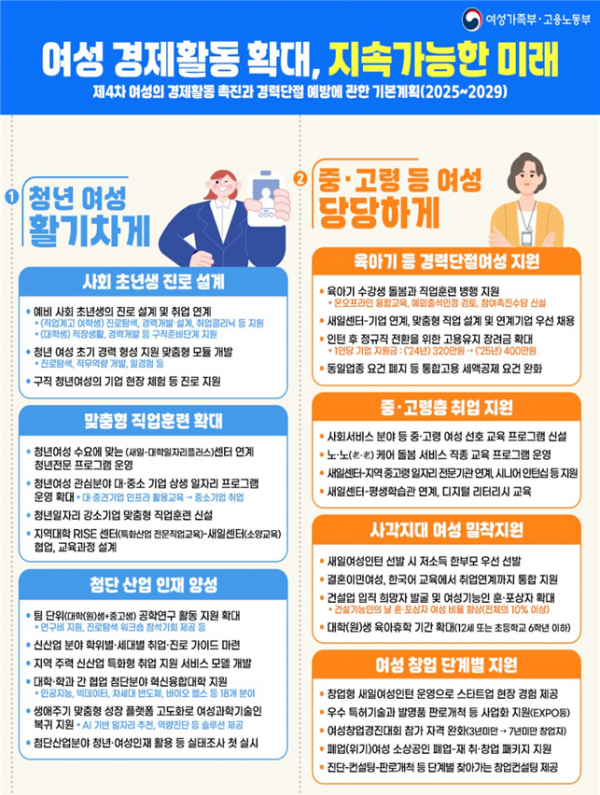
The Ministry of Gender Equality and Family, jointly with the Ministry of Employment and Labor, also established the 4th Basic Plan for Promoting Women's Economic Activities and Preventing Career Interruptions. The focus was on shifting the policy paradigm from supporting 'career-interrupted women' to supporting 'all women' in economic activities. The government set two main goals: supporting women's economic activities by life cycle and promoting work-life balance for women, and will pursue policy tasks in five areas.
First, support will be provided to strengthen the capabilities of young women entering economic activities. Career planning support will be offered to prospective young adults, especially providing employment and career guidance in new industry sectors. Following the enactment of the 'Special Act on Talent Innovation in Advanced Industries' this year, a survey on the utilization of young and female talents in advanced industries will also be conducted. A Ministry official explained, "We plan to strengthen support for areas where women's participation is low, such as in new technology fields, engineering, and technical personnel in the 12 major industries, where women account for only 13.9%."
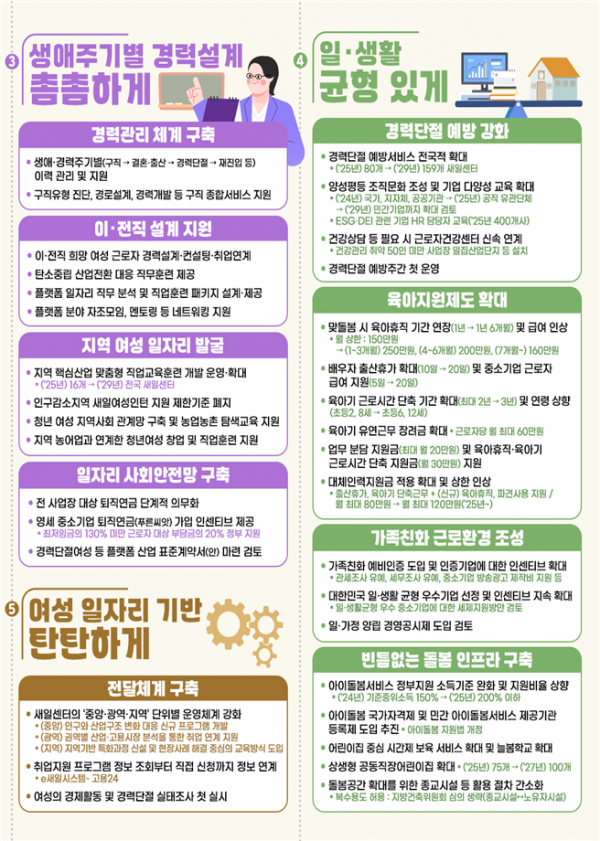
For women experiencing career interruptions due to childcare and middle-aged and older women, various supports tailored to life cycle characteristics will be expanded. New blended online and offline vocational education and training programs will be operated to allow combining childcare and job training, and support for women entrepreneurs will be strengthened. The Saeil Centers supporting women's economic activities will introduce education and training programs preferred by middle-aged and older women in the social service sector, and regional job specialized institutions will collaborate to activate employment support linked to internships and more.
Efforts to prevent career interruptions and spread a culture of work-life balance will also be promoted. The career interruption prevention services of Saeil Centers will expand nationwide from the existing 80 centers to 159 centers this year. To help working parents balance work and family, childcare support systems and time-based childcare services for emergency care will be expanded nationwide. When parents share childcare, the parental leave period will be extended from one year to one and a half years, and the spouse's paternity leave period will increase from 10 days to 20 days.
The functions of Saeil Centers and public-private cooperation will be strengthened. The roles of Saeil Centers will be divided into 'central-metropolitan-local.' The central level will regularly develop new programs responding to population and industrial structure changes; metropolitan centers will analyze industrial and employment markets by region, connect employment, and build public-private cooperation for supporting female workforce; local Saeil Centers will create regionally specialized courses and introduce educational methods that can solve field cases.
Shin Young-sook, Acting Minister of Gender Equality and Family, said, "We hope that women will receive support to engage in economic activities throughout their entire life cycle, expanding their entry into quality jobs and becoming a new growth engine for our society." She added, "Based on the National Gender Equality Index measurement results, we will continue efforts to raise the level of gender equality in our society, including spreading gender equality awareness and strengthening care policies."
© The Asia Business Daily(www.asiae.co.kr). All rights reserved.

![Clutching a Stolen Dior Bag, Saying "I Hate Being Poor but Real"... The Grotesque Con of a "Human Knockoff" [Slate]](https://cwcontent.asiae.co.kr/asiaresize/183/2026021902243444107_1771435474.jpg)

















