International Passenger Traffic Expected to Reach 76.64 Million This Year
Preference for Short-Haul Routes Rises Due to High Exchange Rates
Early Opening and Increased Staffing at Departure Halls During Holidays
Passenger traffic at Incheon International Airport in the first quarter of this year recorded the highest number ever for the first quarter. It is expected that more than 76 million passengers will use Incheon Airport by the end of the year.
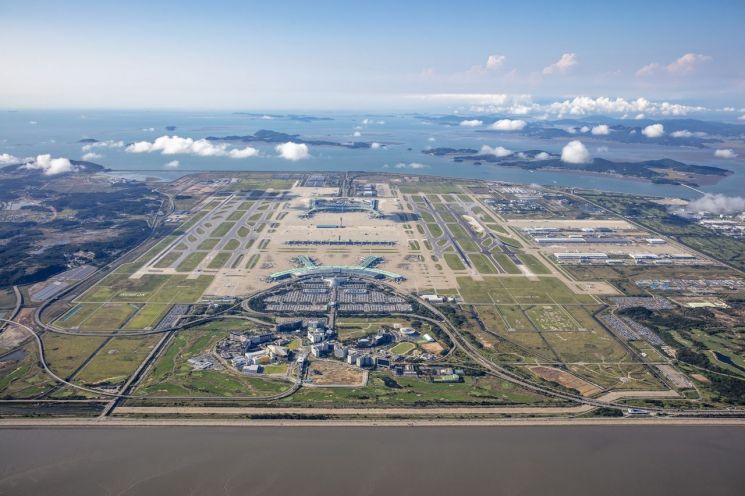 Panoramic view of Incheon International Airport. Courtesy of Incheon International Airport Corporation
According to Incheon International Airport Corporation on the 16th, passenger traffic at Incheon Airport in the first quarter of this year reached 18.6 million, an increase of 7.3% compared to the same period last year. Compared to the first quarter of 2019, before COVID-19, it increased by 3.9%.
By region, the number of passengers was highest in the following order: ▲Southeast Asia 5.67 million (30.5%) ▲Japan 4.81 million (25.9%) ▲China 2.66 million (14.3%) ▲Northeast Asia 1.76 million (9.5%) ▲Americas 1.58 million (8.5%) ▲Europe 990,000 (5.3%).
The corporation analyzed that the increase in passengers on medium- and short-haul routes such as Japan, China, and Southeast Asia drove the growth. In particular, passengers on China routes reached 2.66 million, a 24.1% increase compared to 2.14 million in the same period last year, thanks to the temporary visa exemption policy implemented in November last year. Passengers on Japan and Northeast Asia routes increased by 10.4% and 16.1%, respectively, during the same period. A corporation official said, "We initially forecasted passenger demand for this year at 73.03 million, but if the current trend continues, 76.64 million is also possible."
However, by airline type, full-service carriers (FSC) saw passenger numbers increase by 11.3% compared to the same period last year, while low-cost carriers (LCC) only increased by 2.6%. The accident at Muan Airport at the end of December last year affected Jeju Air’s operations (-7%) and passenger numbers (-15.5%).
International flights in the first quarter totaled 105,817, a 5.7% increase compared to the same period last year. The proportion of short-haul routes such as Japan, China, and Southeast Asia (84.3%) was higher than that of long-haul routes such as the United States and Europe. The share of short-haul flights gradually increased from 82.1% in 2019. The corporation identified that the preference for short-distance travel has gradually increased due to international political and economic situations such as high exchange rates and high oil prices.
Considering the increase in passengers, the corporation also announced measures to alleviate congestion during the early May holidays (April 30 to May 6). The average daily number of users at Incheon Airport during this holiday period is expected to be 211,000. In particular, May 3 is expected to be the busiest day with 218,000 passengers traveling through Incheon Airport. In preparation, the corporation plans to implement early operation and increased staffing at security checkpoints, flexible operation of temporary parking lots, encourage the use of Smart Pass and self-bag drop, and extend operating hours of commercial facilities.
Both Terminal 1 and Terminal 2 will open Departure Hall 2 one hour earlier than usual, starting from 5 a.m. Additionally, during the peak hours from 5 a.m. to 9 a.m., security screening staff will be increased by 195% compared to normal times (from 19 to 56 personnel). Parking demand is expected to reach up to 110% capacity, so additional parking spaces will be secured and temporary parking lots will be operated. Furthermore, passengers are requested to arrive at the airport 2 to 3 hours before their flight schedule.
Meanwhile, the corporation’s revenue in the first quarter of this year was 643.2 billion KRW, reaching 97.7% of the first quarter of 2019. Aviation revenue, including landing fees and apron usage fees, increased by 7.7%, while non-aviation revenue, including rental fees, decreased by 7.9%. Net profit for the period (166.2 billion KRW) was only 66.3%, which the corporation explained was due to increased operating expenses such as outsourcing costs and depreciation.
Lee Hak-jae, president of the corporation, said, "As Incheon Airport has entered a stable operation phase, it is expected to set a new record for the highest number of passengers this year as well," adding, "We will do our best to ensure that passengers can use the airport without inconvenience during the May holidays."
© The Asia Business Daily(www.asiae.co.kr). All rights reserved.

















