Kim Kyung-soo Unveils Economic Policies on June 16
"Tax Hike Needed for Fiscal Strategy in the AI and Climate Economy Era"
Promises Trillion-Won Investment Plan to Secure AI Competitiveness
Kim Kyung-soo, former governor of Gyeongnam and a presidential primary candidate of the Democratic Party of Korea, announced economic policies including artificial intelligence (AI) policy, strengthening fiscal strategy through raising the tax burden rate, and balanced development through mega cities.
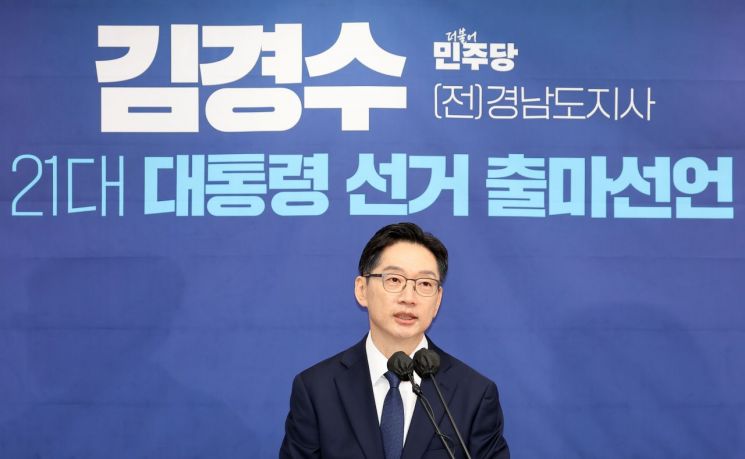
On the 16th, Kim held a press conference to announce his economic policy as a presidential primary candidate at the National Assembly Communication Hall in Yeouido, Seoul. Kim promised ▲ securing AI sovereignty and strategic national investment ▲ proactive fiscal strategy ▲ establishment of a mega city network.
Kim stated that an active fiscal strategy is necessary to prepare for the AI and climate economy era, and to this end, the tax burden rate must be raised above 22%. He said, "How well the government performs its role as an investor will determine the success or failure of the innovative economy we dream of," adding, "In an era where we must turn crises into opportunities and redesign growth, politics is feverishly competing over tax cuts." He continued, "While promising an active role for the government, no measures for securing the necessary resources have been presented, and with this attitude, the crisis cannot be overcome."
Regarding specific tax increase measures, Kim met with reporters after the press conference and said, "If necessary, tax increases should also be discussed," adding, "However, the prerequisite task is for the government to secure trust that taxes are not wasted."
He also promised a trillion-won scale investment plan to secure AI competitiveness. Kim said, "Over the next five years, the government will take the lead in the AI revolution of industry and society by developing a Korean-style AI foundation model through a total of 100 trillion won in public-private joint investment and supporting AI innovation projects specialized by industry," adding, "We will support the establishment of a 50 trillion won National Strategic Technology Fund for research and innovation (R&I) projects in five advanced technology fields: AI, next-generation semiconductors, bio-health, mobility, and decarbonized energy transition."
Balanced development centered on mega cities is also one of Kim’s key policies. He said, "We will move away from the one-pole concentration in the metropolitan area and make the entire country a large stage for innovation," adding, "We will complete five growth axes through 30 trillion won in autonomous budgets for five major regions and the establishment of a wide-area transportation network."
As an extension of the balanced development policy, Kim also stated that offices should be established simultaneously in Seoul and Sejong. After the press conference, he explained, "It is not that the Yongsan Presidential Office should be avoided simply because it was a base for rebellion, but the fact that the president, the defense minister, and the chairman of the Joint Chiefs of Staff work in the same place creates a structure where there could be a gap in the core command in emergencies," adding, "I have also requested the Speaker’s office, but once the ruling and opposition parties reach an agreement and major party candidates are confirmed, offices should be established simultaneously in Seoul and Sejong."
He emphasized, "Having the president in Seoul and administrative ministers in Sejong going back and forth in state affairs management cannot prevent power from concentrating in the presidential secretariat," adding, "I believe that if the president frequently works at the Sejong office and regularly discusses major issues with cabinet ministers, unfortunate national incidents like martial law and rebellion will not be repeated."
© The Asia Business Daily(www.asiae.co.kr). All rights reserved.

















