KAIST researchers have proposed the concept of the 'Neuransistor' and successfully developed the first Neuransistor. The term Neuransistor is a portmanteau of Neuron and Transistor, referring to a new type of transistor that implements the characteristics of neurons in the brain. It is a core semiconductor device for next-generation artificial intelligence hardware that can autonomously process and learn time-varying information by mimicking the excitatory and inhibitory responses of neurons, the nerve cells in the brain.
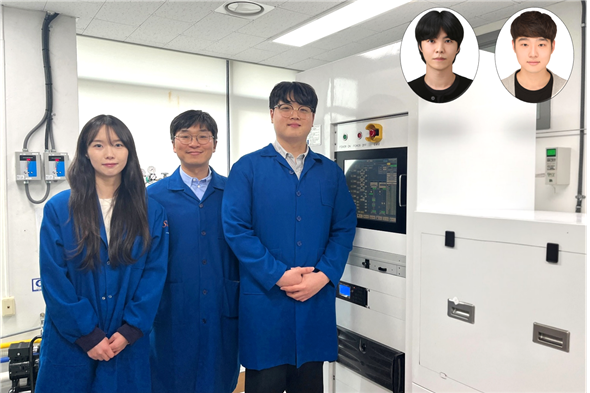 (From left) Kim Eun-young, PhD candidate, Graduate School of Semiconductor Engineering; Kim Kyung-min, Professor, Department of Materials Science and Engineering; Kim Do-hoon, PhD candidate, Department of Materials Science and Engineering; (Top right from left) Jung Woon-hyung, PhD, Department of Materials Science and Engineering; Kim Geun-young, PhD, Department of Materials Science and Engineering. Provided by KAIST
On the 16th, KAIST announced that Professor Kyungmin Kim's research team from the Department of Materials Science and Engineering succeeded in developing a Neuransistor device that enables the hardware implementation of a Liquid State Machine (LSM).
LSM is a spiking neural network model that mimics the dynamic characteristics of biological neural networks to process input data that changes over time.
Until now, computers have required complex algorithms to analyze time-series data, such as videos, which change over time, resulting in significant time and power consumption.
To address this, the research team newly designed a single semiconductor device specialized for processing time-series data by simultaneously implementing excitatory and inhibitory responses, like neurons in the brain, using only electrical signals.
This device is structured by stacking oxide layers such as titanium oxide (TiO2) and aluminum oxide (Al2O3). At the interface where the two layers meet, a two-dimensional electron gas (2DEG) layer is formed, where electrons move freely and rapidly. At both ends of this layer, neuron-type devices that respond to both excitatory (EPSP) and inhibitory (IPSP) signals are connected. The two-dimensional electron gas phenomenon forms a conductive electron layer at the interface, providing high mobility and fast response speed.
Thanks to this structure, the Neuransistor can selectively implement excitatory or inhibitory responses between the source and drain depending on the polarity of the gate voltage.
In particular, this device simplifies the complex input signal preprocessing (masking) process essential for conventional LSM implementation. Previously, implementing the 'masking' function was very complicated, but the Neuransistor easily realizes masking by adjusting the voltage applied to the source electrode, accurately converting time-series input signals into multidimensional output information. Additionally, it enhances practicality by securing high durability and uniformity among devices.
Based on the Neuransistor, the research team also implemented an LSM 'brain-inspired information processing system' that processes complex time-series data. Experiments confirmed that using the Neuransistor results in more than ten times lower error rates, higher prediction accuracy, and faster learning speeds compared to conventional methods.
Professor Kyungmin Kim stated, "This research is significant in that it realized a structure similar to the human brain's signal processing method in an actual semiconductor device." He added, "This technology is expected to be utilized in various fields such as brain-inspired artificial intelligence (AI), prediction systems, and chaotic signal control."
Meanwhile, this research was conducted with support from the Korea Institute of Nanotechnology and the National Research Foundation of Korea. The research results (paper) were published on the 8th in the international materials science journal 'Advanced Materials.' The paper was completed with Dr. Unhyung Jung and Dr. Geunyeong Kim from the Department of Materials Science and Engineering as co-first authors.
© The Asia Business Daily(www.asiae.co.kr). All rights reserved.

















